We live in a time when nutrition is often reduced to numbers. How many calories did you eat? How much protein did you get? Was your meal low-carb, high-fibre or rich in healthy fats? These measures are useful, but they do not tell the whole story of nourishment.
Ayurveda looks at food in relation to the person eating it. The same food may not be equally suitable for everyone, because digestion, appetite, routine, season, Prakriti and Dosha can all influence how food is experienced and processed. Ayurveda, therefore, does not define an Ayurvedic diet simply by a list of foods to eat or avoid. It looks at whether a food suits the person and whether they are able to digest it well. This is why Agni is such an important part of understanding nutrition in Ayurveda.

What Is Agni in Ayurveda?
Agni refers to the body’s ability to digest and transform what we eat. It is often translated as “digestive fire”, but the Ayurveda understanding of Agni is broader than digestion in the usual sense. It includes the processes by which food is broken down, transformed and eventually made available for nourishment.
The first stage of this process is Jatharagni, the main Agni involved in digestion within the gastrointestinal tract. As food is digested, Ayurveda describes a distinction between the part that is useful to the body, called Sara Bhaga, and the part that is not required and is ultimately eliminated, known as Kitta Bhaga. This is where the process of nourishment begins, but it does not end with digestion in the stomach and intestines.
The transformation does not end with Jatharagni. Ayurveda describes further stages through the five Bhutagni, which are associated with the transformation of the five elemental components of food. The nutritive material then undergoes further transformation at the level of the seven Dhatus through their respective Dhatvagni.
Thus, Ayurveda describes 13 forms of Agni in total: one Jatharagni, five Bhutagni and seven Dhatvagni. Together, these provide an understanding of how food is transformed, from initial digestion to the processes through which nourishment is made available to and utilised by the tissues.
What Are the Different States of Agni?
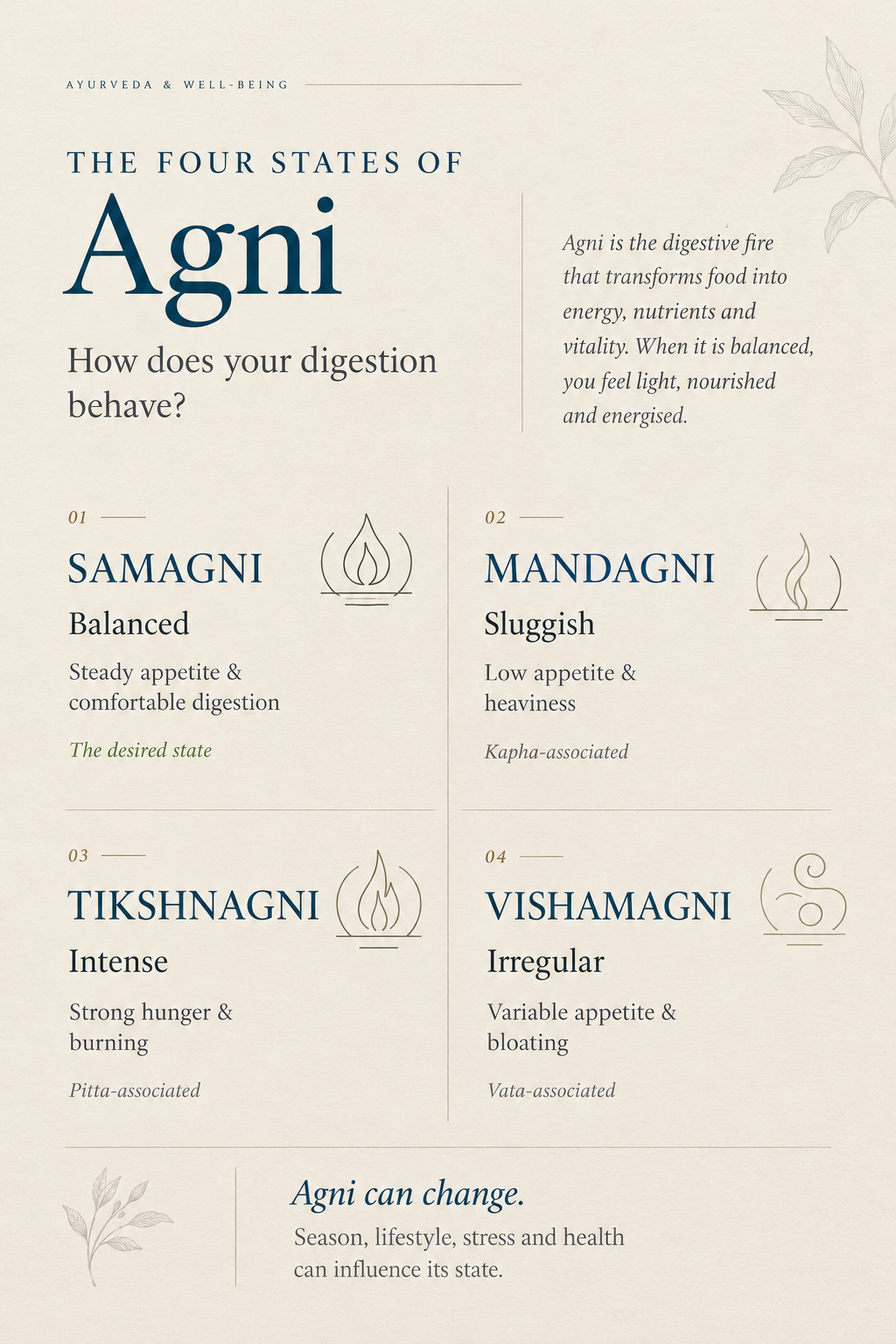
Ayurveda describes four broad states of Agni. These help explain why digestive patterns can vary between individuals and can also change within the same person over time.
Samagni
Samagni is balanced Agni. Digestion is reasonably steady, appetite is appropriate, and food is processed without persistent digestive disturbance. This is the state Ayurveda seeks to maintain.
Mandagni
Mandagni refers to sluggish or weak Agni and is associated with Kapha aggravation. A person may experience reduced appetite, heaviness after meals, lethargy or a feeling that food is taking too long to digest. In this situation, simply adding more food because it is considered nutritious may not be the answer. The quantity, preparation and digestibility of the meal may need to be reconsidered.
Tikshnagni
Tikshnagni is associated with Pitta and describes an excessively sharp or intense digestive pattern. A person may experience pronounced hunger, burning or acidity. Importantly, stronger digestion is not automatically better digestion. Ayurveda aims for balance rather than maximum digestive intensity.
Vishamagni
Vishamagni is associated with Vata and is characterised by irregularity. Appetite may fluctuate, and gas, bloating, and bowel changes may come and go. For someone with this pattern, regular meal timings and a stable daily routine may be as important as the individual foods being chosen.
These states are not permanent identities. Agni can change with season, age, lifestyle, stress, illness and other circumstances.
How Do the Doshas Influence Agni?
The different states of Agni are closely connected with the Doshas, but Ayurveda also looks at the specific roles they play in digestion.
Samana Vata is associated with the movement and coordination involved in digestion. Pachaka Pitta is involved in the digestive and transformative processes, while Kledaka Kapha helps maintain the moisture and stability needed during digestion.
When the Doshas are disturbed, digestion can change in different ways. Vata is more often associated with an irregular appetite and digestion, Pitta with digestion that is too intense, and Kapha with digestion that tends to be slow.
This can also influence how food needs to be approached. If digestion is irregular, eating at more consistent times may help. When digestion is sluggish, the amount of food, how it is prepared and how heavy the meal is become more important.
Where Does Kostha Fit In?
Digestion and elimination are closely connected, which is why Ayurveda also considers Kostha while assessing an individual’s digestive pattern. Kostha broadly describes the functional tendency of the gastrointestinal tract and bowel.
- Mridu Kostha is associated predominantly with Pitta and refers to a softer bowel tendency, where elimination may occur easily, and stools may tend to be softer.
- Madhyama Kostha is considered relatively balanced, with bowel movements that are generally regular and neither particularly soft nor difficult to pass. It is commonly associated with a more balanced influence of the Doshas.
- Krura Kostha is predominantly associated with Vata and is characterised by a tendency towards harder stools and more difficult or irregular bowel movements.
These variations help explain why two people can have very different bowel responses even when their food habits appear similar. Together with the state of Agni, understanding Kostha can help provide a more complete picture of an individual’s digestive and eliminative pattern.
How to Improve Digestion Through an Ayurvedic Diet
If you are wondering how to improve digestion, Ayurveda does not necessarily begin with a long list of herbs or supplements. It often begins with everyday eating habits.
- Eat according to your appetite and digestive capacity. Eating beyond comfortable fullness, even when the food is nutritious, can make digestion more difficult.
- Keep meal timings reasonably regular. This can be especially useful when digestion is unpredictable.
- Give importance to lunch. Ayurveda traditionally considers Jatharagni to be stronger around midday, making the afternoon an appropriate time for the day’s more substantial meal.
- Choose suitable preparation. When digestion feels sluggish, warm, freshly prepared and appropriately cooked foods may be easier to handle than very heavy meals or large quantities of raw food.
- Eat without rushing. Chewing properly and paying attention to the meal are simple but meaningful aspects of the Ayurveda approach to eating.
- Use spices according to your needs. Ginger, cumin and black pepper are traditionally used in dietary practices to support digestion, but their suitability depends on the individual’s condition.
- Take a gentle walk after eating. Light movement after a meal can support comfortable digestion and normal gastrointestinal movement.
The aim is not to force Agni to become stronger. The aim is to support the kind of digestion that is appropriate for you.
How Does an Ayurveda Diet Plan Fit Into Modern Nutrition?
An Ayurveda diet plan can complement modern nutrition by placing greater emphasis on how food suits the individual.
Modern nutrition helps us understand the nutritional value of food: its protein, energy, fibre, vitamins, minerals and other essential components. Ayurveda adds another perspective by considering the person’s digestive capacity, food tolerance, eating patterns and the way food is prepared and consumed. This creates a more complete way of looking at nourishment. A food may provide valuable nutrients, yet its quantity, preparation or timing may need to be adapted depending on how well it suits the individual.
Does the Season Affect Agni?
Seasonal changes can influence digestive capacity. Traditionally, Agni is considered stronger during winter, while digestion may become more vulnerable during the monsoon. During periods of weaker digestion, lighter, warm and easier-to-digest meals may be preferred.
Daily timing is considered as well. Ayurveda traditionally regards digestion as stronger around midday and weaker at night. This is one reason a heavy late-night dinner may be less suitable for some people than a more substantial meal earlier in the day.
These observations reinforce an important principle in Ayurveda nutrition: food does not exist outside time and context.
Conclusion
A nourishing meal is not simply one that looks good on a nutrition chart. It is food that is appropriate for the person, prepared suitably, consumed in the right quantity at an appropriate time, and, importantly, food that the person’s digestive capacity can handle.
This is the perspective Agni brings to the conversation about nutrition. Rather than separating food from the person eating it, Ayurveda looks at nourishment as a process: what we eat, how it is prepared and consumed, how it is digested, and how its nourishing portion is ultimately utilised by the body. So, before asking what should be on your plate, Ayurveda invites you to consider something more fundamental: How well can your Agni transform it?
References