Introduction
There has been an interesting change happening in the choice of health care in India. An increasing number of individuals are considering Ayurveda for various treatments related to well-being and recovery from illness. However, quite a few people remain reluctant to receive treatment in hospitals due to financial constraints and apprehension about the cost.
Health insurance comes as a blessing in disguise. It allows one to access treatment with increased ease and reduced stress. Naturally, a question arises in this regard – is Ayurvedic treatment covered by insurance? The answer is yes, as long as the treatment meets the policy rules and is provided in the right clinical setting.
Here is a clear guide to Ayush insurance coverage in India, the claim process, exclusions, and practical steps for a successful Ayurvedic treatment insurance claim India.
Is Ayurvedic treatment covered by insurance?
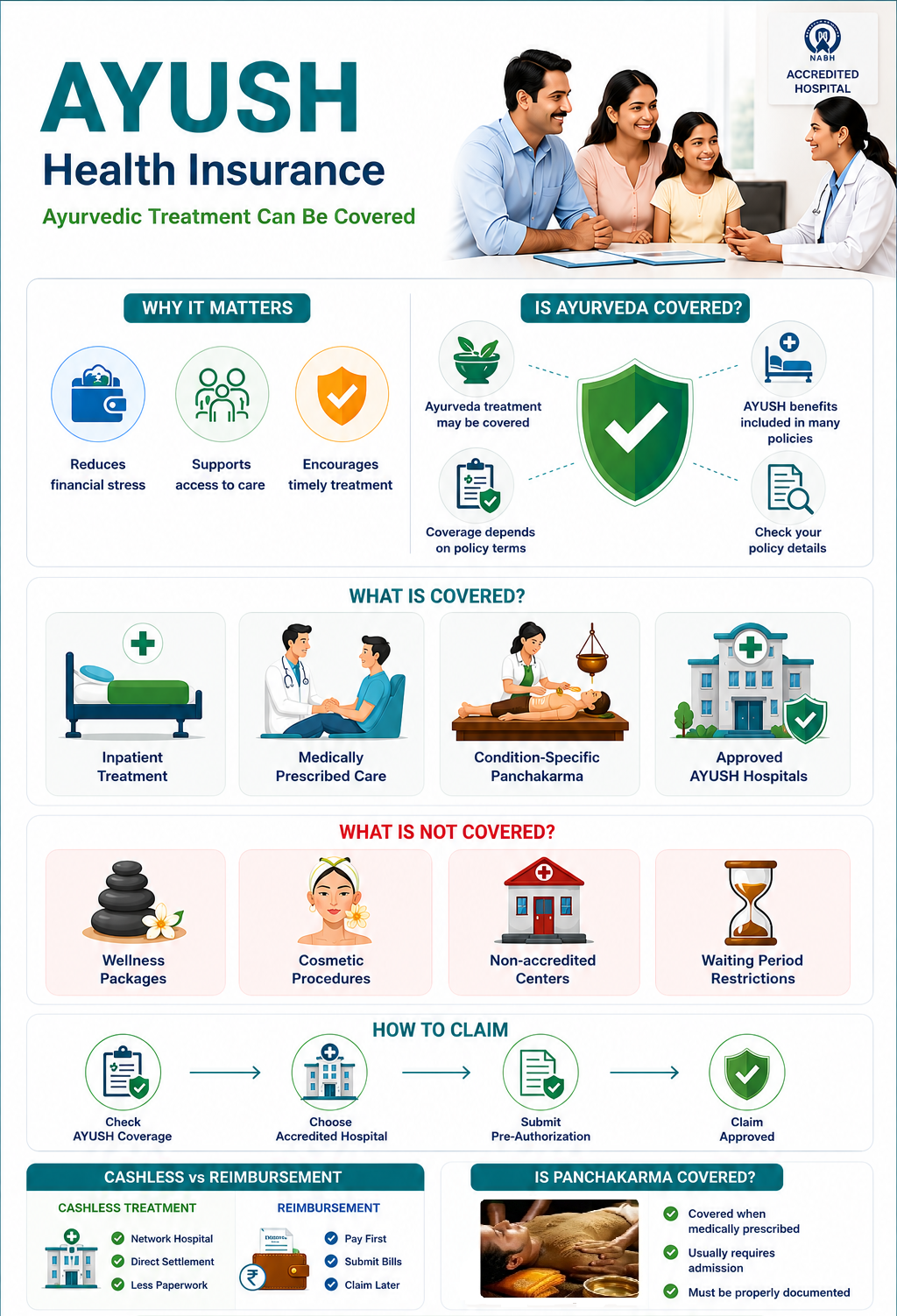
Yes, many health policies now include Ayurvedic treatment under Mediclaim as part of their standard benefits. This means treatment under Ayurveda may be reimbursed when it is prescribed for a medical condition and delivered in an eligible hospital or healthcare facility.
When is coverage generally available?
- The treatment is medically necessary
- The institution is recognized/has accreditation
- The patient is admitted to the facility as an inpatient
The required documentation is submitted fully and correctly
Therefore, when people enquire whether Ayurvedic treatment is covered by insurance, the honest answer is yes, but only if certain conditions are met.

Why IRDAI AYUSH coverage matters
IRDAI (Insurance Regulatory and Development Authority of India) is the apex statutory body under the Government of India’s Ministry of Finance, tasked with licensing, regulating and systematically developing the insurance and reinsurance industries.
A major reason for this progress in Ayurveda insurance claims is IRDAI AYUSH coverage. The insurance regulator has pushed for greater parity between AYUSH systems and allopathic care. This has brought Ayurveda into the mainstream of insurance planning and improved acceptance across many policies.
For the insured, this change translates to:
- The AYUSH therapy is no longer considered a secondary option
- They are supposed to cover this form of medicine as part of their policies
- Claims will be easier to process provided that the proper documentation is in place and admission criteria are fulfilled
- Patients will feel much more comfortable considering Ayurveda remedies where applicable
It’s definitely an encouraging trend for patients and practitioners alike.
Who can usually claim AYUSH benefits?
Most retail and corporate health policies now include some form of Ayush health insurance benefit. However, the level of coverage may differ from one insurer to another.
You are more likely to have coverage if:
- Your policy explicitly mentions AYUSH treatment
- The hospital is accredited or recognized
- The treatment is prescribed by a qualified practitioner
- The admission is medically justified
- The treatment is not purely wellness-based
Patients should always check their policy wording, because coverage limits, sub-limits, and exclusions may still apply.
What is usually covered?
In most cases, Ayush insurance coverage in India is strongest when treatment is provided as inpatient care for a specific medical condition.
Commonly covered situations may include:
- Chronic musculoskeletal conditions
- Digestive or metabolic disorders
- Skin conditions
- Stress-related or lifestyle-related illness
- Rehabilitative or restorative therapies
- Physician-prescribed Panchakarma, when medically indicated
This scenario is where health insurance for Panchakarma in India becomes relevant. Panchakarma may be covered when it is part of a hospital-based treatment plan and not simply a wellness retreat.
Inpatient care vs outpatient care
This distinction is very important.
Inpatient care
Usually covered when:
- The patient is admitted to the hospital
- The stay meets policy requirements
- The treatment is supervised and documented
- The insurer recognises the facility
Outpatient care
Usually not covered unless the policy has a special OPD benefit:
- Regular consultations
- Pharmacy-only purchases
- Day visits without admission
- Wellness therapies without diagnosis
In short, an Ayurvedic treatment insurance claim in India is far easier to process when the treatment is inpatient and medically necessary.
What is not covered?
Insurance is meant for medical treatment, not general relaxation or lifestyle rejuvenation. This is one of the most common reasons for claim denial.
Usually excluded:
- Wellness packages without a diagnosis
- Spa-style relaxation therapies
- Cosmetic procedures
- Experimental or unproven therapies
- Treatment at unrecognised facilities
- Claims filed during the waiting period for pre-existing disease
So, while Ayurveda is now widely accepted, the insurer still looks for medical necessity and proper hospital standards.
Why the hospital matters
For a successful claim, the centre where treatment is taken matters as much as the treatment itself.
A claim is stronger when the hospital is
- Government-recognised
- NABH-accredited
- Accepted by the insurer’s network
- Equipped for inpatient care
- Supervised by a qualified AYUSH physician
If a patient receives excellent treatment but the facility does not meet insurer requirements, the claim may still be rejected. This is why hospital verification should happen before admission whenever possible
How to claim Ayurvedic treatment under health insurance
There are two main routes for claim settlement:
1. Cashless claim
This method is the simplest option. The insurer pays the hospital directly, subject to approval.
Use this route when:
- The hospital is in the insurer’s network
- Pre-authorisation is obtained
- Admission is medically justified
- All papers are submitted on time
This is the preferred option for many patients seeking cashless Ayurvedic treatment in India.
2. Reimbursement claim
Here, the patient pays first and later asks the insurer to repay eligible expenses.
Use this route when:
- The hospital is not in the network
- The facility is still eligible and accredited
- Cashless approval is not available
- Bills and records are complete
Reimbursement works well, but it requires more careful document collection.
Pre-authorisation process
Before planned admission, the hospital usually sends a pre-authorisation request to the insurer or TPA (Third-Party Administrator).
This process helps the insurer check:
- Whether the admission is necessary
- Whether the condition is covered
- Whether the hospital is eligible
- Whether the treatment falls within policy terms
A delay in pre-authorisation can affect cashless approval, so it is always better to submit your request early.
Documents you should keep ready
A claim becomes much smoother when the records are complete. Keep the following ready:
- Policy copy or insurance card
- Claim form
- Hospital admission records
- Doctor’s prescription and diagnosis
- Discharge summary
- Final bill with breakup of charges
- Payment receipts
- Medical test reports
- Accreditation details of the hospital, if needed
For Ayurvedic treatment insurance claims in India, documentation is often the difference between approval and rejection.
Is Panchakarma covered?
Yes, in many cases, health insurance for Panchakarma in India is possible.
However, conditions usually apply:
- It must be prescribed for a medical reason
- It should usually involve inpatient admission
- It must be done in a recognised setup
- It should be supported by proper medical notes
A few hours of daily Panchakarma as an outpatient program is usually not enough unless your policy specifically includes OPD benefits.
How patients benefit from AyurVAID support
For many patients, insurance is not difficult because the treatment is Ayurveda. It becomes difficult because the process is unfamiliar. This stage is where AyurVAID insurance empanelment becomes valuable.
At Apollo AyurVAID, patients benefit from:
- Support with pre-authorisation
- Guidance on claim paperwork
- Help with hospital documentation
- Coordination with insurer requirements
- Assistance for cashless and reimbursement cases
Because of its structured clinical and administrative systems, AyurVAID insurance empanelment helps patients navigate insurance more smoothly and confidently.
Tips for making a successful claim
- Examine the terms of your policy before admission
- Make sure that AYUSH therapy is covered
- Admit yourself to an approved/reputed hospital
- The treatment must be for a genuine illness
- Keep all your bills, receipts, and discharge slips
- Apply for pre-authorisation for making cashless claims
- Use reimbursement mode only if cashless claims are not possible
- Get assistance from the hospital’s insurance counter
Conclusion
The growth of Ayush health insurance has made Ayurveda more accessible to patients across India. With the support of IRDAI AYUSH coverage, more people can now seek treatment with greater financial confidence.
Still, a successful claim depends on the basics:
- proper diagnosis
- recognised hospital
- inpatient care when required
- complete records
- policy compliance
So, when patients ask if Ayurvedic treatment is covered by insurance, the best answer is ‘yes, often it is, especially when the treatment is medically justified and properly documented.’ With the right hospital support and the right paperwork, Ayurvedic treatment is covered under Mediclaim.
And for those seeking cashless Ayurvedic treatment in India, choosing the right empanelled centre can make the entire experience much more stress-free and healing-focused.
References