Dosha Dushti

Table of Contents

Introduction

Have you ever looked at your body and realised it does not fail all at once? It gives signals first. The digestion slows, the sleep becomes lighter, the mind feels scattered, the skin reacts, the joints complain, or the energy simply does not flow the way it should. Ayurveda calls this early disturbance Dosha Dushti.

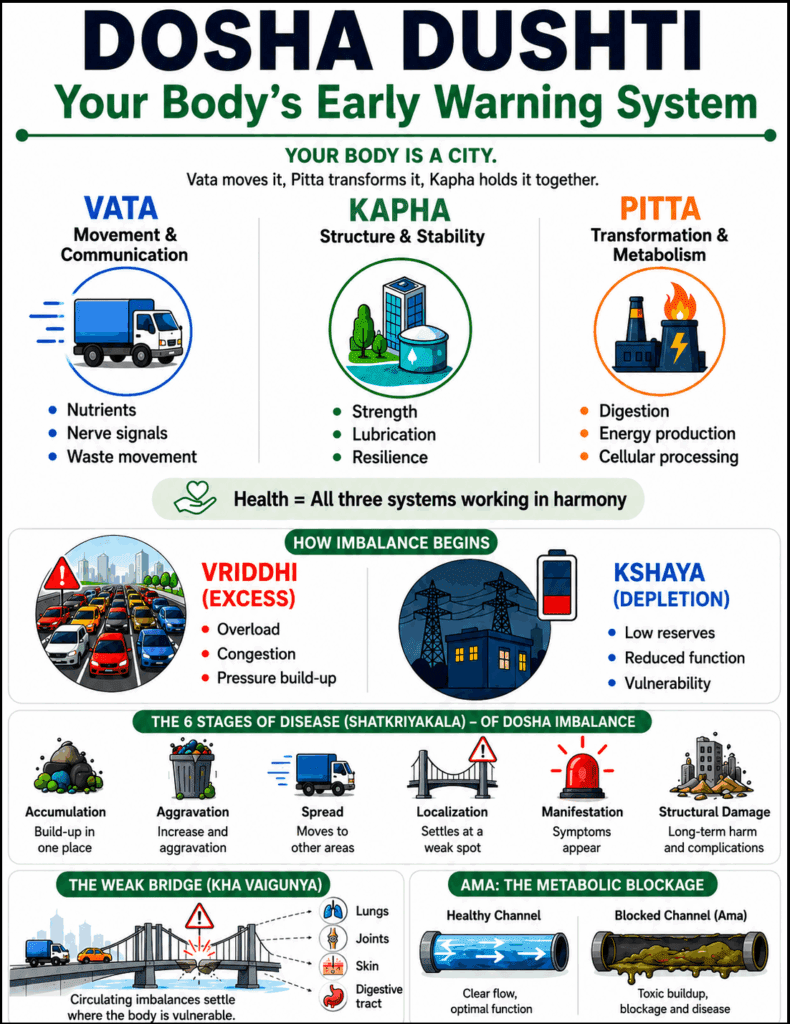
To understand it clearly, imagine the body as a busy modern city. A city survives only when its systems work together. The traffic must move, power must generate energy, buildings must remain stable, water must circulate, waste must be removed, and weak structures must be protected. In the same way, the body depends on the proper functioning of Vata, Pitta, and Kapha. When these Doshas are in balance, the city runs smoothly. When they are disturbed, the city begins to show signs of strain.

Ayurveda does not see disease as a sudden event. It sees disease as a process. And Dosha Dushti is the first major step in that process.

The city players: what the Doshas do

What is Dosha Dushti?

Dosha Dushti means the Doshas are no longer functioning in their natural state. They may increase, decrease, move to the wrong place, mix with waste material, or disturb vulnerable tissues.

Think of a city that is operating normally. Now imagine one system starts breaking down. Garbage piles up in a neighbourhood, traffic is diverted, a bridge weakens, a drainage pipe gets blocked, and the power supply becomes unstable. The whole city feels disturbed even if the collapse has not yet happened. That is Dosha Dushti in the body.

Insurance Backed

Precision Ayurveda
Medical Care

Vriddhi and Kshaya

The first way a Dosha becomes disturbed is through Vriddhi and Kshaya.

  • Vriddhi means increase, overload, or excess. It is like turning the city’s traffic high. Roads become jammed, services overflow, and pressure builds in the system.

In the body, increased Kapha may feel like sluggishness and heaviness, aggravated Pitta may feel like heat and irritation and aggravated Vata may feel like instability and scattered movement.

  • Kshaya means depletion or reduction. This condition is like a weak city system running on low power. A low battery does not always create dramatic symptoms at first, but it makes the whole system vulnerable. Likewise, a Dosha that is reduced can allow opposite qualities to dominate and create imbalance.
DoshaVriddhi Lakshana (Aggravation)Kshaya Lakshana (Depletion)
Vata• Tremors, twitching, spasms
• Pain – pricking, shooting or colicky in nature
• Bloating, flatulence, constipation
• Dryness of skin and tissues
• Anxiety, fearfulness, restlessness
• Insomnia and disturbed sleep
• Dizziness and instability
• Reduced movement and activity
• Sluggish speech and delayed responses
• Dullness of sensory perception
• Weakness and fatigue
• Emaciation and loss of vitality
• Reduced enthusiasm and motivation
• Increased heaviness and sleepiness due to relative Kapha predominance
Pitta• Burning sensation in the body
• Excess body heat and feverish feeling
• Hyperacidity and acid reflux
• Intense hunger and thirst
• Increased sweating
• Loose stools or diarrhoea
• Redness or yellowish discolouration of skin, eyes, and urine
• Irritability, anger, impatience
• Reduced digestive capacity (Mandagni)
• Poor metabolism and digestion
• Feeling unusually cold
• Loss of body warmth and radiance
• Reduced visual acuity
• Dull complexion
• Decreased sharpness of intellect and discrimination
Kapha• Heaviness in body and mind
• Excess sleep and lethargy
• Sluggish digestion and metabolism
• Excess mucus, cough, congestion
• Fluid retention and oedema
• Weight gain and obesity
• Pale or whitish appearance, feeling cold
• Emotional attachment, inertia, low motivation
• Dryness of throat and tissues
• Increased thirst and internal heat
• Joint looseness or instability
• Loss of strength and endurance
• Tissue depletion and weight loss
• Reduced immunity and resilience
• Disturbed sleep
• Dizziness or light-headedness

The six stages of disease: a city moving toward crisis

Ayurveda explains disease progression through Shatkriyakala, the six stages of pathology.

1. Sanchaya — accumulation in one district
This is like waste that begins to collect in one neighbourhood. It has not spread across the city yet, but the signs are there.

In the body, a Dosha begins to build up in its seat. There may be mild heaviness, slight food intolerance, or a vague discomfort. Nothing seems serious, but the system is already shifting.

2. Prakopa — the overflow starts
The garbage piles up more. The dumpsters are full. The pressure in that district rises.

In the body, the Dosha becomes aggravated. Symptoms begin to show more clearly—an acidic feeling, bloating, irritability, congestion, or restlessness depending on which Dosha is disturbed.

3. Prasara — the spilled cargo spreads
This is the stage of overflow. Once the local site can no longer contain the waste, it begins spreading into other parts of the city.

Here Vata becomes extremely important. Vata is the transport system, so when it is aggravated, it behaves like a fleet of trucks carrying polluted material through the main highways and into other districts. The disturbed Dosha does not remain local anymore. It begins moving throughout the body.

A classic Ayurveda simile helps here: just as fermenting dough overflows from its vessel, the aggravated Dosha spills beyond its original place. This is not a random movement. Vata directs it.

4. Sthana Samshraya — the weak bridge
This is the most important turning point. A city under stress will not fail equally everywhere. It fails first at the weak bridge, the rusty drainage pipe, or the damaged power junction.

Ayurveda calls this weak spot Kha Vaigunya. As the disturbed Doshas circulate, they settle where there is vulnerability. If the weak point is the lungs, the person may develop respiratory symptoms. If it is the joints, pain and stiffness may begin. If it is the skin, irritation or eruptions may appear.

This stage is where Dosha and Dushya begin to interact. ‘Dushya’ refers to the bodily elements that are susceptible to being vitiated or disturbed by imbalanced Doshas. They areDhatus (tissues), upadhatus (sub tissues), Mala (waste products),srotas(channels) andOjas (Vital energy). When the Dosha is disturbed, these dushyas become vulnerable, and disease starts taking shape.

5. Vyakti — the city-wide alert
Now the problem becomes obvious. The bridge collapses, traffic is blocked, and the whole city knows something is wrong.

This is the stage of full manifestation. The disease is now clinically recognisable. A doctor can now name the condition.

6. Bheda — structural damage
If the collapse is ignored, the damage spreads. Nearby roads crack, drainage worsens, and the affected district suffers long-term harm.

In the body, this is the stage of complications, chronicity, and deeper tissue damage.

What causes Dosha Dushti?
In Ayurveda, causes are called Nidana. These are the factors that disturb the body’s balance.
A city does not deteriorate overnight. It usually falls into crisis because of repeated neglect. The same is true in the body.

Vata becomes disturbed with irregular meals, excess travel, fear, sleep deprivation, overwork, cold exposure, and lack of routine.

Pitta becomes disturbed with spicy, sour, and salty food, excess heat, fasting, anger, and irritants.

Kapha becomes disturbed with overeating, too much sleep, heavy and oily foods, sweets, dairy overload and inactivity.

These triggers are like repeated pressure on a city’s infrastructure. Over time, the system starts to fail.

Types of Dosha Dushti

Dosha Dushti can be understood in a few simple ways. Each type helps us see how the imbalance is behaving, where it is moving, and whether Ama is involved.

  1. Vriddhi and Kshaya (explained earlier)
  2. Swatantra – The Dosha is disturbed by its own causes, such as diet, lifestyle, or the environment.
    Paratantra – One Dosha is disturbed because another Dosha is pushing it out of balance.
  3. Sama – This condition is a sticky, heavy, obstructive state, like sewage clogging the channels.
    Nirama – This type is a cleaner form of imbalance and is usually easier to manage.
  4. Leena –The imbalance stays silent in the tissues, waiting for the right trigger to surface.
    Utklesha – Doshas are mobilised and ready for elimination.
    This phase is an important preparatory state before purification therapies.
  5. Samsarga – the involvement of two Doshas.
    The imbalance is mixed, such as Vata-Pitta or Kapha-Pitta.
    Sannipata – the involvement of all three Doshas.
    This condition is the most complex form of Dosha Dushti.
  6. Prakruta – natural or physiological change.
    Some shifts are expected, like seasonal variation.
    Vaikruta – abnormal or pathological change.
    This is an imbalance that appears where it should not.

These types help the physician understand whether the condition is simple, mixed, hidden, or deep-seated and choose the right treatment accordingly.

Ama: the sewage backup

A major reason the disease becomes more difficult is Ama.

Ama is like sewage backup or metabolic sludge. When the city’s waste processing system fails, sticky waste begins clogging the pipes. Channels become blocked, and the city becomes dirty and sluggish.

In the body, weak digestion creates Ama. When Doshas mix with Ama, the condition becomes Sama—sticky, heavy and obstructive. When there is no Ama, the condition is Nirama, and treatment is usually easier.

Ashayapakarsha

Another important concept is Ashayapakarsha. This condition happens when aggravated Vata acts like a violent windstorm.

Imagine a storm blowing through the city so strongly that it picks up healthy water from the reservoir and dumps it into the power plant. The water itself was not harmful. The problem was that it was taken out of its rightful place.

This is what aggravated Vata can do in the body. It can pull a normal Dosha away from its seat and deposit it somewhere inappropriate, creating disease in a new location.

Why one person gets sick and another doesn’t

Two bridges in the same city face the same storm, but one may fall while another remains standing. Why? Because of structural weakness.

Ayurveda explains this through individual vulnerability. Each person has a different constitution, different tissue strength, different past illnesses and different weak points. That is why the same trigger may produce arthritis in one person, eczema in another, or digestive trouble in someone else.

The Dosha may be the same, but the landing place is different.

How Ayurveda treats Dosha Dushti

Ayurveda does not simply suppress symptoms. It restores order to the city.

Shamana — pacification
This is the gentle correction. It is like fixing a flickering streetlight before the entire power grid fails. Herbs, diet correction, sleep regulation, and lifestyle discipline are used to calm the Doshas.

Shodhana — purification
This is a deep clean. If the city is flooded with waste, the answer is not just perfume. The waste must be physically removed.

Shodhana works by mobilising disturbed Doshas from the peripheral areas of the body and bringing them back to the central processing system so they can be eliminated. This is the logic behind Panchakarma.

Shamana is useful when the disturbance is mild or recent. Shodhana is needed when the imbalance is heavy, deep-seated, or loaded with Ama.

To conclude,

Dosha Dushti is the beginning of disease, but it is also the beginning of understanding. When we see the body as a city, the logic becomes clear. Vata moves, Pitta transforms and Kapha stabilises.

The body speaks early. A little heaviness, heat, dryness, sluggishness, irritability, or repeated symptoms are not meaningless. They are warning signals.

Ayurveda teaches us to notice these signals before the storm becomes a disaster. That is the real strength of understanding Dosha Dushti: it gives us a chance to protect the city before the bridge falls.

FAQs

What is dosha dushti?
Dosha dushti is the perverted or imbalanced state of the body's fundamental energies (Vata, Pitta, and Kapha). It is the chief contributory factor in the development of all diseases, acting as the initiating force of pathogenesis.
What is dushya in Ayurveda?
Dushya refers to the bodily elements, including tissues (Dhatus), secondary tissues (Upadhatus), and waste products (Malas), that are susceptible to disturbance or vitiation by imbalanced Doshas. In the disease process, the Dosha acts as the initiating factor while the Dushya serves as the physical substrate for pathological changes.
Can multiple Doshas be imbalanced at the same time?
Yes, multiple Doshas often act together; Samsarga Dushti refers to the simultaneous vitiation of two Doshas, while Sannipata Dushti involves the simultaneous vitiation of all three. These combined imbalances can occur in equal strengths or with one Dosha being more dominant than the others.
Can a "normal" Dosha still cause disease?
Yes, through a process called Ashayapakarsha, where vitiated Vata forcibly "pulls away" a healthy, normal Pitta or Kapha from its original seat. Once displaced and thrown into a new area of the body, these otherwise normal Doshas can produce disease symptoms.
What is the difference between "Independent" and "Dependent" vitiation?
Swatantra Dushti (Independent) occurs when a Dosha is vitiated by specific etiological factors that are directly responsible for its imbalance. Paratantra Dushti (Dependent) occurs when a Dosha becomes vitiated as a secondary result of the etiological factors that primarily aggravated a different major Dosha.
How do metabolic toxins (Ama) affect Dosha imbalance?
When imbalanced digestion (Agni) produces Ama (sticky, immature metabolic byproducts), it can circulate and deposit in tissues, causing blockages. Doshas associated with this toxin are called Sama Doshas, whereas those devoid of it are called Nirama Doshas.
Is there such a thing as "natural" Dosha vitiation?
Yes, Prakruta Dushti is a form of normal vitiation that occurs due to natural factors like diurnal shifts or seasonal changes. Conversely, Vaikruta Dushti is considered abnormal vitiation because it occurs in seasons that are not natural to that specific Dosha's typical cycle.
Did the information meet your needs?

As we work hard to improve our services, your feedback is important to us. Please take a moment to help us serve you better.

Stay Connected to Health and Wellness

Subscribe to our hospital newsletter for the latest health tips, updates on services, patient stories, and community events. Sign up today and stay informed!

Homepage B RCB

Please fill out the form below to Request a call back

Patient details

Select Preferred Center

Content Details

We update our articles as new material becomes available, and our specialists keep a close eye on the health and wellness industry.

Written by
Dr Shobitha Madhur
Share this article on
Last updated on:
Do you have concerns with the content?

Report Problem

Table of Contents

Last updated on:

Report Problem

Do you have concerns with the content?

We’d Love to Hear from You!

Feedback form(disease page)

Can we help?

Something wrong with our medical content?
 
Report Problem form

Popular Searches: DiseasesTreatmentsDoctorsHospitalsWhole person careRefer a patientInsurance

Follow Apollo AyurVAID hospitals