Every Independence Day brings with it familiar images of the tricolour, patriotic songs, and memories of sacrifice. Yet beyond the celebrations lies a quieter question that many families carry in their daily lives: what does independence truly mean when it comes to health?
For some, it means waking up without pain. For others, it means sleeping through the night without anxiety, walking without fear, eating without discomfort, or living without being defined by a long list of chronic illnesses.
AyurVAID’s journey has gradually shaped a more profound understanding of this question. Over the years, the focus has moved beyond temporary symptom relief toward a more demanding but meaningful goal: understanding why illness occurs and how long-term healing can be supported. This philosophy is reflected in AyurVAID root cause healing.
This is not a story of choosing one medical system over another. It is a story of building a patient-centric approach that combines the strengths of Ayurveda with the realities of modern healthcare.

A Journey That Began with a Question
AyurVAID did not emerge from a belief that Ayurveda was simply a collection of traditional home remedies. The turning point came from recognising that Ayurveda has a structured clinical framework, with its own physiology, pharmacology, and systems thinking. The insight was that Ayurveda is not merely about treating isolated symptoms. It is about understanding relationships between different body systems and identifying the underlying disturbances that give rise to disease.
From the beginning, the effort was to bring discipline, documentation, and accountability into Ayurveda practice. Every treatment, assessment, investigation, allergy, previous therapy, and follow-up was carefully recorded. This process-driven approach eventually helped AyurVAID become the first Ayurveda hospital network to receive NABH accreditation. For patients, this was not just an administrative achievement. It was a statement that traditional medicine could also be transparent, measurable, and accountable.
When Symptoms Are Not the Disease
One of the most important ideas shaping this philosophy is simple: a symptom of a disease is not the disease itself.
A person may come with diabetes,hypertension, joint pain, digestive problems,anxiety, fatigue, or disturbed sleep. Treating each complaint separately may provide relief, but many patients continue to feel unwell because the deeper imbalance remains unaddressed.
Modern life has created a growing burden of multimorbidity. People increasingly live with several chronic conditions at the same time. Poor sleep, digestive disturbances, stress, metabolic dysfunction, inflammation, and emotional exhaustion often coexist. This is where AyurVAID root cause healing becomes relevant. The goal is not only to reduce what is visible, but to explore the patterns connecting different complaints. Questions become more important than quick fixes:
- What changed before the illness began?
- How are sleep and digestion?
- What is the level of stress?
- How has energy changed over time?
- What treatments have already been tried?
- Which systems seem to be influencing one another?
Sometimes patients feel heard for the first time in years.
A Systems Approach to Health
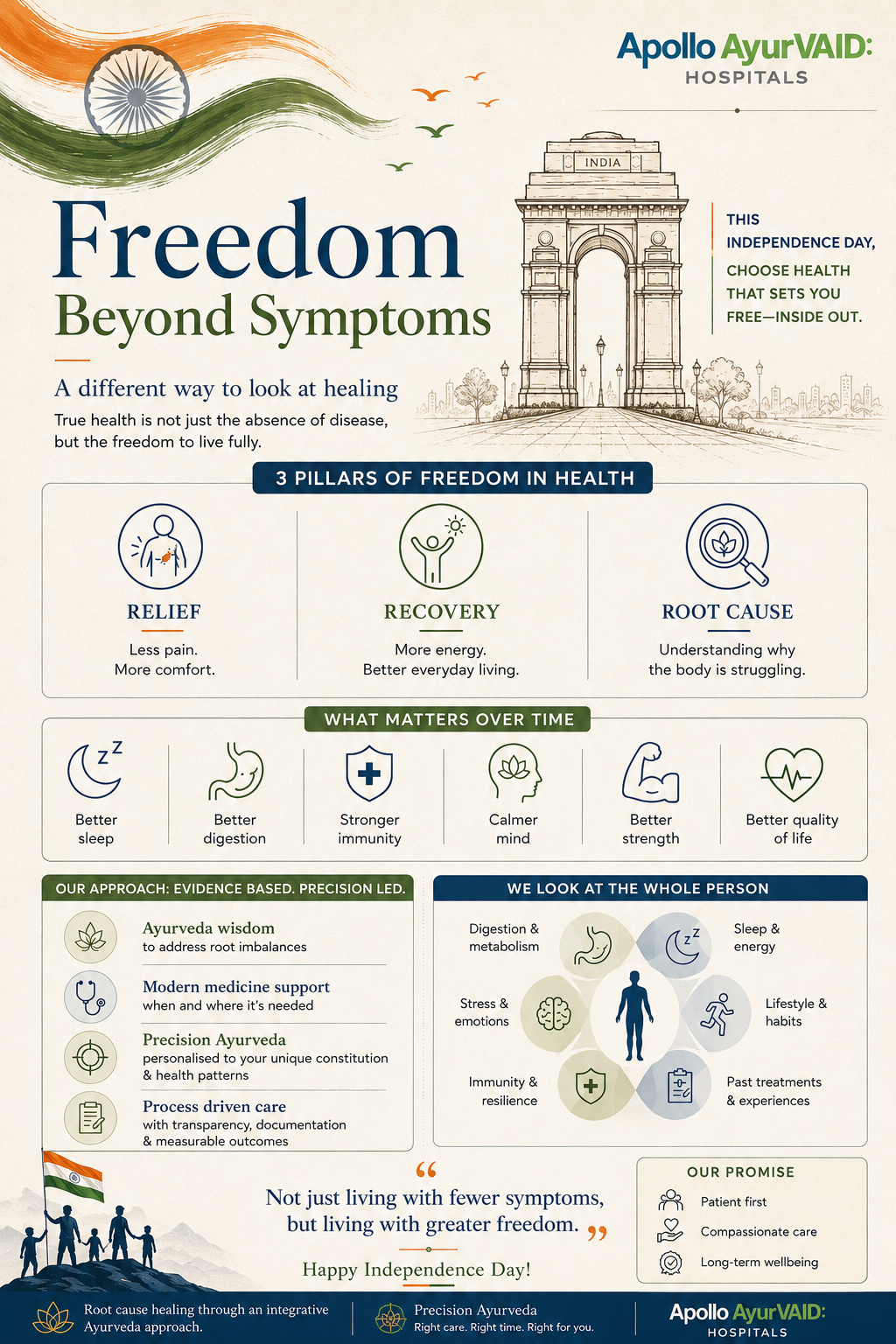
AyurVAID often describes Ayurveda as a systems approach to health. A systems approach does not view the body as isolated organs working independently. It looks at how digestion, metabolism, sleep, immunity, stress, and emotional wellbeing interact with each other. Ayurveda has a conceptual framework for understanding these relationships. If a disturbance appears in one region, the root cause may lie elsewhere in the system.
This perspective does not reject modern medicine. In fact, the approach has consistently emphasised bringing out the best in both allopathy and Ayurveda. Acute emergencies, surgeries, intensive care, severe infections, and many life-threatening conditions require modern medical treatment. Chronic functional disorders, recurrent symptoms, rehabilitation, and long-term wellbeing may benefit from an Ayurveda and integrative approach. The future of healthcare is not a competition between systems. It is a patient-centric integration of strengths.
Listening to the Whole Person
A systems approach becomes meaningful only when the consultation looks beyond isolated symptoms. Many patients do not arrive carrying only reports. They carry fear, frustration, confusion, and fatigue. Some have been told that everything is normal even though they feel exhausted. Others have learned to live with pain because they believe nothing more can be done. A root cause consultation therefore begins with listening to the whole person. Sleep, digestion, appetite,bowel habits, stress, emotional health, work patterns, family responsibilities, previous treatments, and lifestyle changes are all part of the clinical picture. This approach recognises that chronic illness is rarely only physical. It often affects confidence, relationships, productivity, and the sense of control over one’s life.
From Vikruti to Prakruti
After understanding health as an interconnected system, the next question is how Ayurveda attempts to restore that balance in practice. This is where Panchakarma is often discussed, although authentic Ayurveda practice views it very differently from the popular idea of a magical detox.
The central idea is the restoration of Prakruti from a Vikruti avastha. Prakruti refers to an individual’s natural constitutional balance.Vikruti is the state of deviation from that inherent balance. Health is not defined by making all threedoshas equal. Every person has a unique constitutional combination, and treatment aims to support a return toward that natural state. This is why AyurVAID root cause healing does not rely on standardised detox packages.
Panchakarma is a set of deep systemic cleansing therapies selected according to the patient’s specific vikruti.
- Nasyam is used when the disturbance is predominantly in the head region.
- Vamanam helps cleanse the chest region and accumulated Kapha.
- Virechanam addresses the upper part of the alimentary canal.
- Vasti focuses on the lower gut and colon.
- Raktamokshana may be considered in certain localised conditions involving blood-related pathology.
Together, these therapies aim to support whole system cleansing and restoration of physiological balance. The important point is that Panchakarma is never chosen casually. The body already possesses a remarkable capacity for self-correction. When that capacity becomes insufficient, an experienced Ayurveda physician decides which therapy, in what sequence, and for which individual it may be appropriate. That is where Precision Ayurveda becomes essential. The emphasis is not on performing more therapies. It is on performing the right therapy for the right person at the right time.
Independence from Personality-Driven Medicine
Another important reflection from this journey is that healthcare should not depend on the charisma of a single healer. A sustainable medical system requires processes, protocols, documentation, outcome tracking, and ethical standards.
For traditional medicine to earn wider trust, it must move from personality-driven practice to institutional reliability. This is especially important for younger generations who seek evidence, clarity, and accountability alongside compassion. Transparency becomes a form of respect. Patients deserve to know their diagnosis, the line of treatment, what improvement can realistically be expected, and where the limitations of treatment lie.
Health as a Lifelong Relationship
Making Care More Accessible
A meaningful healthcare model cannot remain limited to a small section of society. AyurVAID therefore developed different care pathways for different economic groups, with the intention of making structured Ayurveda care accessible not only to the upper middle class but also to lower-income families, widows, elderly patients, and those with limited access to quality chronic care.
Affordability is not merely about reducing the cost of treatment. Financial clarity is equally important. Apollo AyurVAID has also worked to simplify the process of helping patients understand the AYUSH coverage available under their medical insurance policies. As a chain of Ayurveda hospitals approved by a large number of insurance providers and third-party administrators, the effort has been to reduce confusion around insurance-linked access to Ayurveda care. When treatment is delayed because of cost, uncertainty, or lack of access, disease often becomes more difficult to reverse, and suffering becomes longer. Making healthcare accessible therefore means addressing both medical and financial barriers with transparency and trust.
Rebuilding Trust Through Evidence and Ethics
What Independence Means to AyurVAID
References