Missing a period (medically known as amenorrhea) is more than an inconvenience. It often comes bundled with worry, confusion and a sense that something inside your body has gone wrong. Patients commonly ask, “Am I infertile? Is there a serious illness? Should I be frightened?”
What is amenorrhea? Medically, amenorrhea definition is the absolute absence of menstruation in someone of reproductive age. This absence can be temporary, intermittent, or permanent, depending on the triggering factors.
From an Ayurveda perspective, this condition is known as Anartava or Nashtartava, where Artava (menstrual blood/ovum) is either destroyed or obstructed from flowing out by imbalanced Doshas. In this blog, let’s explore amenorrhea causes, amenorrhea symptoms, types of amenorrhea and amenorrhea treatment in detail.
Types of amenorrhea
When we think about types of amenorrhea, we usually divide them into two clinical categories:
- Primary amenorrhea — when a girl has not started menstruating by age 16 if she has normal secondary sexual characteristics (breast development), or by age 14 if those features are absent.
- Secondary amenorrhea — when a woman who has had periods stops getting them for three consecutive months (if cycles were regular) or six months (if cycles were previously irregular).
There are also physiological states where the absence of menses is normal—before puberty, during pregnancy, lactation, and after menopause—and these are not considered pathological.
Why do periods stop?
- Hormonal imbalances: Conditions like PCOS (polycystic ovary syndrome), high prolactin levels, or thyroid problems can stop ovulation or prevent bleeding.
- Stress or energy loss (hypothalamic suppression): Very low weight, intense exercise, or chronic stress can “switch off” the brain signal that runs your cycle.
- Ovarian insufficiency: Early decline of ovarian function (sometimes genetic, as in Turner syndrome) lowers hormone production.
- Anatomical problems: Some women are born without a uterus or have blockages (imperforate hymen) or scar tissue inside the womb (Asherman’s) that physically prevent flow.
- Certain medicines, long-standing illnesses, or severe nutritional deficiencies can also stop your periods.
What will you notice?
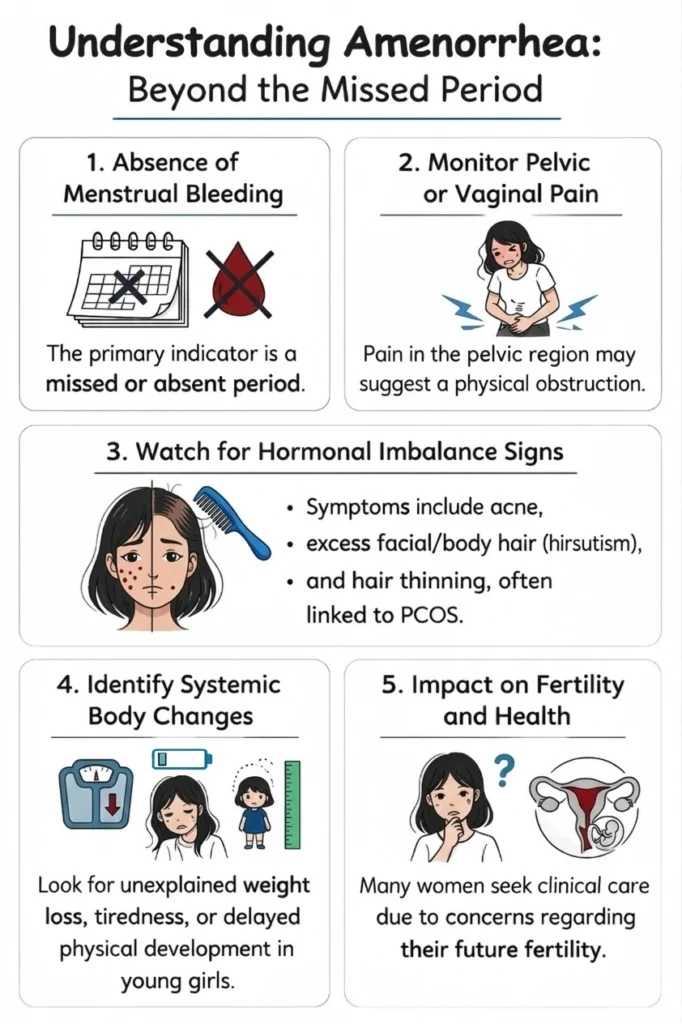
The most obvious sign is the missed period, but other amenorrhea symptoms depend on the cause:
- Pelvic or vaginal pain is more likely to occur when there is a physical obstruction.
- Signs of hormonal imbalance include acne, increased facial or body hair (hirsutism), or hair thinning, commonly seen with PCOS.
- General/systemic signs — weight loss, tiredness, pallor, or, in young girls, lack of breast or pubic hair development (seen with some forms of primary amenorrhea).
- Many women first come for help because they are worried about fertility.
How is amenorrhea diagnosed
A structured evaluation identifies the root cause:
- History and physical exam — growth and development, weight changes, exercise, medications, and signs of androgen excess.
- Hormonal assays — FSH, LH, prolactin, TSH, and testosterone help localise the problem (ovarian, pituitary, thyroid, or hypothalamic).
- Imaging — pelvic ultrasound looks for ovarian morphology (polycystic changes), uterine anatomy, or uterine scarring.
- Special tests — karyotype for suspected chromosomal conditions, or hysteroscopy for suspected intrauterine adhesions.
The evaluation is both investigative and reassuring: many causes are treatable and reversible once identified.

Principles of amenorrhea treatment
Treatment is tailored to the cause, the patient’s age, desire for fertility, and overall health. For anatomical blockages (imperforate hymen, adhesions), minimal surgical correction can restore normal flow.
Ayurveda and integrative care
When periods stop because of blocked channels or a Dosha imbalance, Ayurveda focuses on gently clearing the obstruction and restoring your body’s natural rhythm:
- Abhyanga and herbal steam therapies help to reduce the muscle cramps and relax them.
- Vamana (emesis) — used when excess Kapha is blocking flow; it clears the congestion after careful preparation.
- Virechana (purgation) — cleanses the metabolic pathways and helps rebalance hormones.
- Vasti (enemas) — powerful for balancing Apana Vayu, the downward force that helps monthly expulsion.
- Uttaravasti (uterine instillation): A targeted therapy using medicated ghee or oils to nourish the uterine lining and support ovarian health.
- Nasya (nasal drops): Small, supervised nasal applications that calm the nervous system and assist hormonal regulation.
- Udwartana (herbal powder massage): A stimulating massage that helps reduce localised Kapha and excess fat — useful in patterns like PCOS.
- Local measures (Yoni Pichu / Varti): Medicated tampons or suppositories placed briefly to treat specific vaginal or cervical issues.
All treatments are individualised and must be performed by a qualified practitioner after proper assessment. Some procedures are avoided in pregnancy or active infections.
Regular sleep, moderate exercise, restorative yoga and simple breathing practices are essential because stress and energy imbalances often trigger missed periods.
Integrative care is collaborative – where modern diagnostics reveal a surgical or endocrine problem, those treatments are prioritised, while Ayurveda therapies support recovery, nutrition, and long-term balance.
Food also plays a major role in maintaining or worsening the condition. Following is the list of them:
Pathya (Favourable foods)
- Black sesame (Krishna tila) with jaggery, black gram (masha), and horse gram — nourishing and warming.
- Barley, red rice, warm milk-based meals or light broths to rebuild tissues.
- Warming spices: garlic, black cumin, and pepper — use moderately.
- Sour/fermented items in moderation (sour curd, buttermilk, lemon) if tolerated.
Apathya (Avoid)
- Junk/fast food and very heavy, overly sweet foods.
- Skipping meals or erratic eating (eat warm, regular meals).
- Excess cold/raw foods that hamper digestion.
When to seek help
To Conclude
References
- Gujarathi JR, Gujarathi R. Amenorrhoea – An Ayurveda Perspective. World Journal of Pharmaceutical Research. 2018;7(18):509-519.
- Bhadre D, Shirshetty J, Swamy S. Anartava (Amenorrhea) And Its Management – An Ayurvedic Review. International Ayurvedic Medical Journal. 2018;2(6):1368-1372.
- Jat S. Ayurvedic principles in managing primary amenorrhea: a review of ancient and modern perspectives. International Journal of Ayurvedic Medicine and Mental Health. 2024;1(2):20-28.
- Chauhan S. A Conceptual Study of Anartava. World Journal of Pharmaceutical and Medical Research. 2022;8(11):112-116.
- Harshitha G, Bhat NVG, Apoorva RN. An Ayurvedic Approach in Management of Anartava w.s.r to Secondary Amenorrhea – A Case Study. International Journal of Ayurvedic and Pharmaceutical Chemistry. 2024;21(3).