- AyurVAID Pharmacy
Thailam (medicated oil) is one such preparation that may look simple at first glance, but within that oil lies a thoughtful blend of tradition, pharmacology, and clinical wisdom.
To many people, oil is only something used for massage. But in Ayurveda, Thailam is much more than that. It is a medium that helps the therapeutic qualities of herbs reach deeper tissues, soothe aggravated doshas and support recovery in a calm, nurturing way. Whether used for joint stiffness, stress, dryness, sleep disturbance, or nervous system imbalance, Thailam remains one of Ayurveda’s most versatile preparations.
What makes it so special is not only what it contains but also how it works. It nourishes while it heals. It comforts while it corrects. That is the beauty of Thailam.
Ayurveda sees the human body as naturally Snigdha—lubricated, soft, and sustained by healthy fats. This quality is essential for joint movement, skin health, nerve function, mental steadiness, and even emotional resilience.
Today, however, many people are running low on this inner nourishment. Irregular meals, stress, too much screen time, lack of sleep, travel, and processed food all tend to aggravate Vata dosha. And when Vata rises, the body begins to show dryness, stiffness, anxiety, constipation, fatigue, and premature ageing often follow.
This is where medicated oils become deeply relevant.
Among the fats used in Ayurveda, plant-based oils hold a special place because they are easy to absorb and can carry herbal action into the tissues. Sesame oil is especially valued for its warming, grounding nature and its ability to pacify Vata. Coconut oil, by contrast, is cooling and soothing and is often preferred when there is excess heat or a Pitta imbalance.
But Thailam is not just about the oil base. Its real strength comes from the way herbs are processed into it.
Ayurveda describes this process as Sanskarasya Anuvartana—the ability of the oil to take on the medicinal qualities of the herbs without losing its own beneficial properties. In practical terms, the oil becomes a carrier, delivering the herbal action in a form the body can use well.
Modern science explains some of these effects through transdermal absorption. Warm oil applied to the skin can help certain fat-soluble compounds pass through the skin barrier and influence circulation, muscles, nerves, and lymphatic flow. But Ayurveda has always understood that the effect is not only physical. A good oil therapy calms the mind, grounds the nervous system, and creates a sense of safety in the body.
The preparation of medicated oil is called Sneha Kalpana. It is one of the most refined pharmaceutical methods in Ayurveda.
Authentic Thailam is not simply oil mixed with herbs. It is made in a methodical process that ensures both water and fat-soluble properties of herbs can be infused in the oil.
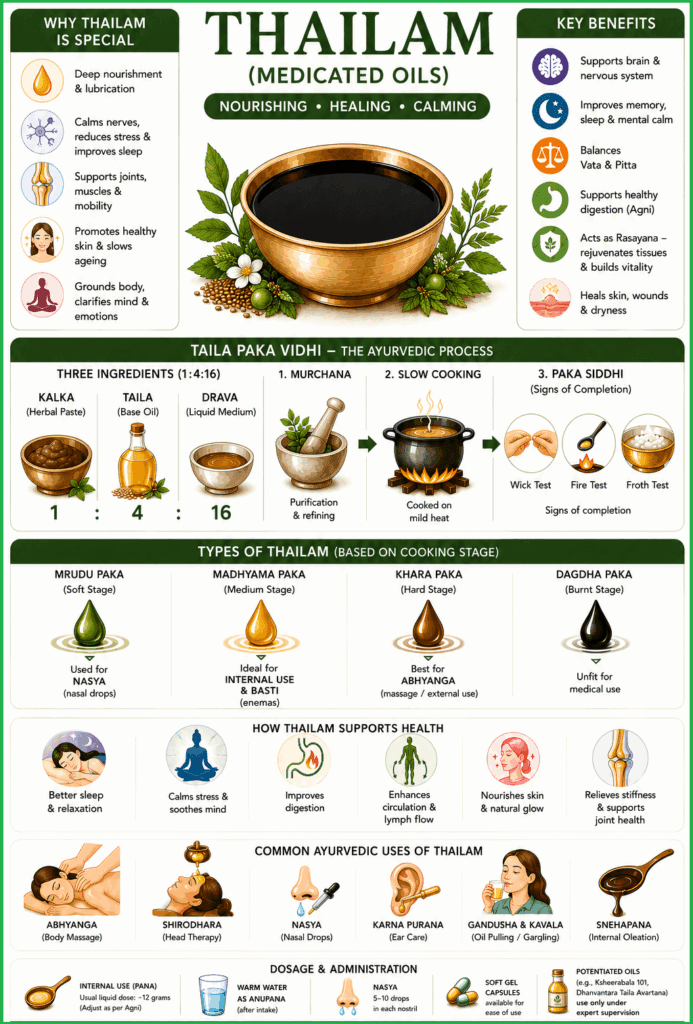
Classically, three components are needed in the classic ratio of 1:4:16.
Kalka – the paste of herbs
Taila – the oil
Drava – the fluid, like herbal decoction, milk, juices, water
Before the preparation of the medicated oil, the oil undergoes a refinement procedure called Murchana, which ensures that it becomes pure, gets rid of any foul smell or instabilities in it, prolongs its life, and improves its healing power.
Following that comes the process of cooking on a Mandagni (gentle heat). Herein lies the art of patience. With due diligence, the paste and liquid herbs are added to the oil to prevent burning. The whole process is done precisely in the manner of classical Ayurveda.

The ancient doctors of Ayurveda used to recognise the completion of cooking by checking for signs of Paka Siddhi.
The mixture can be pinched between one’s fingers to check whether it takes the form of a soft wick. If it does not crackle when exposed to fire, then it means that the moisture has completely evaporated. In the last stage, the oil attains its distinct aroma and colour.
The procedure requires experience. A slightly undercooked or overcooked oil can behave very differently in the body, so precision is essential.
Ayurveda classifies medicated oils according to the degree of cooking.
Mrudu Paka
This is the softer stage, with slight moisture remaining. It is gentle and is commonly used for Nasya—nasal administration.
Madhyama Paka
This is the medium stage, where the paste becomes wax like and moisture-free. It is considered ideal for internal use and for Basti.
Khara Paka
This is the harder stage, where the paste becomes dry and slightly blackened. It is mainly used for external therapies such as Abhyanga, where quick absorption and stability are desired.
Dagdha Paka
This is the burnt stage. Such oil is no longer suitable for medical use.
These distinctions show how carefully Ayurveda matches the preparation to the purpose.
One reason medicated oils have remained so valued across generations is that they work on many levels at once.
They not only lubricate the skin. They calm the nerves, soften stiffness, support circulation, and help the body feel more whole.
For the nervous system
Many people today live in a state of constant tension. Stress, poor sleep, emotional overload, and burnout have become part of daily life.
Warm oil therapies help shift the body from “fight or flight” into a more settled, restorative state. This is why many people feel deeply relaxed after Abhyanga. Sleep improves. Restlessness reduces.
Mental clarity is better than before.
Joint and muscular disorders
Osteoarthritis, lumbar spondylitis, cervical spondylosis, and stiff shoulders frequently increase Vata with dryness in the tissues.
Classic oils are applied to improve flexibility and nourish the muscles.
For circulation and lymphatic flow
Massage stimulates the tissues. It supports circulation, encourages lymphatic drainage, and helps reduce a feeling of heaviness in the body.
For skin and ageing
Ayurveda has long recommended daily oil application as part of healthy ageing. Oil helps soften the skin, reduce dryness, improve complexion, and support the natural vitality of the tissues.
In that sense, Abhyanga is not only skincare. It is a form of nourishment.
A dry person (Ruksha) may exhibit hard or solid faeces, difficulty digesting food, a burning sensation in the chest, and general debility or dryness of the body, indicating that they need snehana therapy. Medicated oils are used in several important Ayurveda treatments.
Even though Thailam is natural, it is still medicine.
Internal use is not appropriate during indigestion, fever, severe nausea, or weak digestion. External massage may need to be avoided during acute infections, high fever, or certain stages of pregnancy.
The choice of oil, dose, method, and duration should always be tailored to the individual’s constitution, current imbalance, digestive strength, and clinical need.
This is why strongly medicated oils should not be used casually without guidance.
Ayurveda continues to adapt to contemporary needs. Today, some traditional oils are available in soft gel capsule form for those who find internal oil intake difficult. Some preparations also undergo Avartana—repeated processing—to increase potency. Classic examples include Ksheerabala 101 and Dhanwantharam 101.
Quality control has also become a major part of modern Ayurveda pharmacy. Parameters such as acid value, saponification value and chromatographic profiling help ensure purity, stability, and standardisation.
Storage matters too. Oils should be kept away from direct sunlight and stored in clean, airtight glass containers to reduce the risk of rancidity.
According to the Government of India notifications, the official shelf life of medicated Thailam is three years. These preparations are considered more stable than crude oil due to their specialised processing.
Medicated oils should be stored in cool, dark, moisture-free conditions, away from heat, light, and air. They are best kept in glass, aluminium, or polythene containers that remain completely dry.
For internal use, the usual liquid dose of Pana is around 12 grams, though classical texts recommend adjusting the dose according to the patient’s Agni.
A dose that digests in about 6 hours is considered ideal, while one that takes 12 hours is a moderate dose. Higher doses are used only in specific clinical situations.
Soft gel capsules are a modern adaptation for ease of administration, but the exact dose varies by formulation.
After internal intake, warm water is commonly advised as anupana to aid digestion. The anupana can be kashaya or warm milk. The physician decides it based on the patient’s condition. For Nasya, the usual dose is 5–10 drops in each nostril.
One of the simplest and most beautiful ways to benefit from Thailam is through daily self-massage, or Dinacharya Abhyanga.
A little warm oil applied before bathing can quietly transform the way the body feels over time. It can reduce dryness, support sleep, calm the mind, nourish the skin, and improve body awareness.
For children, it can be grounding and comforting. For working adults, it can offset stress and fatigue. For older adults, it can bring warmth, stability, and support to the joints.
Thailam is one of Ayurveda’s finest offerings—a preparation where herbs, oil, touch, and therapeutic intelligence come together in a deeply human way.
In a world that often asks the body to do more while giving it less, medicated oils remind us to slow down, restore, and nourish. They speak the language of warmth, softness, and repair.
Whether used for pain relief, stress reduction, preventive care, or rejuvenation, Thailam continues to hold timeless relevance.
That is the enduring strength of Ayurveda: it remains deeply ancient, yet always alive to the needs of the present.
As we work hard to improve our services, your feedback is important to us. Please take a moment to help us serve you better.
Subscribe to our hospital newsletter for the latest health tips, updates on services, patient stories, and community events. Sign up today and stay informed!

Report Problem
Popular Searches: DiseasesTreatmentsDoctorsHospitalsWhole person careRefer a patientInsurance

