During clinical practice, there are patients whose symptoms do not fit comfortably into a single Dosha disturbance or a clearly defined disease category. Digestive complaints may appear along with heaviness of the body. A patient with respiratory discomfort may simultaneously report mental dullness, altered sleep, or bowel irregularity. Another may present with pain and stiffness, yet the symptoms shift in pattern over time and do not entirely correspond with simple aggravation of Vata.
Ayurveda explains many such presentations through the concept of Avarana. Rather than describing an independent disease, Avarana describes a mechanism through which normal physiological activity becomes disturbed because one component of the body interferes with the natural function of another.
The word ‘Avarana‘ is derived from the Sanskrit root ‘Avri‘, meaning to cover, obstruct, conceal, or restrict. A principle associated with the understanding of Vata states:
“Vata – vaa gati gandhanayoho”
Vata is responsible for movement and functional activity.
Movement here extends beyond visible bodily motion. Digestion progresses through stages of transformation, nutrients are transported and assimilated, waste products move toward elimination, and sensory as well as mental functions remain coordinated through uninterrupted physiological activity. Disturbance of this movement forms the clinical basis of Avarana.
The body is not viewed as a collection of isolated organs functioning independently. Physiology is understood as a continuous interaction among regulatory principles, tissues, metabolic activity, and transport systems.
Food enters the body and is transformed by Agni (metabolic and transformative function). The products of digestion nourishDhatus (tissues). Waste products are separated and eliminated through Mala (waste products). All of these activities occur throughSrotas (functional channels and pathways). Movement remains central to this process.
Avarana develops when movement becomes disturbed because another factor interrupts its normal direction or expression. Two participants are generally involved.
This concept becomes particularly useful during clinical assessment. The symptoms seen in a patient often reflect the altered function of the Avruta rather than the Avaraka that initiated the process.
For example, a person may present with heaviness of the body, breathing discomfort, reduced alertness, and sluggishness. The dominant complaint may appear respiratory, while the underlying process involves Kapha interfering with Prana Vata. The body expresses disturbance according to what has become restricted.
To understand Avarana, it is useful to first understand how the body functions when there is no obstruction. When Vata moves normally, body functions tend to remain regular. Hunger appears at expected times, digestion feels comfortable after meals, bowel movements occur without difficulty, sleep follows a consistent pattern, and physical as well as mental activity can be carried out without unusual effort. The importance of Avarana lies in helping explain what happens when this coordination begins to change. Even before a clear disease develops, a person may notice small changes in everyday function. Ayurveda values these small changes, as they can indicate the body is no longer functioning as smoothly as before. People often ignore them because they seem minor at first. A person may think they are simply feeling fatigued, sleeping poorly, eating at the wrong time, or having a few stressful days. But when such changes keep appearing repeatedly, they may indicate that normal physiological activity is gradually becoming disturbed.

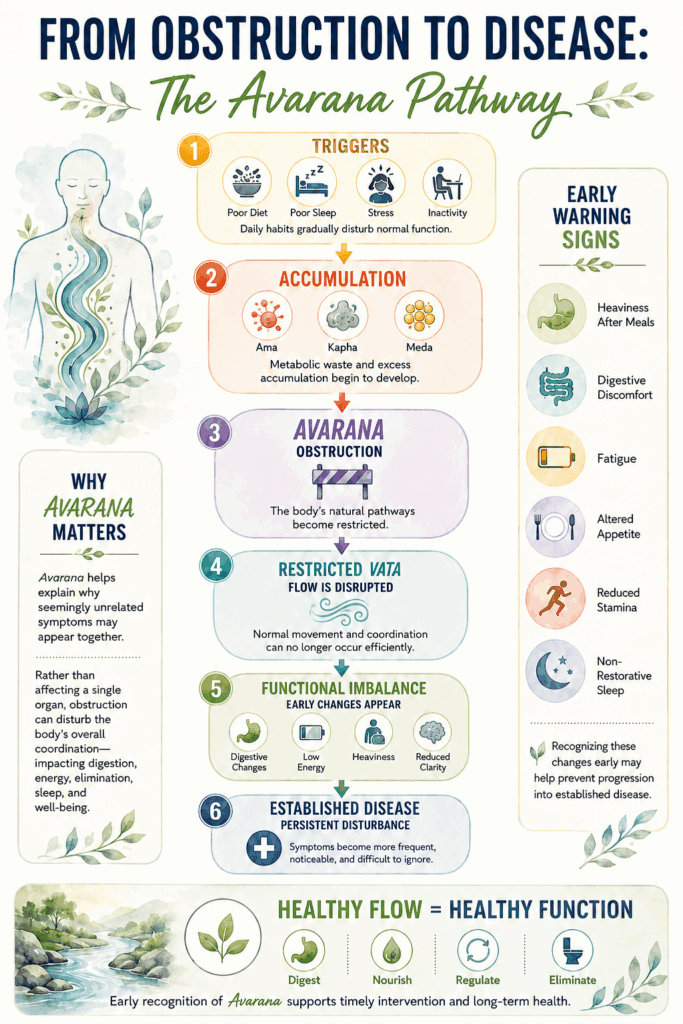
Avarana usually does not appear suddenly. It tends to develop slowly over time. Habits such as irregular eating, frequent heavy and oily food intake, lack of physical activity, disturbed sleep, and long periods of stress gradually begin affecting normal body function.
Because of this, Kapha, Meda Dhatu (fat tissue), and Ama (undigested metabolic waste) begin to increase. At this stage, there is no structural disease yet, only a functional imbalance. As these factors build up, they start blocking or disturbing the normal movement of Vata. This is the main event in Avarana. Vata cannot move properly or perform its normal functions. Digestion, movement, and regulation start becoming less coordinated.
If this continues for a longer time, the disturbance slowly spreads deeper and affects body tissues (Dhatu). Over time, what begins as a mild functional problem can become a more stable disease pattern.
The clinical features of Avarana are usually mixed and do not point to a single system in the early stage. Patients often present with more than one complaint at the same time.
In the beginning, symptoms are mild and may come and go. A person may complain of heaviness after meals, mild digestive discomfort, changes in appetite, or a feeling that food is not being digested properly. Some may also report feeling fatigued more often than usual or say that sleep does not feel refreshing even after adequate rest. In the early stage, people usually ignore these mild complaints because they do not clearly point toward a particular disease.
As the disturbance continues, symptoms may start appearing more regularly. Digestive changes, altered bowel habits, heaviness of the body, reduced stamina, and difficulty maintaining the same level of daily activity can begin occurring together. Some individuals may also notice reduced concentration or a general sense of sluggishness.
In later stages, these symptoms become more persistent and start affecting day-to-day routine more noticeably. For example, in chronic conditions like established diabetes or fatty liver disease, fatigue, digestive disturbance, and reduced activity tolerance may remain persistent rather than intermittent.
Avarana may be confused with simple aggravation of Vata or with Srotorodha (obstruction of channels). In increased Vata states, symptoms often reflect excessive movement or instability. Pain may shift location, dryness becomes prominent, sleep may become irregular, and anxiety, tremors, or variable symptoms may occur.
A simple way to understand the difference is through a traffic analogy. Vata vriddhi (increased Vata) is like vehicles moving too fast or erratically on a road. In contrast, Avarana is like a traffic jam—movement is still present, but it cannot proceed smoothly because something is obstructing it.
Similarly, Srotorodha refers more directly to blockage within channels. Avarana extends beyond simple blockage and includes functional suppression, where one physiological component interferes with the normal activity of another. This distinction is clinically important because treatment aimed only at increasing movement may sometimes worsen symptoms if the underlying obstruction remains unaddressed.
Management of Avarana begins with identifying the relationship between the obstructing factor and the obstructed function. Treatment decisions are guided by mechanism rather than symptoms alone.
Dietary recommendations vary according to the dominant pattern. Patients with Kapha-related obstruction often require measures that reduce heaviness and improve digestive activity. Patients demonstrating tissue depletion may require nourishment and support.
Lifestyle planning also depends upon presentation. Physical activity may benefit patients experiencing stagnation and reduced movement. In another patient with depletion and pronounced Vata disturbance, aggressive exercise may increase symptoms. Panchakarma (purificatory therapeutic procedures) occupies an important place in management. Among these procedures, Vasti (medicated enema therapy) receives considerable emphasis because of its role in regulating Vata. Different forms are selected according to clinical need.
Medicine selection also follows the mechanism involved in Avarana rather than symptom relief alone. The first consideration is identifying the Avaraka (obstructing factor) and Avruta (obstructed component). When Kapha, Meda Dhatu (fat tissue), or Ama are dominant, medicines that help reduce these factors and clear Srotas (functional channels and pathways) may be selected while supporting normal Vata function. In other situations where tissue depletion or weakness becomes more prominent, treatment may focus on supporting Dhatu (body tissues) while restoring normal movement and regulation.
Long-term management usually extends beyond immediate symptom reduction. Attention is directed toward maintaining Agni, reducing factors that aggravate Dosha, supporting proper nourishment of Dhatu, and preventing the recurrence of Avarana-related disturbances.
Avarana becomes important in disease prevention because many disorders do not begin suddenly. Before a recognisable disease appears, early changes may develop in normal physiological function. Mild digestive discomfort, altered appetite, irregular bowel habits, unexplained tiredness, heaviness of the body, or disturbed sleep may appear long before a stable disease pattern becomes evident.
Ayurveda considers such findings important because they can indicate early disturbance involving Vata and the gradual influence of factors such as Kapha, Meda Dhatu, or Ama. At this stage, the disturbance may still be functional and reversible. Recognising these changes early helps identify imbalances before they develop into a clearer disease pattern.
As we work hard to improve our services, your feedback is important to us. Please take a moment to help us serve you better.
Subscribe to our hospital newsletter for the latest health tips, updates on services, patient stories, and community events. Sign up today and stay informed!

Report Problem
Popular Searches: DiseasesTreatmentsDoctorsHospitalsWhole person careRefer a patientInsurance

