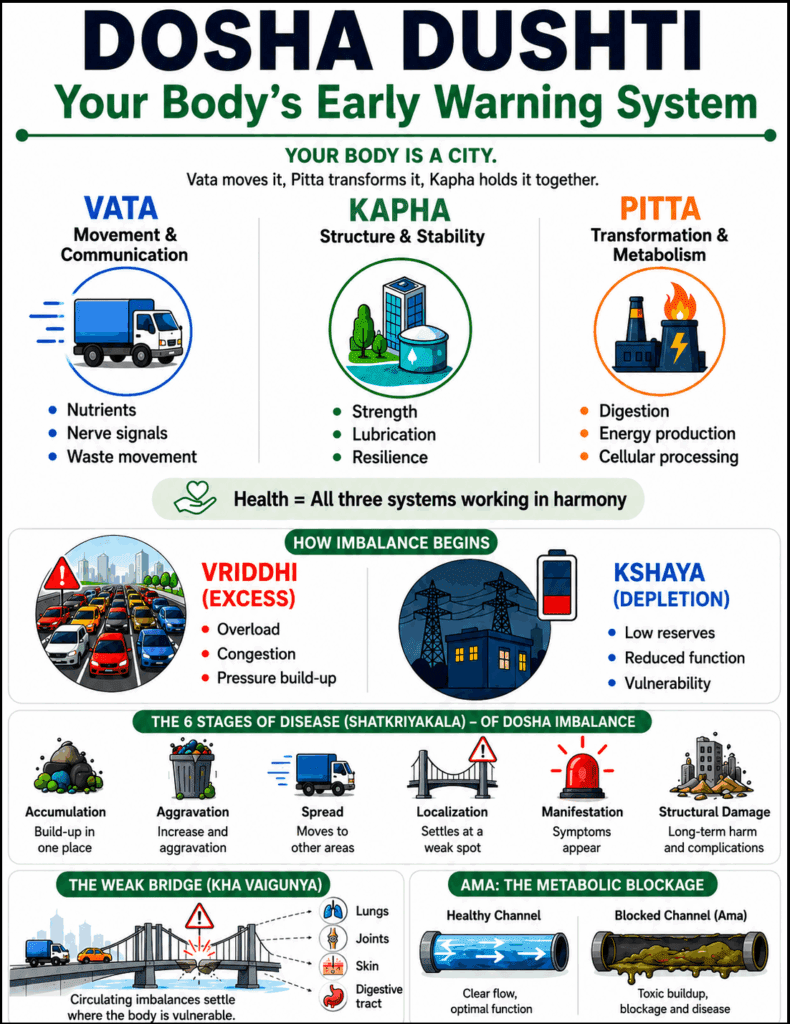
Ayurveda explains disease progression through Shatkriyakala, the six stages of pathology.
1. Sanchaya — accumulation in one district
This is like waste that begins to collect in one neighbourhood. It has not spread across the city yet, but the signs are there.
In the body, a Dosha begins to build up in its seat. There may be mild heaviness, slight food intolerance, or a vague discomfort. Nothing seems serious, but the system is already shifting.
2. Prakopa — the overflow starts
The garbage piles up more. The dumpsters are full. The pressure in that district rises.
In the body, the Dosha becomes aggravated. Symptoms begin to show more clearly—an acidic feeling, bloating, irritability, congestion, or restlessness depending on which Dosha is disturbed.
3. Prasara — the spilled cargo spreads
This is the stage of overflow. Once the local site can no longer contain the waste, it begins spreading into other parts of the city.
Here Vata becomes extremely important. Vata is the transport system, so when it is aggravated, it behaves like a fleet of trucks carrying polluted material through the main highways and into other districts. The disturbed Dosha does not remain local anymore. It begins moving throughout the body.
A classic Ayurveda simile helps here: just as fermenting dough overflows from its vessel, the aggravated Dosha spills beyond its original place. This is not a random movement. Vata directs it.
4. Sthana Samshraya — the weak bridge
This is the most important turning point. A city under stress will not fail equally everywhere. It fails first at the weak bridge, the rusty drainage pipe, or the damaged power junction.
Ayurveda calls this weak spot Kha Vaigunya. As the disturbed Doshas circulate, they settle where there is vulnerability. If the weak point is the lungs, the person may develop respiratory symptoms. If it is the joints, pain and stiffness may begin. If it is the skin, irritation or eruptions may appear.
This stage is where Dosha and Dushya begin to interact. ‘Dushya’ refers to the bodily elements that are susceptible to being vitiated or disturbed by imbalanced Doshas. They areDhatus (tissues), upadhatus (sub tissues), Mala (waste products),srotas(channels) andOjas (Vital energy). When the Dosha is disturbed, these dushyas become vulnerable, and disease starts taking shape.
5. Vyakti — the city-wide alert
Now the problem becomes obvious. The bridge collapses, traffic is blocked, and the whole city knows something is wrong.
This is the stage of full manifestation. The disease is now clinically recognisable. A doctor can now name the condition.
6. Bheda — structural damage
If the collapse is ignored, the damage spreads. Nearby roads crack, drainage worsens, and the affected district suffers long-term harm.
In the body, this is the stage of complications, chronicity, and deeper tissue damage.
What causes Dosha Dushti?
In Ayurveda, causes are called Nidana. These are the factors that disturb the body’s balance.
A city does not deteriorate overnight. It usually falls into crisis because of repeated neglect. The same is true in the body.
Vata becomes disturbed with irregular meals, excess travel, fear, sleep deprivation, overwork, cold exposure, and lack of routine.
Pitta becomes disturbed with spicy, sour, and salty food, excess heat, fasting, anger, and irritants.
Kapha becomes disturbed with overeating, too much sleep, heavy and oily foods, sweets, dairy overload and inactivity.
These triggers are like repeated pressure on a city’s infrastructure. Over time, the system starts to fail.