Patients seek treatment for obesity for different reasons. Some are concerned about weight gain itself. Others are more troubled by what it is beginning to affect. Excess weight can make everyday activities more difficult than they once were. Walking longer distances becomes tiring. Climbing stairs takes more effort. In some people, the first complaint is simply that their knees no longer feel the same. Getting up from the floor feels harder. A short walk that was previously routine leaves them uncomfortable. The effects are not limited to the joints. Diabetes, fatty liver disease, elevated cholesterol, and insulin resistance often accompany obesity. In many cases, these conditions are already present by the time weight becomes a major concern. One issue often seems to lead to another. In practice, these problems tend to overlap.
Ayurveda discusses obesity under the conditions of Sthaulya and Medoroga (fat metabolism disorder). The discussion extends beyond body weight alone. It considers how excess fat accumulation develops, why it tends to persist, and why joint pain and metabolic disorders so often accompany it.
Why Obesity is a Contributor to Joint Pain
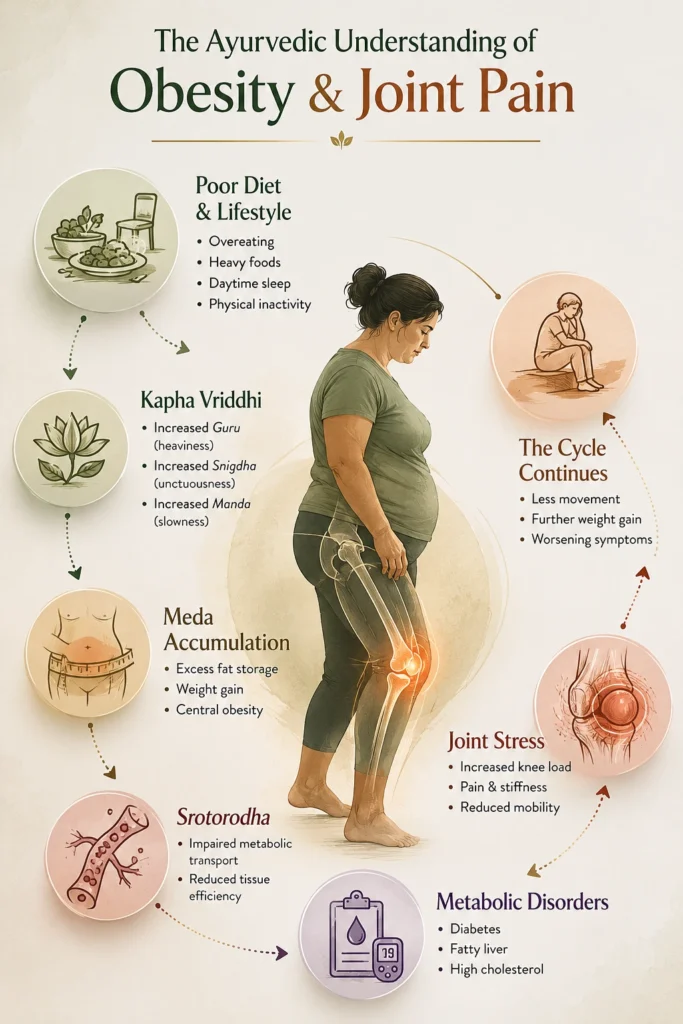
Patients often think of joint pain and weight gain as separate issues. In practice, they are frequently linked. Excess body weight places additional mechanical stress on the knees, hips, ankles, and lower back every day. The body can compensate for a while. Eventually, symptoms begin to appear. At first, it may be mild discomfort. Then, climbing stairs becomes difficult. Walking distances become shorter. People start avoiding certain movements without even realising it.
This reduction in movement creates another problem. Lower activity levels mean lower energy expenditure. Weight gain may continue, which places even greater strain on the joints. The cycle feeds itself. For this reason, discussions around obesity and joint pain in Ayurveda are not limited to pain management alone. The factors contributing to weight gain also need attention.

The Medoroga Framework — Understanding Medo Dhatu
The word ‘Medo’ is derived from the Sanskrit root ‘mid snehane’, referring to unctuousness or lubrication. In normal quantities, Medo Dhatu serves several physiological functions. It provides cushioning, contributes to lubrication, supports energy storage, and helps maintain structural integrity. The problem is not the existence of Medo. The problem is the excess accumulation and impaired metabolism of Medo.
Ayurveda recognises that tissues are continuously formed and nourished through a process called ‘Dhatu Poshana’. When this process becomes disturbed, excess Meda may begin to accumulate. Medovriddhi, or an increase in Meda Dhatu, is often most noticeable around the abdomen, flanks, and thighs. Patients do not usually describe this in Ayurveda terms, of course. They may simply say that most of the weight seems to settle around the waist or that clothes fit differently despite no major change in routine. A feeling of heaviness is another recurring feature. Excess sweating is also commonly noted. Not every person experiences these changes to the same degree, but they appear often enough to be repeatedly associated with Medovriddhi.
This leads to another important concept: Srotorodha, or obstruction of body channels. As excess Meda accumulates, normal physiological transport is thought to become less efficient. Nutrients may not reach tissues as effectively as they should, despite there being an overall excess of stored energy. Disturbed Meda is also closely associated with a group of metabolic disorders that includes diabetes. Ayurveda, therefore, describes severe obesity as more than a weight issue. The concern is the broader effect of Medovriddhi on metabolism, mobility, and long-term health.
How Excess Kapha Contributes to Weight Gain
Obesity rarely develops for a single reason. In one person, long hours of sitting may be a major factor. In another, irregular sleep, frequent snacking, or years of reduced physical activity may play a larger role. Sometimes, people notice the weight gain only in hindsight because it appears gradual. Within the Ayurveda framework, Kapha is associated with qualities such as guru (heaviness), snigdha (unctuousness), manda (slowness), and sthira (stability). These are normal physiological qualities. In fact, they are necessary. The difficulty begins when Kapha increases beyond what the body requires.
Factors linked with Kapha Vriddhi include overeating, frequent consumption of heavy foods, inadequate physical activity, excessive daytime sleep, and prolonged sedentary habits. Modern lifestyles often contain more than one of these factors at the same time. As Kapha increases, the accumulation of Meda Dhatu becomes more likely. At the same time, metabolic efficiency may begin to decline. The result is not simply greater fat accumulation but a gradual shift towards reduced utilisation of stored energy.
This is one reason weight gain can become difficult to reverse once established. Weight gain usually does not develop because of one meal or a few weeks of reduced activity. Often, the contributing factors have been present for years. People usually notice the result before they notice the process.
This is where the concept of Medoroga becomes useful. Rather than viewing weight gain as an isolated problem, it considers excess Kapha, accumulation of Meda, and metabolic changes as parts of the same picture.
Why Simply Eating Less Is Often Not Enough
Most overweight individuals have attempted weight loss before seeking Ayurveda care. Some have followed calorie-restricted diets. Others have joined gyms, tried intermittent fasting, or followed online weight loss programmes. A number of them initially lose weight. Maintaining the loss is usually the difficult part.
This is where the Ayurveda assessment and the Precision Ayurveda approach differ from many conventional weight-loss programmes. Rather than focusing only on calorie intake, attention is also given to digestive function, appetite regulation, meal timing, physical activity, sleep quality, and associated metabolic conditions. Two patients weighing the same amount may not require the same treatment approach. That becomes clear rapidly during the consultation.
Ayurveda Diet Plan for Weight Loss
When patients ask about an Ayurvedic diet for weight loss, they often expect a rigid list of permitted and prohibited foods. The reality is usually less dramatic. Meal timing matters. Portion size matters. Food quality matters. The tendency to snack constantly or eat heavy meals late at night matters as well. Many people searching for how to lose weight with Ayurveda find that some of the most important recommendations are simple. Regular meal schedules. Adequate sleep. Consistent physical activity. Reducing highly processed foods. These changes sound simple when written on paper. Following them consistently is another matter. That is often where long-term success or failure is decided.
Weight Loss and Joint Pain: What Changes First?
Patients commonly assume that significant weight loss must occur before joint symptoms improve. That is not always what happens. In clinical practice, improvements in movement sometimes appear before substantial changes on the weighing scale. A patient begins walking longer distances. Stair climbing becomes less intimidating. Morning stiffness settles more quickly. Confidence in movement returns. These changes may seem small, but they are important because they encourage further activity.
Research has shown that every kilogram of body weight lost reduces the load transmitted through the knee joint during daily activities. For patients with osteoarthritis, this relationship is particularly relevant. Less load generally means less stress on already vulnerable joints.
Panchakarma for Weight Loss: Virechana and Udvartana
Panchakarma is sometimes incorporated into obesity management, although not every patient requires it. Among the procedures traditionally considered are Virechana and Udvartana. Virechana is a medicated purgation used in selected patients to address dosha imbalance and metabolic dysfunction. Udvartana is a dry herbal powder massage performed with firm strokes over the body and is traditionally used in conditions involving excess Kapha and Meda.
The purpose is not rapid weight reduction. Nor should these procedures be viewed as a replacement for dietary correction and physical activity. Patient selection remains important. Age, strength, digestive status, associated diseases, medications, and treatment goals all influence whether Panchakarma is appropriate. In practice, the best outcomes usually occur when therapies are combined with sustained lifestyle modification rather than used in isolation.
A Note on Ayurvedic Medicines
Many online searches focus on Ayurvedic medicine for weight loss. Patients often arrive with a list of products they have already researched. The assumption is understandable. Most people hope there is a single medicine capable of solving the problem. Obesity rarely works that way.
In Ayurveda, medicines are selected after assessing the individual rather than the diagnosis alone. Digestive capacity, associated diseases, constitution, appetite patterns, and current medications all influence treatment decisions. A formulation that is appropriate for one patient may not be appropriate for another.
Important Precaution: Ayurveda medicines should not be started solely based on information found online. Individuals with diabetes, thyroid disorders, fatty liver disease, cardiovascular disease, or kidney disease or those taking prescription medication should consult a qualified Ayurveda physician before beginning treatment. Self-medication, even with commonly discussed herbal formulations, is not advisable.
Looking Beyond the Weighing Scale
One of the more interesting observations in obesity management is that patients often define success differently from clinicians. A doctor may note changes in weight, waist circumference, blood sugar levels, or lipid profile. Patients frequently talk about something else. They mention being able to walk comfortably again. They talk about climbing stairs without stopping midway. They describe having more energy in the afternoon. Those outcomes matter.
The Ayurveda understanding of obesity is ultimately concerned with function. Body weight is important, but it is only one part of a larger clinical picture involving metabolism, mobility, digestion, and long-term health.
That is why Ayurveda weight loss and Ayurvedic weight loss treatment focus not only on reducing excess weight but also on addressing the factors that contributed to it in the first place. For patients living with obesity, joint pain, and metabolic disorders, that broader approach is often where meaningful improvement begins.
References