International Women’s Day 2026: Give to Gain

Table of Contents
Happy International Women’s Day. The 2026 International Women’s Day theme — Give to Gain — speaks to a principle: the body only rewards what we consistently give it. In Ayurveda, “giving” is not charity; it is disciplined care — the small, repeated habits that become the difference between resilience and chronic disease. As we mark International Women’s Day, here is a guide for women to convert the theme Give to Gain into everyday health practices that respect life stages, physiology and modern realities.

Why giving matters now

Women today carry many burdens—professional, familial, and social. This empowerment, while transformative, often comes with a physiological cost: disrupted sleep, irregular meals, chronic stress and sedentary time. These habits precipitate Srotoavarodha (micro-channel blockage), agnimandya (impaired digestive fire) and progressive dosha imbalance. Clinically, we see increasing  PCOSmenstrual irregularities, infertility, fatigue syndromes, and metabolic diseases. To live up to the International Women’s Day theme, women must first give themselves permission and practical tools to prioritise restorative care—that is the precondition for gaining sustained vitality.

Principles of Ayurveda intervention

Ayurveda approaches women’s health across three concentric aims: stop harm (mitigation), correct dysfunction (restoration) and strengthen resilience (rejuvenation). Each “gift” to the body is targeted:

Detox and reset
When channels are blocked by ama, the physiology miscommunicates. A staged Shodhana protocol, starting gently with Pachana (digestive correction) and moving on to targeted Shodhana when indicated, clears obstruction and restores hormonal signalling. For conditions like PCOS, these practices may reduce insulin resistance and improve ovulatory patterns. Clinical protocols with dietary changes reduce inflammation and improve reproductive health.

Reproductive optimisation
Infertility benefits more from preparation than from last-minute interventions. Ritumati Paricharya (menstrual regimens) prepares the body rhythmically. Vasti therapies modulate Apana Vata and local pelvic circulation. Dietary correction and Rasayana measures improve endometrial receptivity. Giving the body months of structured support before conception reliably increases the probability of a healthy pregnancy and reduces early pregnancy loss.

Mental fitness
Stress is both a symptom and a driver of disorder. Simple daily investments — 20–30 minutes of pranayama, short meditations, and counselling where needed — balance Vata and stabilise mood. These practices are low-cost, high-return gifts: improved sleep, better digestion and clearer decision-making.

Lifecycle-specific Paricharyas —for lifelong gain

Ayurveda divides womanhood into distinct stages — Bala, Kumari, Rajaswala, Ritumati, Garbhini, Sutika, and Rajonivrutti. The “Give to Gain” philosophy is best expressed through Paricharyas—specific diet and lifestyle modifications for different life stages.
  • Bala (childhood) — Care for girl child with wholesome foods, sleep, routine, and immunomodulatory care. Childhood lays the foundation for digestive power (agni) and tissue formation.
  • Kumari (adolescence) — Educate and counsel girls on menstrual health, nutrition, and emotional stability. Stabilise Vata and Pitta with warm and regular meals, stress management, and proper hygiene to ensure normal and predictable cycles.
  • Rajaswala (menstruating female) — For the first three days of menstruation, women need to “give” rest and light, warm, and easily digestible foods to their bodies. These practices help you to “gain” Apana Vata balance and prevent conditions like PCOS and other menstrual disorders.
  • Ritumati (fertile years) — Lead a routine life with a nutritious diet and moderate exercise. Seasonal and personalised Paricharya optimise ovulatory function and reproductive resilience.
  • Garbhini (pregnancy) — Focus on high-quality nutrition (ghee, milk, seasonal produce), emotional support and avoidance of toxins. Gentle, supervised therapies and close monitoring protect maternal reserves. “Giving” the mind positive emotions and “giving” the body nutrient-rich foods ensures the optimal development of the fetus as well.
  • Sutika (post-natal) — Prioritise tissue replenishment, lactation support and Vata pacification. Structured rest, nourishing diets and gradual returns to activity prevent Dhatukshaya and chronic weakness.
  • Rajonivrutti (menopause) — Approach menopause as a natural transition. By “giving” the body phytoestrogen-rich herbs, women can “gain” relief from hot flashes and protect themselves against post-menopausal osteoporosis and cardiovascular disease while managing rising Vata and tissue depletion (Dhatukshaya).
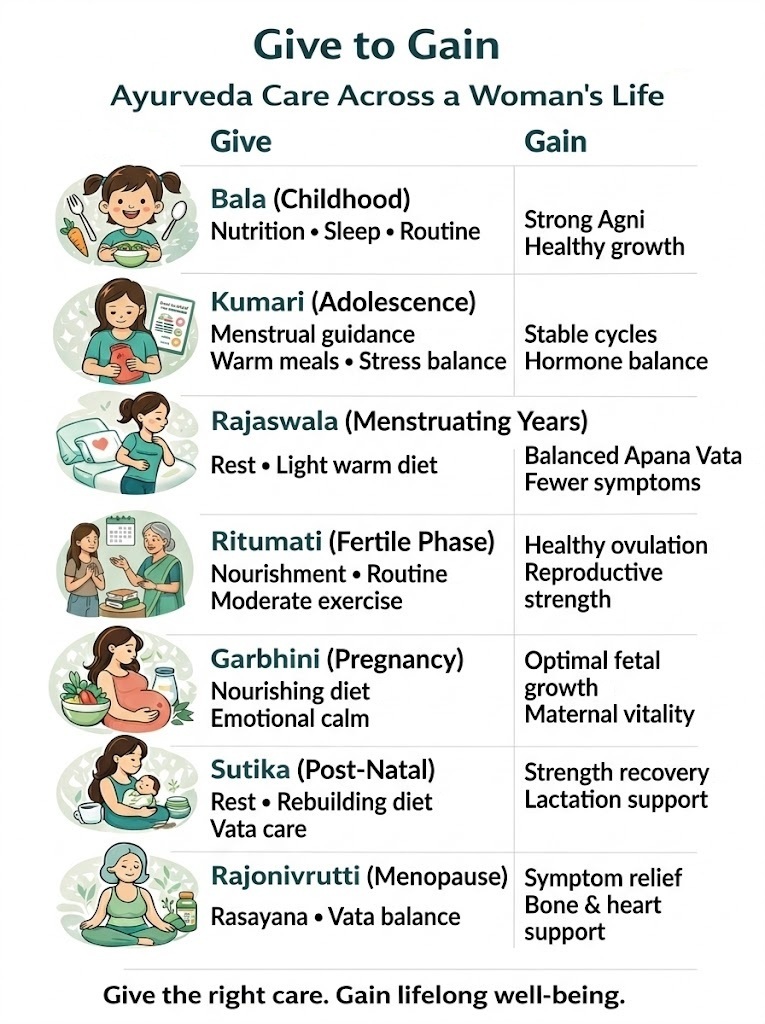
These are practical, evidence-informed tools that provide tailored approaches for different stages of a woman’s life. When followed with consistency and individualisation, it protects reproductive health, reduces chronic disease risks, and sustains overall well-being throughout a woman’s life.

Rasayana — the strategic long-term gift

Rasayana therapies and selective herbs are physiological investments that preserve musculoskeletal integrity, hormonal balance and cognitive resilience. In middle age, regular Rasayana measures reduce frailty, help maintain bone mass, and support lipid and glucose homeostasis.

Insurance Backed

Precision Ayurveda
Medical Care

Translating principles into practice

How does a busy woman “give” without feeling she must add another burden? Start small and make it sustainable.

  • Morning: warm water, 5 -10 minutes of pranayama, and a balanced breakfast to kindle agni.
  • Midday: mindful meal, short walk, and hydration.
  • Evening: screen curfew one hour before bed, a light warm dinner and 10–15 minutes of restorative yoga or meditation.
  • Weekly: at least two sessions of moderate physical activity and one social or creative activity for emotional renewal.
  • Quarterly: clinical check-ins for menstrual health, metabolic markers, and mental health screening.
  •  

Apollo AyurVAID for Women

Our strength is individualised long-term care. When integrated with modern diagnostics such as hormonal assays, metabolic panels, and imaging, the combined approach often yields measurable improvements in cycle regularity, metabolic indices and quality of life. We do not replace modern care. We augment it with lifestyle medicine and age-old protocols that have stood the test of empirical clinical application.


Conclusion

Happy International Women’s Day. The international women’s day theme Give to Gaininvites both cultural and personal movement. Give your body time, rhythm and nutrition. Give it the discipline of daily practices. Give it the rest. Gain decades of functional capacity, stronger bones, clearer minds and a life lived with grace. Let this International Women’s Day be the start of a lifelong promise – give well, and gain deeply.

References

Gujarathi JR, Gujarathi R. Maintaining women health through Ayurveda – a review study. Int Ayu Med J. 2019;7(11):2076-2080.
Baroi M, Goswami DK. An Ayurvedic review on Rajaswala Paricharya. Int J Ayu Pharm Chem. 2022;16(2):142-150.
Jafar M, Swati S, Gupta V. Ayurvedic management of Polycystic Ovarian Syndrome (PCOS) with submucous uterine fibroid in obese patient – a case report. Int J AYUSH CaRe. 2024;8(2):177-184.
Dhimar D, Janghel SK, Bhagat P. A review study: role of Ayurveda in women’s life. World J Pharm Med Res. 2022;8(6).
Karande AC, Nandurkar V, Belge R. From classical texts to laboratory validation: safety profile of Ayurvedic vaginal therapeutics. Int J Multidiscip Res. 2024;6(2).

FAQ

Which supplement is best for women's health?
There is no single “best” supplement for all women—the right choice is always individualised based on age, life stage, diet, health status, and specific concerns. A well-formulated, high-quality supplement tailored to personal needs can effectively support hormonal balance, energy, immunity, and overall well-being when combined with a healthy lifestyle.
How is Ayurveda treated for PCOS?
Ayurveda manages Polycystic Ovarian Syndrome (PCOS) through Shodhana (detoxification) and Shamana (balancing) therapies aimed at clearing channel obstructions and improving metabolism. Key treatments include weight management, a Vata-Kapha pacifying diet, and the use of phytoestrogenic herbs to restore regular ovulation and hormonal harmony.
How to treat hormonal imbalance in Ayurveda?
Hormonal imbalances are treated by correcting Dosha vitiation through customised diet modifications (Paricharya), internal detoxification via Panchakarma, and the use of rejuvenative Rasayana herbs. Integrating yoga and meditation is also vital to stabilise the endocrine system by reducing mental stress, which is a primary cause of physical Dosha disturbances.
Why is 8 March women's day?
March 8th was officially designated to commemorate the 1917 demonstrations by women in Petrograd during the Russian Revolution, which played a critical role in the overthrow of the monarchy. This date has since become a global symbol for women's fight for equality, liberation, and the recognition of their socio-political achievements.
When was National women's day in India?
National Women's Day in India is celebrated on February 13th annually to honour the birth anniversary of Sarojini Naidu, the "Nightingale of India", for her contributions to women's rights and the independence movement.
Why purple for Women's Day?
Purple is traditionally used for International Women's Day because it symbolises justice, dignity, and loyalty toward the cause of gender equality. It is a colour that represents "unwavering firmness" toward a cause within the global feminist struggle.
What is the theme for Women's Day 2026?
The official International Women's Day theme for 2026 is "Give to Gain," which highlights the power of reciprocity, generosity, and collaboration to forge gender equality.
What are the colours for International Women's Day in 2026?
While various colours like purple, green, and white are historically associated with the movement, purple remains the primary symbolic colour representing the firm pursuit of justice.

Leave a Reply

Your email address will not be published. Required fields are marked *

Homepage B RCB

Please fill out the form below to Request a call back

Patient details

Select Preferred Center

Table of Contents
Latest Post
Blog Images part 2 (91)
PMS Diet in Ayurveda: Foods to Eat and Avoid
Blog Images part 2 (90)
Signs of Hormonal Imbalance in Women: What Your Body May Be Trying to Tell You
Blog Images part 2 (89)
Menopause Symptoms: Early Signs Every Woman Should Know
AyurVAID Shop
Book a consultation now

Consult our Ayurvedic doctor with 20+ Years of experience &
Insurance Approved Treatment

Homepage B RCB

Please fill out the form below to Request a call back

Patient details

Select Preferred Center

Popular Searches: DiseasesTreatmentsDoctorsHospitalsWhole person careRefer a patientInsurance

Hours of Operation:
8am – 8pm (Mon-Sat)
8am – 5pm (Sun)

Follow Apollo AyurVAID hospitals