Monsoon is when mosquito-related illnesses become a familiar concern in many households. A few days of rain can leave water collected in plant pots, open containers, construction sites and drains, creating breeding conditions for mosquitoes. Soon after, clinics begin seeing more people with fever, body ache, headache, weakness and loss of appetite.
The difficulty is that dengue, malaria and chikungunya can look similar in the beginning. A person may have fever and assume it is an ordinary seasonal infection, only to find that the illness needs closer monitoring. This is why prevention during monsoon needs to begin before fever appears.
Ayurveda offers a useful way of looking at prevention. Along with protecting against mosquito bites, it considers the individual’s digestion, strength, seasonal adaptation and early changes in health. This broader approach forms an important part of mosquito-borne disease Ayurveda prevention, while medical testing and appropriate treatment remain essential whenever infection is suspected.

Prevention Starts Outside the Body
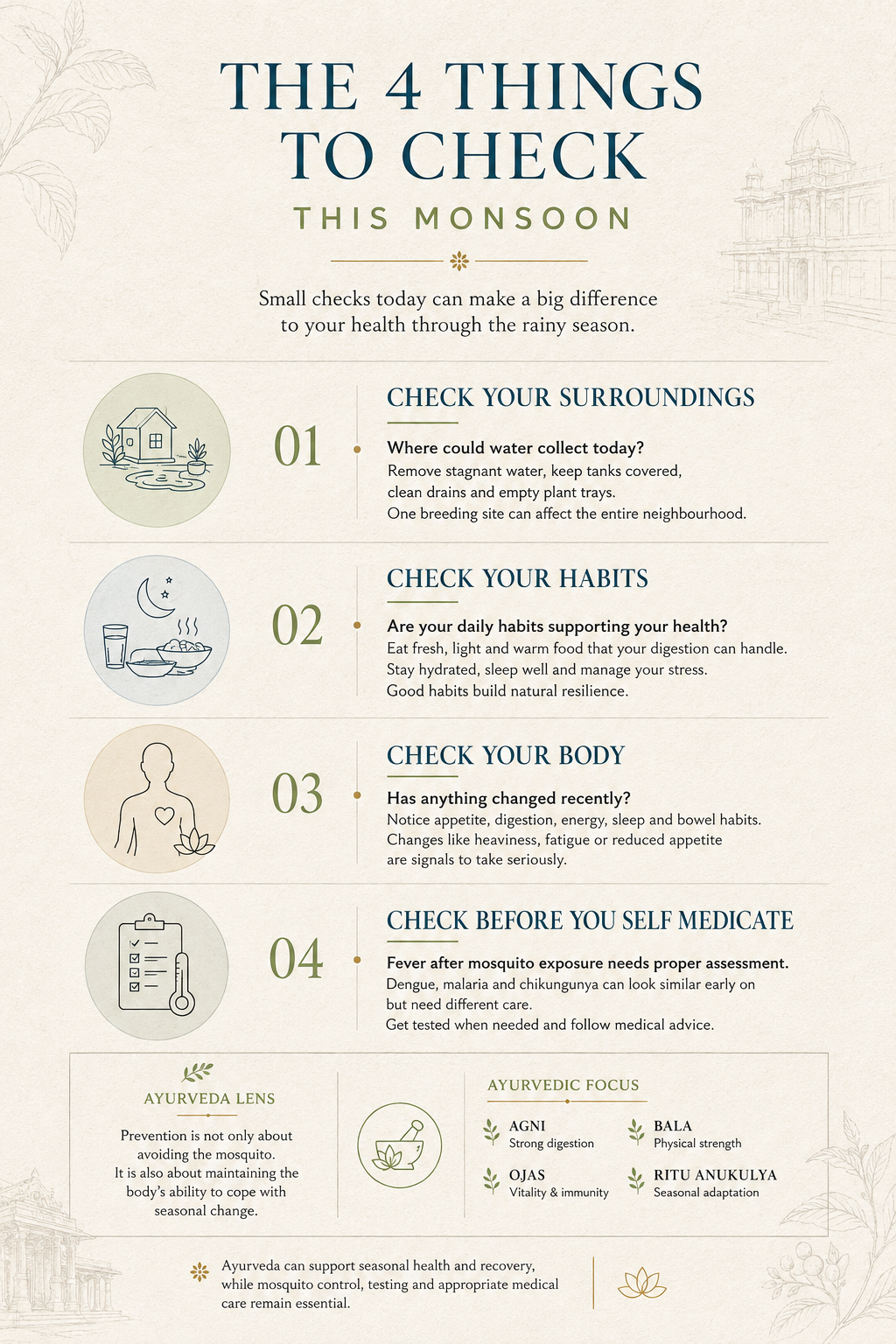
The first question during mosquito season should be very practical: where are the mosquitoes breeding? Removing stagnant water, keeping tanks covered, cleaning drains, emptying plant trays and avoiding accumulation of water around the home are simple measures, but they are among the most important.
Dengue and chikungunya are mainly transmitted by Aedes mosquitoes, which can bite during the daytime. Malaria is transmitted by infected Anopheles mosquitoes. Because their behaviour differs, protection should not be limited to sleeping hours.
Mosquito nets, window screens, suitable repellents and clothing that covers exposed skin can reduce bites. Community-level measures are equally important because a breeding site outside one home can still affect the entire neighbourhood. Ayurveda prevention begins alongside this rather than instead of it.
What Ayurveda Looks At Before Illness
In Ayurveda, prevention is closely connected to the person’s ability to maintain normal function when circumstances change.
During Varsha Ritu, or the rainy season, digestion becomes unpredictable. Appetite reduces, food feels heavy, bowel movements may change, and tiredness can become more noticeable.Vata is aggravated during this period, whilePitta that has accumulated earlier also becomes disturbed. This matters becausedigestion has a direct bearing on nourishment, energy and strength.
When Agni is impaired, symptoms such as poor appetite, heaviness, a coated tongue, indigestion, lethargy or incomplete bowel evacuation appear. Ayurveda describes these asAma Lakshanas, indicating digestion and metabolism are not functioning optimally.
This is particularly relevant during an infection. The body needs adequate nourishment and strength to cope with illness and recover afterwards. When appetite and digestion are already compromised, weakness and depletion can become more pronounced, and recovery may take longer. At the same time, these symptoms should not be interpreted as early signs of dengue, malaria or chikungunya. Poor appetite, heaviness or a coated tongue are nonspecific and cannot establish the presence of a mosquito-borne infection. They are considered along with the person’s overall health, exposure, symptoms and clinical findings when an Ayurveda physician assesses the need for preventive or supportive care.
Dengue: Why Prevention Cannot Be Reduced to Immunity
Dengue is a viral infection spread by infected Aedes mosquitoes. It may begin with fever, headache, body pain, weakness, nausea and sometimes a rash. There is understandable interest in “boosting immunity” during dengue season. Ayurveda does consider the body’s strength and resistance important, but this is not simply a matter of taking an immunity booster.
A physician may consider Bala (body strength), digestion, sleep, nutrition, constitution and existing illnesses when assessing preventive care.
(vitality and immunity) is also part of this broader Ayurveda understanding of strength. The focus is therefore on understanding what may be affecting the person’s overall resilience rather than assuming that one immunity product is appropriate for everyone. For one person, correcting irregular meals and poor digestion may be important. For another, inadequate sleep, overwork or an existing health problem may need attention. Someone recovering from a previous infection may need a different plan altogether.
Ayurveda medicines may be considered when clinically appropriate, but there is no justification for taking several herbal preparations simply because dengue cases are increasing.
Early Changes After Mosquito Exposure
One aspect of the Ayurveda approach is paying attention to subtle changes rather than waiting for a severe symptom. After mosquito exposure, a person may notice reduced appetite, heaviness, unusual tiredness, sour belching, constipation or a coated tongue. In Ayurveda, these may be assessed as signs of Ama. They are not specific to dengue and should never be presented as proof of infection.
If fever subsequently develops, the clinical picture changes. Dengue, malaria, chikungunya and other infections need to be considered, and appropriate investigations may be required. This is where Ayurveda and modern medicine should work together. Ayurveda can assess the person’s digestive and systemic state, while laboratory testing establishes what infection is actually present.
When Dengue Becomes a Medical Emergency
Dengue needs particular caution because a patient can appear to improve when the fever begins to settle and still develop complications. Severe abdominal pain, persistent vomiting, bleeding, breathing difficulty, marked restlessness or drowsiness, reduced urine output, cold or clammy skin or sudden deterioration require urgent medical attention.
Platelet numbers are often discussed by families, but a platelet count alone does not tell the complete story. Hydration, blood investigations and the patient’s overall clinical condition need to be monitored. Ayurveda treatment should never be used as a reason to postpone such care. Where appropriate, Precision Ayurveda may be used as supportive care under physician supervision, particularly around digestion, diet, strength and recovery.
Malaria: Fever With Chills Should Be Investigated
Malaria has a different cause. It is caused by Plasmodium parasites transmitted by infected Anopheles mosquitoes. Fever, chills, sweating, headache and weakness are common, but the presentation can vary. In areas where malaria is prevalent, fever after mosquito exposure should therefore not be dismissed.
Ayurveda has a detailed clinical understanding of Jwara, or fever. The physician looks at the quality of fever along with appetite, thirst, digestion, body ache, heaviness, bowel function and other associated symptoms. This assessment can help understand the clinical pattern and guide supportive care, while testing remains necessary to confirm malaria.
Once malaria is confirmed, appropriate antimalarial treatment is necessary. Ayurveda care can have a supportive role in maintaining nutrition and digestion and in helping the person regain strength after the acute illness.
Chikungunya: The Illness May Continue After the Fever
Chikungunya often has a different challenge. Fever may settle, but joint pain and stiffness can remain. A person who was unable to work for several days may return to normal activities as soon as the fever disappears, only to discover that the body has not recovered at the same pace. This is where the recovery phase becomes important.
Once the acute infection has been assessed, an Ayurveda physician may evaluate the remaining joint symptoms along with digestion, sleep, strength and functional capacity. The recovery plan may include internal medicines, external therapies, diet, and graded activity, depending on the individual. The aim is to restore function rather than simply wait for the pain to disappear.
What Belongs in an Ayurveda Monsoon Kit?
A monsoon kit can include carefully selected Ayurveda medicines or formulations, alongside a few practical habits that support health through the season. The medicines need not be the same for everyone; their selection can be guided by an AyurVAID physician based on individual health needs and seasonal requirements.
Freshly prepared food is preferable to stale or repeatedly reheated food when digestion is weak. Warm meals may be easier to tolerate than very cold foods and drinks. If appetite is reduced, smaller meals may be better than forcing large portions. Rice, moong, light khichdi, soups and cooked vegetables can provide nourishment without placing excessive demand on digestion. Ginger, cumin or coriander may be used in food according to individual tolerance. Adequate sleep is equally important. A person who is already exhausted, eating irregularly and sleeping poorly is unlikely to benefit simply from adding another herbal product. Ayurveda preventive care is therefore about improving the overall terrain rather than chasing a single symptom.
A thoughtfully prepared AyurVAID monsoon kit complements this approach, with medicines or formulations selected according to the individual’s health needs rather than used routinely. The contents can be decided after consultation with an AyurVAID physician, making the kit a more personalised form of seasonal preparedness.
Can Dhoopana Help?
Dhoopana, or medicinal fumigation, is another traditional Ayurveda environmental practice. Herbal fumigation preparations, such as Aparajita Dhoopam, may be included in an appropriate preventive programme. However, it is important to keep expectations realistic.
Dhoopana does not eliminate the need to remove stagnant water or prevent mosquito bites. It should be viewed as an additional environmental measure, not a substitute for established vector control.
Recovery Is Where Ayurveda Can Be Particularly Useful
After the infection has passed, many patients are left with a different set of complaints. “I am no longer feverish, but I am exhausted.” “I don’t have an appetite.” “My digestion has not returned to normal.” “My joints still hurt.”
These are common experiences during recovery. Ayurveda pays considerable attention to this period because the body may have lost strength even after the acute symptoms have settled. The focus may therefore shift towards restoring Agni, improving nourishment and rebuilding Bala. Where appropriate, physician-guided Ayurveda medicines or therapies may support this process. This is particularly relevant after chikungunya, where joint symptoms can persist, and after dengue, where fatigue may continue for some time.
When Should a Fever Be Evaluated?
A significant or persistent fever during mosquito season should not automatically be labelled as a viral fever. Medical assessment is especially important when there is severe weakness, repeated vomiting, abdominal pain, bleeding, breathing difficulty, confusion, excessive drowsiness, dehydration, reduced urine output or yellowing of the eyes. Children, older adults, pregnant women and people with chronic illnesses may need earlier assessment. Ayurveda care should always complement necessary medical treatment, particularly in potentially serious infections such as dengue and malaria.
Conclusion
Monsoon prevention begins long before the first fever. It starts with something as simple as checking where rainwater has collected around the house. It continues with protecting the skin from mosquito bites, eating food that digestion can handle, sleeping properly and paying attention when the body begins to feel different.
Ayurveda adds another dimension to this process. Agni, Ama, Bala, Ojas and seasonal adaptation provide a framework for understanding why some people feel depleted during monsoon and why recovery can take time after infection.
For dengue, malaria and chikungunya, this traditional understanding should work alongside modern diagnosis, vector control and appropriate medical treatment. The goal is not to promise immunity from every mosquito bite. It is to prevent what can be prevented, recognise illness before it becomes severe, and help the body regain its strength once the infection has passed.
References