There is often a quiet moment when a woman begins to notice a shift. Her periods are still coming. Nothing has clearly stopped. But something feels different in her body. The rhythm she was used to no longer feels the same. She may not say it immediately. It comes out slowly, sometimes after a pause. “I don’t feel like myself lately.” This phase is perimenopause.
If someone asks what is perimenopause, it is described as the time before menopause when hormonal patterns begin to change. Cycles may become irregular. Ovulation may not occur every month. This can continue for a few years. But that explanation rarely matches what is actually felt. What stands out more is the unpredictability.
The pattern begins to shift
The early changes are easy to miss
The first signs of perimenopause are usually mild. A cycle comes a few days earlier than expected. Sleep feels lighter. There is a little more irritability before menstruation. Sometimes a kind of restlessness appears without any clear reason. These changes are easy to brush aside.
But they reflect early disturbance in Apana Vayu, the subtype of Vata that governs reproductive function and menstrual flow. When this becomes irregular, the rhythm of the cycle shifts.

Understanding Symptoms Through Ayurveda
When you look closely, the symptoms of perimenopause are not random. They follow patterns, even if they don’t feel that way at first.
Irregular menstrual cycles are linked to Apana Vayu. This is what governs downward movement in the body, including menstruation. When it loses stability, the cycle loses its rhythm.
Hot flashes are often described very clearly. A sudden rise of heat, sometimes with sweating. This relates to Ranjaka Pitta, the aspect of Pitta connected to blood and liver function. When it becomes more active than usual, internal heat increases, and that is what is felt.
Night sweats follow a similar pattern. The body struggles to regulate heat during rest, again pointing toward increased activity of Ranjaka Pitta.
Mood swings, irritability, anxiety… these rarely come from one place. Prana Vayu plays a role here. It governs the mind and its stability. Alongside it, Sadhaka Pitta influences how emotions are processed. When both are disturbed, reactions feel quicker and less filtered.
Vaginal dryness reflects Vata, particularly Apana Vayu. Its dry quality gradually reduces natural lubrication.
Reduced libido is usually not just physical. Vata brings a sense of depletion, while Kledaka Kapha, which maintains moisture and nourishment, becomes less supportive. Energy feels lower.
Sleep disturbances are commonly seen. Prana Vayu affects the mind, while Vyana Vayu is involved in movement and circulation. When they are not steady, sleep becomes light or broken.
Fatigue can feel like two things at once. A lack of energy from Vata, and a kind of heaviness from Kapha, especially Kledaka Kapha.Weight gain tends to be gradual. This is linked to Kapha, particularly Kledaka Kapha and Meda Dhatu, which represent fat tissue.
Breast tenderness involves both heat and fluid. Ranjaka Pitta contributes to sensitivity, while Sleshaka Kapha contributes to fluid retention.
Changes in skin and hair are often noticed quietly. Dryness comes from Vata. Changes in texture and sensitivity relate to Bhrajaka Pitta, which governs skin function.
Bone density loss is linked to Vata, as it governs Asthi Dhatu, the bone tissue. Over time, its dry and light qualities can contribute to weakening.
When all of these are seen together, Vata tends to sit at the center, even when other doshas are involved.
Daily rhythm begins to matter more
At this stage, irregularity itself becomes uncomfortable.
So in Ayurveda for perimenopause, the focus often returns to something very simple. Routine.
Waking at a similar time. Eating at regular intervals. Sleeping at a consistent hour. Nothing complicated. But it makes a difference.
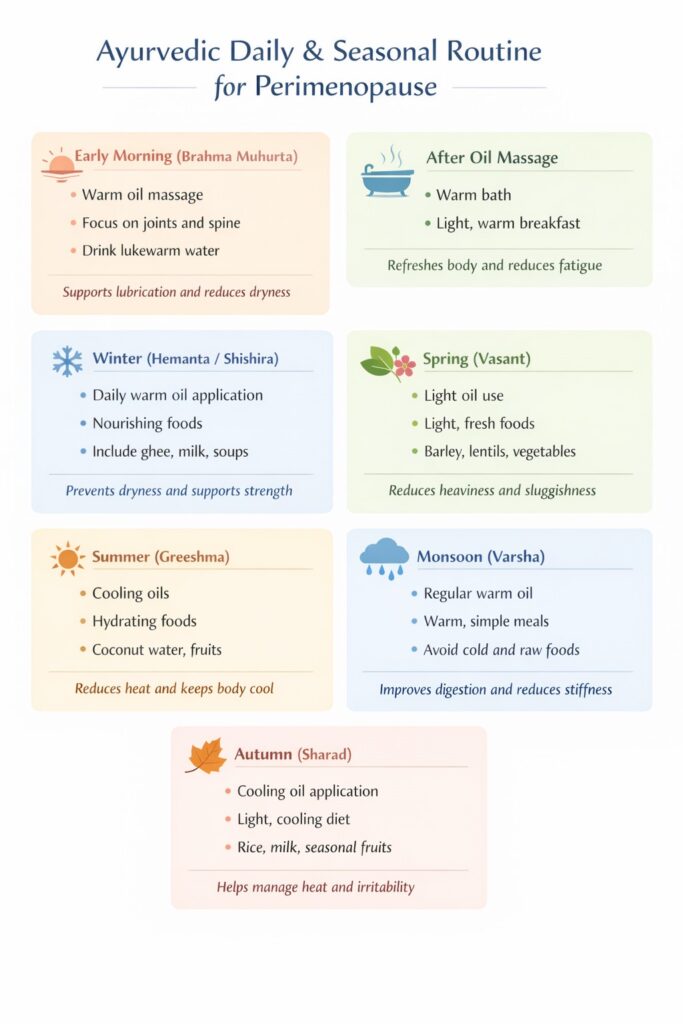
Oil application, or Abhyanga, is often included as part of daily care. Warm oil over the body, especially over the joints and spine, helps with dryness and has a settling effect over time. Warm water in the morning. Warm meals throughout the day. These small things support digestion and stability.
Food begins to feel different
A perimenopause diet is not strict, but the body becomes less forgiving. Skipping meals. Eating very late. Relying on cold food. These start to show their effect more clearly.
Warm, freshly prepared food is usually better tolerated. In colder periods, slightly heavier and nourishing food feels supportive. Food that is cooler and lighter feels more comfortable in warmer weather. These shifts are often noticed without needing much explanation.
Daily and seasonal adjustments
Movement and breath
The body does not respond well to extremes during perimenopause. Too much exertion leads to fatigue. Too little movement leads to stiffness. Simple practices are enough. Postures like Tadasana (Mountain Pose), Vrikshasana (Tree Pose), Baddha Konasana (Butterfly Pose), and Setu Bandhasana (Bridge Pose) support strength and balance. Shavasana (Corpse Pose) allows the system to settle. Breathing practices such as Anulom Vilom (alternate nostril breathing), Bhramari (humming bee breath), and Nadi Shodhana (channel cleansing breath) have a gradual calming effect.
The role of family
This part often stays in the background, but it matters. Perimenopause brings changes that are not always visible. Mood may shift. Energy may fluctuate. Sleep may not feel the same. When this is misunderstood, it adds strain. When it is recognised, even quietly, things feel lighter. Sometimes support is very simple. Giving space. Allowing rest without questioning it. Not reacting immediately. It does not change the process itself, but it changes how it is experienced.
Conclusion
Perimenopause does not arrive all at once. It unfolds gradually, often in ways that are only understood in hindsight. The body begins to respond differently. It asks, in its own way, for more regularity, more rest, and a little more attention. These changes are not always easy, but they are not without meaning either. With the right support, through routine, food, and a steady environment, the transition becomes easier to live with.
References