Introduction
Finding out that your child is in pain is something no parent is ever prepared for. A child who suddenly refuses to run, struggles to get out of bed, or starts avoiding activities they once loved can leave you wondering whether it is simply “growing pains” or something more.
Most people think of arthritis as a condition that affects older adults. But arthritis can also occur in children. Juvenile Idiopathic Arthritis (JIA) is the most common chronic inflammatory arthritis in children under 16.
One of the biggest challenges is that juvenile arthritis symptoms are often subtle. They may come and go, affect only one joint initially, or show up as tiredness, limping, or reduced activity rather than obvious pain. Recognising these early signs and seeking timely medical care can make a significant difference to your child’s long-term joint health and overall quality of life.

Juvenile Idiopathic Arthritis: More Common Than We Think
Current estimates suggest that nearly one in every 1,000 children is affected by JIA worldwide. While every child may not develop severe disease, untreated inflammation can affect growing bones, joints, eyes and overall development. This is why persistent children’s joint pain should never be ignored.
Juvenile Arthritis Symptoms Every Parent Should Know
JIA is not a single disease but a group of inflammatory conditions. As a result, symptoms can vary considerably from one child to another.
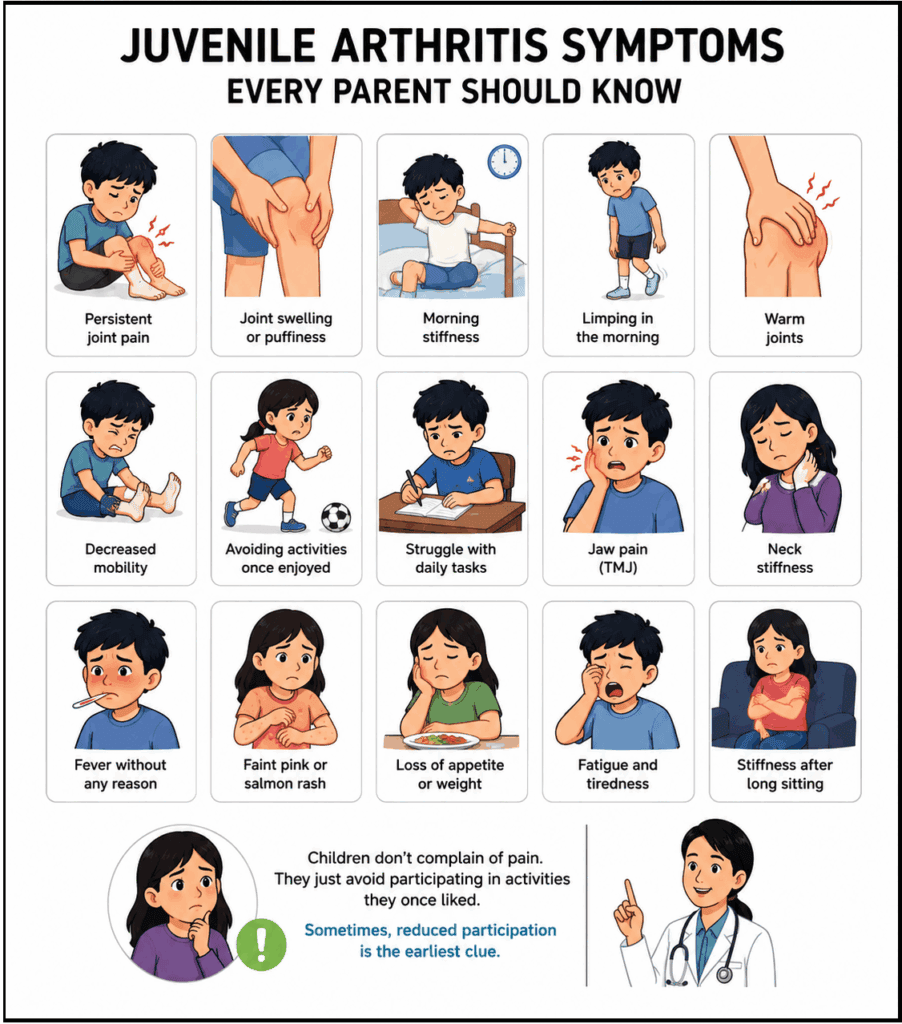
- Persistent joint pain lasting more than six weeks, even without an injury.
- Visible joint swelling or puffiness around the knees, ankles, wrists, fingers or other joints.
- Morning stiffness, where your child walks slowly, limps, or needs time to “warm up” after waking.
- Limping especially in the morning, that improves during the day.
- Warm joints that feel noticeably warmer than the surrounding skin.
- Decreased mobility such as inability to straighten an elbow or bend a knee joint.
- Resistance to engaging in activities which were enjoyed in the past like jogging, bicycling, dancing and playing outdoors.
- Struggle in carrying out basic tasks such as writing, gripping a pen or fastening their clothes.
- Jaw pain (TMJ) causing problems while eating.
- Neck stiffness or avoiding turning of the head.
- Fever without any apparent reason.
- Faint pink or salmon colored rash, especially when there is a fever.
- Loss of appetite and sudden loss of weight.
- Fatigue and tiredness even after having enough rest.
- Stiffness after long periods of sitting.
Children do not complain of pain. They just avoid participating in activities they once liked. Sometimes, reduced participation is the earliest clue.
Growing Pains or Something More?
Many parents wonder whether their child is simply experiencing growing pains.
Growing pains usually:
- occur at night
- affect both legs
- improve by morning
- are not associated with swelling or stiffness
JIA behaves differently.
Persistent children’s joint pain, swelling, morning stiffness, limping, or reduced joint movement should always be assessed by a doctor. Early diagnosis helps prevent long-term complications.
When Should You Consult a Specialist?
Please don’t wait until symptoms become severe.
Arrange a medical evaluation if:
- Joint pain lasts longer than six weeks
- There is visible joint swelling
- Your child develops morning stiffness regularly
- Daily activities like writing, cycling, running, or climbing stairs become difficult
- Joint symptoms are accompanied by fever, rash, or swollen glands
- Your child complains of jaw pain or difficulty chewing
JIA is a diagnosis made after excluding infections, injuries, blood disorders, and other inflammatory conditions. A paediatric rheumatologist is best equipped to make this diagnosis and guide treatment.
Why Early Treatment Matters
Children’s bones and joints are still developing. When inflammation continues unchecked, it may lead to:
- joint deformity
- restricted growth of affected limbs
- muscle weakness
- reduced mobility
- chronic eye inflammation (uveitis), which may silently affect vision
The encouraging news is that with early diagnosis and appropriate treatment, many children with JIA grow into active, healthy adults.
Can Ayurveda Support Children with JIA?
Modern treatment has transformed outcomes for children with JIA. Medicines such as NSAIDs, corticosteroids, and DMARDs help control inflammation and protect joints from permanent damage.
Many parents, however, also look for ways to improve their child’s overall wellbeing, reduce stiffness, support digestion and enhance quality of life alongside conventional care.
In juvenile idiopathic arthritis, Ayurveda can serve as a complementary approach—not as a replacement for medical treatment, but as supportive care under qualified supervision.
The Ayurveda Perspective
In Ayurveda, many features of JIA resemble Amavata.
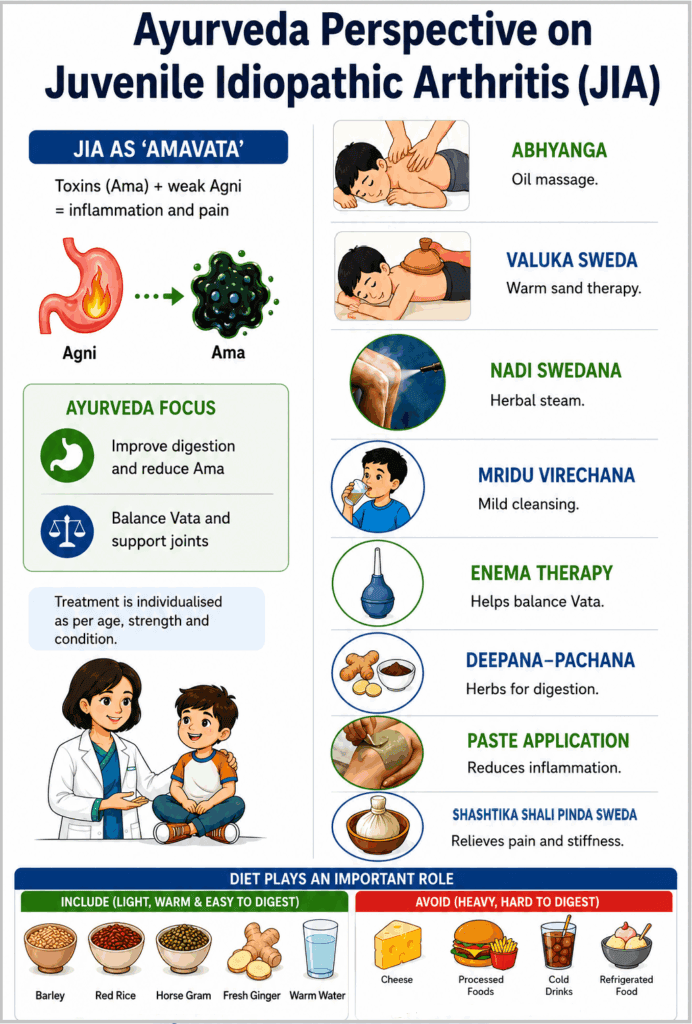
Ama refers to improperly processed metabolic by-products that accumulate when digestion and metabolism (Agni) are impaired. Combined with aggravatedVata, this may contribute to pain, stiffness, swelling, and restricted movement.
The Ayurveda approach therefore focuses on two broad goals:
- improving digestion and reducing Ama
- restoring balance to Vata while supporting healthy joint function
Treatment is always individualised according to the child’s age, strength, disease stage, and overall constitution.
How Juvenile Idiopathic Arthritis Ayurveda Supports Conventional Care
Gentle oil therapies (Abhyanga)
Age-appropriate massage with medicated oils may help reduce stiffness, improve circulation, and maintain joint mobility.
Dry fomentation (Valuka Sweda)
Warm sand bolus therapy provides gentle dry heat that can reduce stiffness and discomfort.
Local steam treatment (Nadi Swedana)
Specific herbal steam treatments can help relax the muscles and increase flexibility.
Mild purification (Mridu Virechana)
In case a clinical need is found, gentle methods of purification can be employed to aid digestion and decrease Ama accumulation.
Basti
Under appropriate circumstances, properly chosen paediatric Basti treatments may be suggested.
Digestive enhancement (Deepana-Pachana)
A vital component of Ayurveda treatment is improving digestive ability using herbs and diet.
External treatments
Medicated pastes and decoctions poured locally may be helpful in reducing inflammation.
Strengthening therapies
As inflammation settles, nourishing therapies such as Shashtika Shali Pinda Sweda may be introduced to support muscles and joints.
Diet Plays an Important Role
Diet is considered an integral part of juvenile idiopathic arthritis Ayurveda management.
Children are generally encouraged to consume foods that are light, warm, and easy to digest, such as:
- barley
- red rice
- horse gram
- fresh ginger
- warm water
Heavy, difficult-to-digest foods, excessive cheese, processed foods, cold beverages, and refrigerated meals are often minimised depending on the child’s digestive capacity and overall clinical picture.
Is Ayurvedic Treatment Safe for Children?
This is an important question that many parents ask.
When prescribed by a qualified Ayurvedic physician and integrated with ongoing paediatric care, Ayurvedic treatment can be used safely. However, self-medication, over-the-counter products, or stopping prescribed conventional medicines without medical advice can be harmful.
To Conclude
The priority is always the child’s long-term health.
Conventional medicine plays a vital role in controlling inflammation early and preventing irreversible joint damage. Ayurveda can complement this approach by supporting digestion, improving mobility, reducing stiffness, enhancing overall wellbeing and helping the child build resilience during recovery.
If your child has persistent joint pain or other juvenile arthritis symptoms, don’t dismiss them as “just growing pains.” Early evaluation can change the course of the disease.
When thoughtfully integrated, Ayurveda for juvenile idiopathic arthritis offers a holistic, child-centred approach that gives children the best opportunity to grow, play and thrive with healthy, active lives.