Some Ayurveda formulations earn their place not through complexity, but through experience. Karpooradi Thailam is one of them. The moment it touches the skin, it makes its presence known.
The first thing most people notice is the immediate sense of comfort upon application. Tightness begins to ease. Movement feels less restricted. A sore muscle does not seem to demand the same attention it did a few moments earlier. It is this very experience that often leads people to explore more Karpooradi Thailam uses in everyday joint and muscle care.
In traditional practice, Karpooradi Thailam has long been associated with discomfort that feels active and reactive. Not the slow stiffness that develops over years, but the kind that appears after strain, overuse, inflammation, or physical exertion.
What Karpooradi Thailam actually is
Karpooradi ingredients are simple and traditionally centred on Karpura,, blended into a sesame oil base.
Karpura or camphor (Cinnamomum camphora) is traditionally described as having Ushna Veerya, meaning ‘hot potency’. This often surprises first-time users, especially those searching for camphor oil for joint pain in Ayurveda, because the initial sensation upon application is cooling.
That cooling feeling is largely a sensory response created through stimulation of nerve endings on the skin. Its deeper action behaves differently. Traditionally, Karpura is considered stimulating in nature and supports local circulation, which helps explain why the area often begins to feel lighter and more comfortable after application. Sesame oil plays a quieter role. It acts as the carrier medium while also helping nourish muscles and joints that feel strained or overworked. Together, these contribute to many of the recognised Karpooradi Thailam benefits.

Karpooradi vs Mahanarayana oil
People often compare these two oils because both are used for muscles and joints. But they are not meant for the same stage of discomfort.
Karpooradi Thailam is generally chosen when symptoms feel active. There may be tenderness, swelling, warmth, and recent strain or soreness after physical activity.
Mahanarayana Thailam serves a different role. It is traditionally used when the focus shifts toward nourishment, strength and long-term support for muscles, joints and nerves.
| Feature | Karpooradi Thailam | Mahanarayana Thailam |
| Best suited for | Active discomfort and inflammation | Long-term muscle, joint and nerve support |
| Pain experience | Tender, warm, reactive | Deep stiffness, weakness or chronic discomfort |
| Typical use | Sprains, inflammatory joint pain, sports soreness | Joint stiffness, nerve weakness, and muscle strengthening |
| Tissue action | Comfort and calming support | Nourishing and strengthening support |
| Common users | Athletes, recent strains or flare-ups | People seeking flexibility, strength and muscle support |
In simple terms, Karpooradi is often considered when the body feels irritated and reactive. Mahanarayana is more commonly used when the body needs nourishment, recovery and long-term musculoskeletal support.
Where is Karpooradi Thailam commonly used?
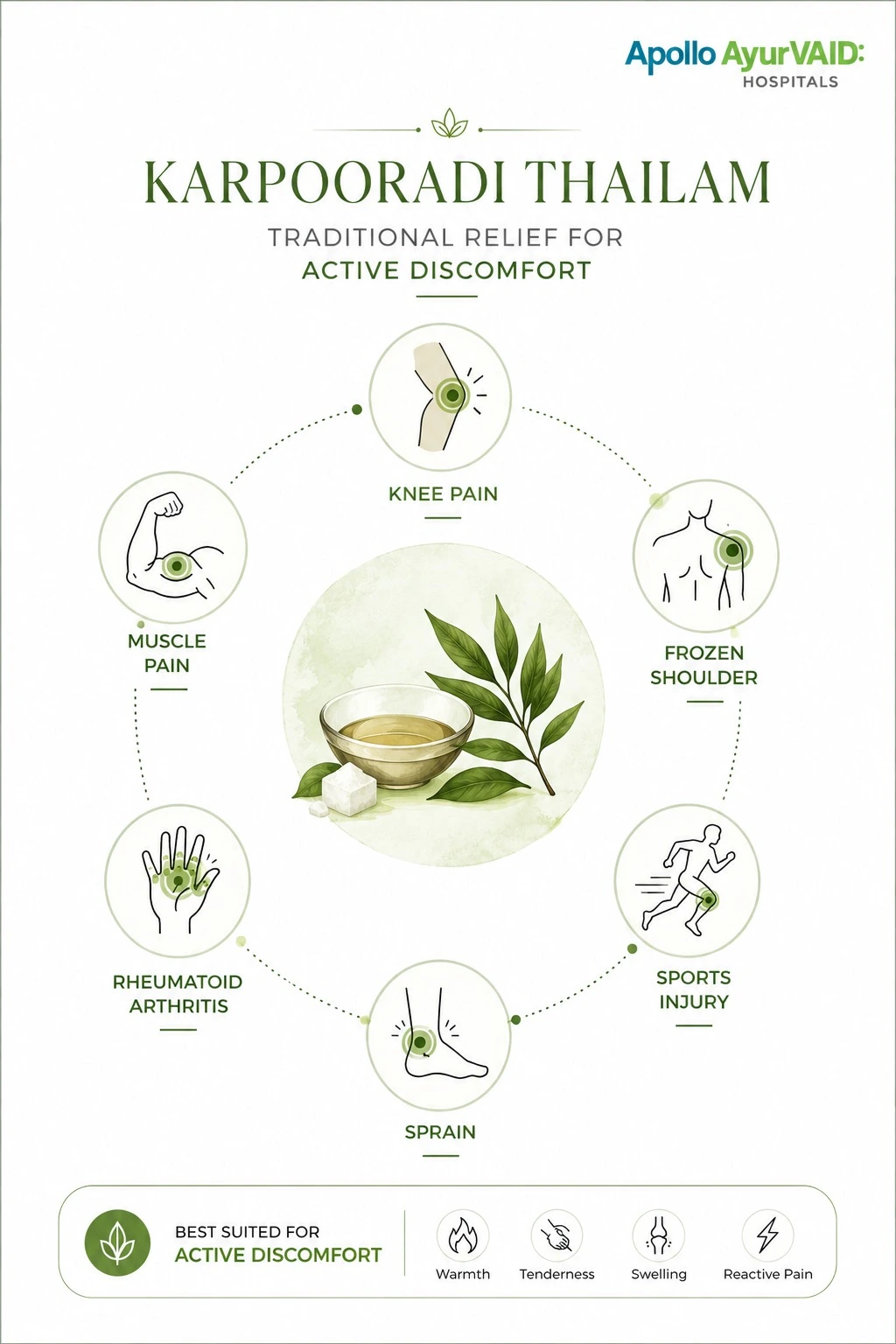
In practice, Karpooradi Thailam has traditionally been chosen for situations where discomfort feels active and physically limiting.
Karpooradi for knee pain
A knee that becomes swollen after prolonged standing, climbing stairs, or physical exertion.
Karpooradi for frozen shoulder
Tenderness and inflammatory discomfort associated with restricted shoulder movement.
Karpooradi for sports injury
Muscle soreness or strain that appears after intense training sessions or physical activity.
Karpooradi for sprain
Minor injuries involving localised tenderness, bruising, or soft tissue stress.
Karpooradi for Rheumatoid Arthritis
Inflammatory joint discomfort where warmth and sensitivity are noticeable.
Karpooradi for muscle pain
Muscles that feel tight, overworked, or uncomfortable after exertion.
These are also situations where people frequently search for the best Ayurvedic oil for inflammation, particularly when symptoms feel recent and active.
Karpooradi Thailam uses in real life
The range of Karpooradi Thailam has naturally expanded because physical stress patterns have changed. Long sitting hours, repetitive strain, travel fatigue, posture-related stress, and intense workouts all create new patterns of discomfort. Today, Karpooradi Thailam is commonly used for the following:
- Post-workout soreness
- Joint strain from overuse
- Swelling after physical activity
- Sudden muscular tightness
- Recovery support after injury
It is also frequently used by active individuals and increasingly appears in recovery routines involving Karpooradi for athletes. The formulation’s sensory action and support for local comfort are among the reasons why many users continue exploring karpooradi oil for joint pain in modern settings.
Karpooradi Thailam also has a lesser-known traditional role. External application over the chest has long been used during seasonal discomfort and mild chest congestion. This traditional use often appears in discussions around Karpooradi for cold. Camphor’s aromatic and warming action creates a feeling of openness and breathing comfort, which explains why it continues to remain part of household Ayurveda practices.
Precautions
Even natural formulations require thoughtful use.
- Avoid application on broken or irritated skin.
- People with known sensitivity to camphor should be cautious.
- Pregnancy and use in infants require medical guidance.
- Applying more does not necessarily improve results.
Apollo AyurVAID quality and safety approach
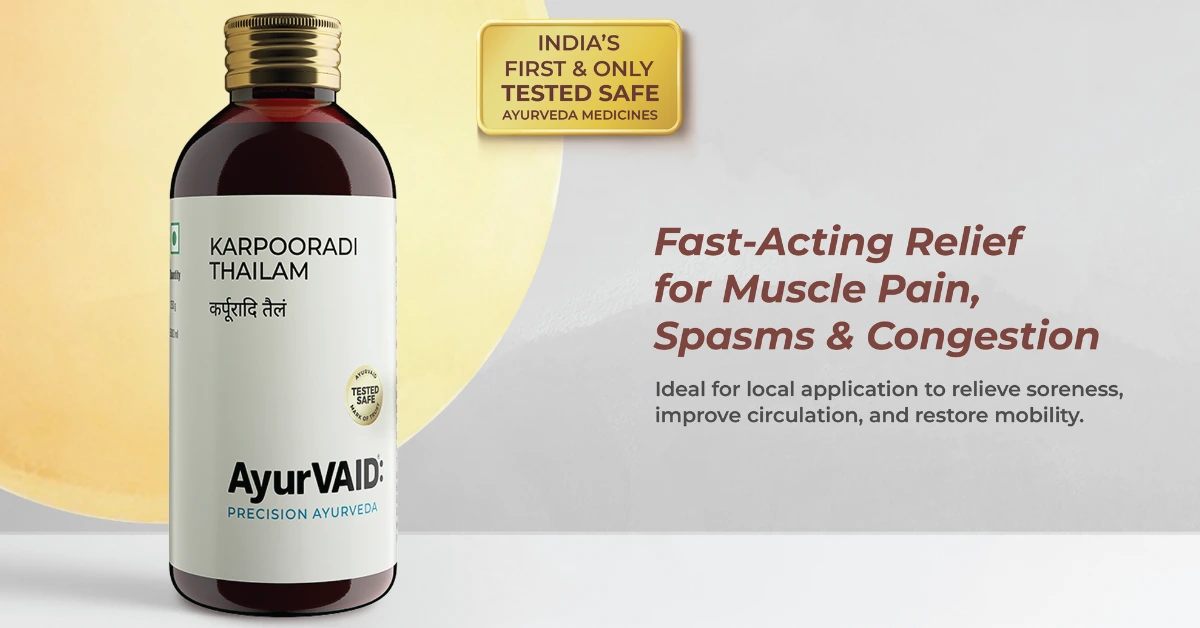
At Apollo AyurVAID, Karpooradi Thailam is not approached as just another external oil. The formulation follows classical Ayurveda principles and modern quality systems that ensure safety, consistency, and therapeutic integrity.
Each batch undergoes rigorous testing in accordance with API standards, including evaluation of heavy metal limits and safety parameters. QR-based traceability and batch verification systems help users access product and quality information directly.
AyurVAID represents India’s first Tested Safe Ayurveda range, combining classical Ayurveda knowledge with structured clinical validation. For products that may become part of everyday recovery and wellness routines, quality becomes more than a manufacturing detail. It becomes part of the therapeutic experience itself.
Final thoughts
Karpooradi Thailam is not designed to be a one-size-fits-all oil. Its role is specific. It performs best when discomfort feels active rather than long-standing, when muscles feel overworked, and when joints feel irritated. When movement itself begins to feel limiting. That is why it continues to remain relevant across traditional practice and modern lifestyles alike.
Sometimes the body notices the difference before words do. And perhaps that is one reason Karpooradi Thailam has stayed part of Ayurveda care for so long.
Final Thoughts

References
- Hepsibah PT, Prasad NB, Kumar PS. Standardisation of ayurvedic oils. Anc Sci Life. 1998 Apr;17(4):280-3. PMID: 22556856; PMCID: PMC3331126.
- Kotaka T, Kimura S, Kashiwayanagi M, Iwamoto J. Camphor induces cold and warm sensations with increases in skin and muscle blood flow in human. Biol Pharm Bull. 2014;37(12):1913-8. doi: 10.1248/bpb.b14-00442. PMID: 25451841.
- Hamidpour R, Hamidpour S, Hamidpour M, Shahlari M. Camphor (Cinnamomum camphora), a traditional remedy with the history of treating several diseases. International Journal of Case Reports and Images 2013;4(2):86–89.
- Shabbir A, Parvinzadeh Gashti M. Camphor’s Therapeutic Uses and Potential Hazards: An In-Depth Review of Its Medicinal Applications. Molecules. 2026 Feb 13;31(4):648. doi: 10.3390/molecules31040648. PMID: 41752424; PMCID: PMC12943631.
- “An updated review on camphor “, IJSDR – International Journal of Scientific Development and Research (www.IJSDR.org), ISSN:2455-2631, Vol.8, Issue 6, page no.1231 – 1237, June-2023, Available :https://ijsdr.org/papers/IJSDR2306172.pdf