Most women are told that menopause begins when periods stop. Clinically, that’s true. Twelve months without menstruation marks menopause.
But the body doesn’t wait until that moment to start changing. For many women, the first clues are smaller. Odd, almost dismissible. Sleep becomes lighter. A woman who once slept through the night suddenly wakes at 3 a.m., mind alert for no clear reason. Periods arrive late… then early… thennot at all for two months.Skin feels drier, even though the same moisturiser has worked for years. Sometimes the changes are emotional. A little more impatience. A little less tolerance for noise, stress, or long days.
Women often say something simple in the clinic: “Something feels different.”
Those quiet shifts are often the first menopause symptoms, and they may begin several years before menopause itself. In Ayurveda, menopause is called Rajonivritti—the natural cessation of menstruation. It is not considered a disease. Rather, it is a physiological transition linked to Jara Avastha, the natural ageing process of the body. Still, transitions can feel uncomfortable when we don’t understand what the body is doing. Learning to identify the signs and symptoms of menopause helps women approach this stage with less worry and more clarity.
What Is Happening Inside the Body
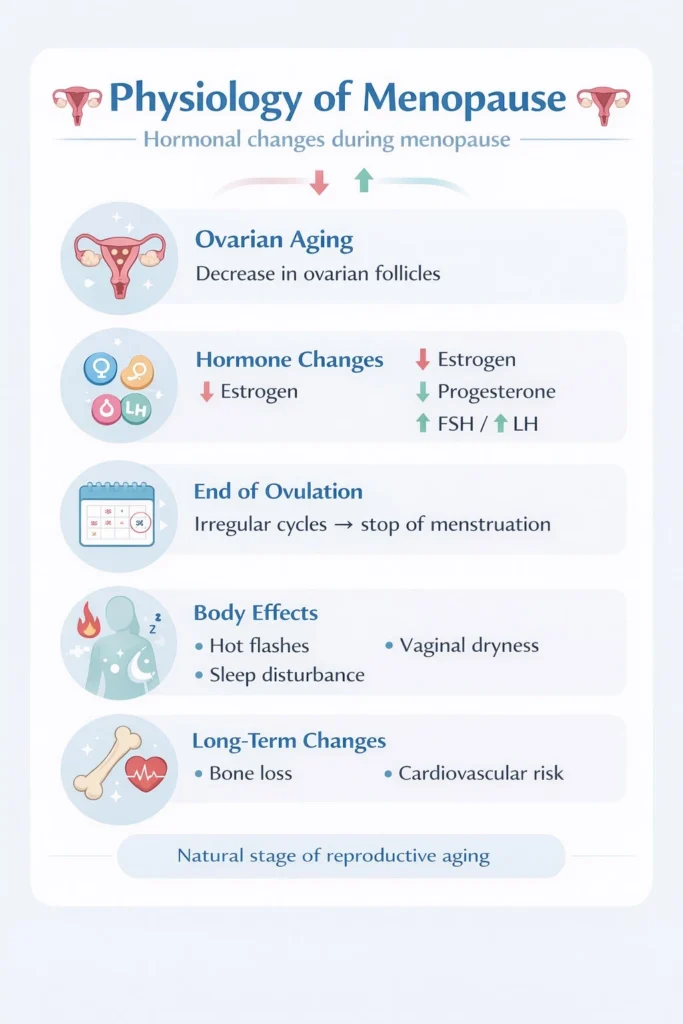
Throughout reproductive life, the ovaries release eggs and produce hormones—primarily oestrogen and progesterone. These hormones regulate the menstrual cycle, but they also influence sleep, skin elasticity, metabolism, mood, and bone health. Over time, ovarian follicles decline. Hormone production becomes less predictable. Oestrogen may rise sharply one month and fall the next. Progesterone slowly decreases. The brain tries to compensate by sending stronger hormonal signals to the ovaries—particularly follicle-stimulating hormone (FSH). But eventually, the ovaries respond less and less. That hormonal back-and-forth is why many signs of menopause appear irregular at first. One month, everything feels normal. The next month, sleep becomes difficult, or periods behave unpredictably.
Ayurveda describes this same transition in a different language.
The primary system involved in menopause is the Artavavaha Srotas, which governs menstrual and reproductive activity. With advancing age, there is a reduction in the functional capacity of these channels, leading to the cessation of menstruation and diminished ovarian activity.
This transition also occurs due to Vata predominance and Dhatu Kshaya, both of which are typical features of ageing in Ayurveda. As a result, other systems may be secondarily influenced. Rasavaha Srotas may reflect relative depletion of Rasa Dhatu, which can manifest as symptoms such as dryness, fatigue, and vasomotor disturbances. The increase in Vata, along with tissue depletion, may also affect the Asthivaha Srotas, contributing to reduced bone strength and an increased risk of osteoporosis.In addition, Manovaha Srotas may be involved, helping to explain the emotional and cognitive changes that some individuals experience during this phase, including mood fluctuations, anxiety, and sleep disturbances.
In summary, menopause in the Ayurveda framework is best understood as a physiological stage of ageing characterised by Artava Kshaya.
Early Menopause Symptoms Women Often Notice First
The early menopause symptoms rarely arrive dramatically. They creep in quietly.
Menstrual cycles begin to change first. A period that used to arrive every 28 days may now appear after 35 days. Then, 22 days pass, followed by a month of disappearance.
Sleep often follows. Many women report waking up during the early hours of the morning. Sometimes, because of warmth or sweating. Sometimes, they wake up for no apparent reason at all.
Temperature regulation becomes less predictable, too. A sudden warmth spreads across the chest or face. It may last only seconds. But it’s noticeable. There are also subtle signs and symptoms of menopause that women don’t always associate with hormonal changes. Things like:
- difficulty concentrating
- feeling mentally “foggy”
- increased sensitivity to stress
- lower energy in the afternoon
- changes in sexual desire
One patient once said something that stayed with me: “It’s like my body is speaking a slightly different language now.” That description is surprisingly accurate.
The Less-Spoken Changes
Hot flashes usually steal the spotlight when menopause is discussed. They’re dramatic. Memorable. Easy to point to. But many of the day-to-day changes women talk about in the clinic are quieter.
Skin, for instance. It often becomes noticeably drier. Moisturisers that worked perfectly for years suddenly feel… inadequate. Some women say their skin looks a little thinner or that it loses the soft elasticity it used to have. Nothing alarming. Just different.
Hair sometimes follows the same pattern. A bit finer. A little less volume in the ponytail. Nails may start splitting more easily, too—small things that people often blame on “weather,” “stress,” or “just getting older”.
Joints can also begin to complain. Fingers feel stiff in the morning, especially when making a fist. Knees may ache after a long walk or a day spent climbing stairs. Usually, the stiffness subsides as the body warms up, yet it remains noticeable.
Then there’s digestion — a change that catches many women off guard. Foods that were perfectly fine for years suddenly feel heavy. Bloating appears after meals that never caused trouble before. Sometimes it’s inconsistent too. One day, everything feels normal. The next day, the same lunch feels like it’s been sitting there for hours.
Researchers are still trying to map out exactly why this happens. Menopause doesn’t only affect reproductive hormones; it also influences metabolism, the gut, and inflammatory pathways throughout the body. Those systems are deeply connected, which means small shifts can show up in places people don’t immediately expect. And that’s often what women say: “I didn’t realise menopause could affect these functions too.” Because many of these changes are subtle. Not severe. Just unfamiliar enough to make someone pause and wonder what their body is up to.
Cognitive & Emotional Changes
Mood changes are fairly common during menopause, although they don’t look the same for everyone. Some women notice a kind of anxiety that feels unfamiliar — not overwhelming, just a low hum in the background. Others say they become more easily irritated than they used to. Small things that once passed unnoticed suddenly feel… louder. Emotionally too, reactions can feel closer to the surface, leading to heightened sensitivity and a tendency to overreact to minor frustrations.
Then there’s the mental fog people often talk about. It shows up in small, everyday ways. Forgetting someone’s name mid-conversation and walking into a room and wondering why. Putting the phone down somewhere and immediately losing track of it. Concentration slips a bit. Thoughts don’t line up as neatly. None of it is dramatic, but it’s enough to feel slightly unsettling.
Hormones are part of this picture, too. Shifts in oestrogen appear to influence brain chemicals involved in mood, memory, and emotional regulation. The body is adjusting, and sometimes the mind feels those adjustments first.
Interestingly, many women also describe something else happening alongside all of this. A gradual shift in perspective. Caring less about small stressors and focusing on what’s important. A stronger instinct to simplify things. Priorities start to rearrange themselves a bit — sometimes in ways that feel surprisingly clear — leading individuals to focus more on what truly matters in their lives, such as family and personal well-being.

The Importance of Family Conversations
Gentle Home Practices That May Help
Ayurveda often emphasises simple daily practices that promote balance during transitions, like Rajonivritti.
- Warm meals tend to support Agni and digestion. Soups, cooked vegetables, whole grains, and lightly spiced foods are often easier for the body to process than very cold or heavily processed meals.
- Regular oil massage—known as Abhyanga—can help counter dryness and calm the nervous system. Even applying warm oil to the skin before a shower can feel grounding.
- Sleep routines matter as well. Reducing screen exposure before bedtime and dimming lights earlier in the evening helps the body release melatonin naturally.
- Gentle movement, such as yoga or walking, supports circulation and mood stability.
These practices are simple, but consistency often matters more than intensity.
A Different Way of Viewing Menopause
Menopause is often described as something women must endure. Ayurveda views it differently. Rajonivritti is considered a natural event in life, much like ageing itself. The body is not malfunctioning. It is adapting to a different physiological rhythm.
At Apollo AyurVAID, the approach to menopause focuses on supporting that transition rather than suppressing every symptom individually. Attention is given to digestion, sleep, emotional balance, and metabolic health as interconnected systems. Because menopause is not only about hormones.
It is about the body adjusting to a new stage of life. And when women understand the signs and symptoms of menopause, receive support from family, and adopt small daily practices that support balance, this transition often becomes far more manageable than many expect.
The body, after all, has been adapting its entire life. Menopause is simply another chapter in that long process.
References