Heavy periods have a way of entering a woman’s life quietly. Almost unnoticed at first. And then, slowly, they begin to take up more space than they should. It usually starts with something small. The flow feels somewhat heavier than before. You begin carrying extra pads just in case. You plan your day a little differently during those few days. Nothing alarming. Just small adjustments.
But over time, those adjustments become routine. You think twice before long meetings. Travel plans start revolving around your cycle. There is a constant awareness in the background—a kind of silent calculation. And somewhere along the way, a question comes up. Is this still normal?
In clinical terms, we call this menorrhagia. It refers to menstrual bleeding that is excessive in amount or lasts longer than expected. The formalmenorrhagia definition describes blood loss beyond a certain limit or bleeding that continues beyond seven days. But most women do not measure their cycles in numbers. They notice how they feel.
When your period starts draining your energy, interrupting your routine, or making you anxious about something that used to feel manageable, your body is asking for attention. Not panic. Just attention. Many women try to adjust quietly. Some push through. Others begin looking for ways to understand how to stop heavy periods naturally, without immediately turning to strong medications unless clearly necessary. That instinct to pause and observe is important.
What Is Menorrhagia?
When someone asks what is menorrhagia, the simplest answer is heavy menstrual bleeding. But the experience is rarely that straightforward.
A woman may not track millilitres. She notices how often she needs to change her pad. Whether she wakes up at night because of the flow. Whether she still has energy by the third or fourth day or already feels unusually tired.
Some describe it as a period that feels difficult to keep up with. From a clinical perspective, bleeding that extends beyond a week or requires very frequent changes falls under the menorrhagia definition. Still, there are many women who technically fall within these limits and yet feel completely depleted. That gap matters.
In Ayurveda, this condition is described as Asrugdara or Raktapradara. The terminology reflects excess flow. The focus is not only on how much bleeding is happening but also on the internal environment that allows it. There is attention to Pitta, which governs heat and transformation, and Vata, which governs movement. When these are disturbed, especially along with Rakta dhatu, the menstrual flow can become heavier, faster, or less controlled. Sometimes the body is not just bleeding more. It is losing rhythm.
How to Stop Heavy Periods Naturally
When women ask about how to stop heavy periods naturally, what they are often seeking is stability. A sense that their body is predictable again. The approach is usually gradual. It does not begin with strong interventions. It begins with understanding patterns. Very often, digestion is the first place to look.
In Ayurveda, Agni plays a central role. When digestion is steady, tissues receive proper nourishment, and the system functions with more balance. When it is irregular, subtle imbalances begin to build. In daily life, this comes down to simple habits. Eating at regular times. Choosing freshly prepared meals. Avoid the habit of eating again before the previous meal has settled. These are small shifts. But over time, they change how the body responds. The next layer is internal heat. Since Pitta is closely linked with blood, excess heat can influence how intensely the body bleeds. Many women notice this connection on their own. Certain foods or habits seem to make their periods heavier. Gradually reducing very spicy, fried, or overly sour foods can make a difference over a few cycles. Not instantly. But steadily. Some foods support the system more gently. Simple meals that are easy to digest. Adequate hydration. A routine that does not push the body during its most vulnerable days.

Natural remedies for menorrhagia
When the body is ready, supportive measures can be layered in thoughtfully. Not all at once. Not aggressively. Just enough to guide the system back toward balance. These may include:
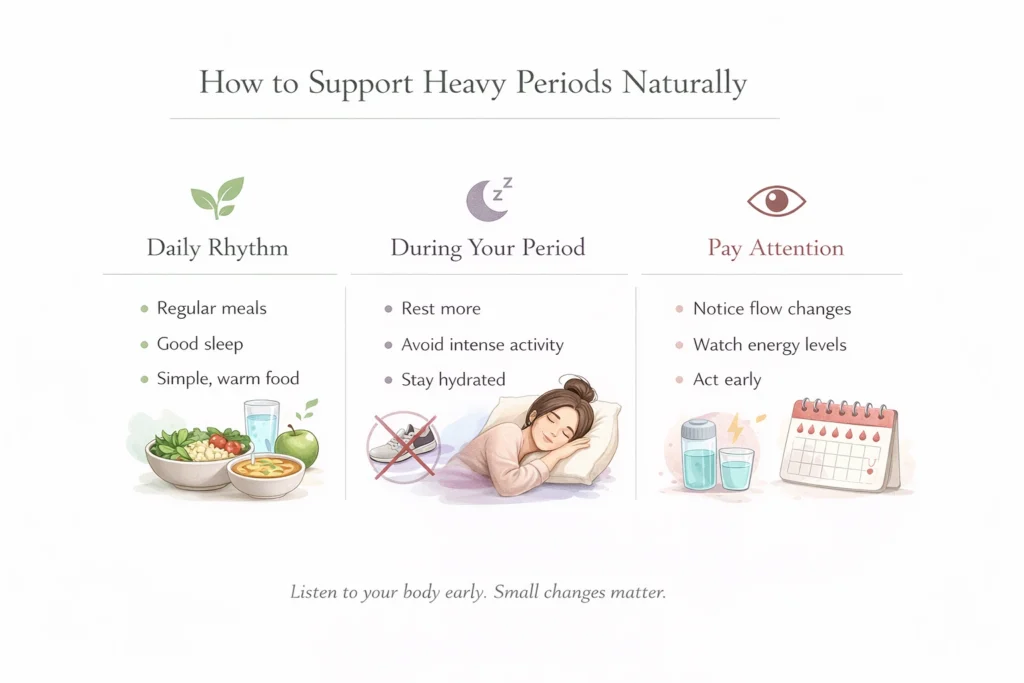
- Eating simple, warm, freshly prepared meals, especially in the week leading up to your cycle. Maintain consistent meal timings so Agni does not fluctuate too much. Avoiding very spicy, oily, fermented, or sour foods when you notice your flow tends to be heavier
- Preferring slightly cooling and nourishing foods like ghee during the menstrual phase.
- Drinking warm water throughout the day instead of cold beverages, especially around your cycle. Keeping yourself hydrated is important to reduce heavy bleeding.
- Reducing caffeine intake if you notice increased flow or restlessness during periods
- Allowing proper rest during the first two to three days of heavy bleeding instead of pushing through physical or mental strain
- Avoiding high-intensity exercise during heavy flow days and choosing slower, grounding movement instead
- Keeping the lower abdomen warm and supported, especially if there is discomfort or fatigue
- Ensuring regular sleep, particularly in the week before your cycle, as sleep disruption can influence hormonal rhythm
- Creating small pockets of quiet during the day, even ten minutes of stillness, can help regulate the nervous system. Practising gentle breathing exercises to reduce internal tension and support Vata balance
- Paying attention to bowel regularity, as sluggish digestion can indirectly affect menstrual flow. Avoid constipation by including fibre-rich foods and adding ghee to your diet.
- Avoiding overeating or very late-night meals, which can disturb metabolic balance over time.
- Being mindful of emotional load, especially unprocessed stress, anger, or exhaustion, which often reflects in cycle changes
- Observing your cycle without judgment for a few months, noting patterns rather than reacting to a single heavy cycle
These are not dramatic changes. But they allow the body to find its rhythm again.
When Should You Seek Medical Attention
This is important. As soon as you notice a change in your usual cycle, it is worth paying attention. Do not wait for it to become severe. If your periods suddenly become heavier than what is normal for you, if the duration begins to extend, or if you find yourself feeling more exhausted than usual during your cycle, it is a good time to consult a clinician.
Do not wait for it to become unmanageable. Some situations require immediate medical care. Bleeding that soaks through protection within a short time. Repeated dizziness. Breathlessness. A feeling of near fainting. These are not patterns to observe at home.
Even when exploring natural approaches, safety comes first.
Living with Menorrhagia
Heavy periods often become something a woman quietly adapts to. She adjusts her routine. Plans her days differently. Carries extra supplies. Conserves energy without even realising it.
Over time, this adaptation can begin to feel normal. But in clinical conversations, there is often a moment when a woman pauses and realises that what she has been managing for years is not something she has to simply live with. Understanding what is menorrhagia, recognising early menorrhagia symptoms, and exploring underlying menorrhagia causes opens up that possibility.
From there, the question of how to stop heavy period flow naturally becomes less about quick fixes and more about restoring balance. And that process usually begins earlier than most women think.
References
- Mule K, Kerle N. A critical review of Asrugdar. Int J Res Ayurveda Pharm. 2020 Apr;11(2):133–7. DOI: 10.7897/2277-4343.110246.
- Karache S A, Mehere S. Complete review of Ayurvedic management of Raktapradar w.s.r. to Brihatrayi and Laghutrayi. Int J Ayurveda Pharma Res. 2021 Oct;9(9):51–8. DOI: 10.47070/ijapr.v9i9.2075.
- Rajput S, Mata S, Saxena U, Ota S, Gupta B. Ayurveda Management of Menorrhagia (Raktapradara): Protocol for a Randomized Controlled Trial. JMIR Res Protoc. 2025 Mar 31;14:e60801. DOI: 10.2196/60801.
- Malik N, Swathi C, Chaturvedi A. Ayurvedic approach for management of Asrigdara: a case study. Int J Res Ayurveda Pharm. 2022;13(6):5–8. DOI: 10.7897/2277-4343.1306146.
- Dharshini priya G, Chitra devi K, Crossia A W F, Bhuvaneswari S. Efficacy of Saraca Asoca in the treatment of gynecological disorders in herbal medicinal system. Afr J Biomed Res. 2025 Jan;28(1s):1220–2. DOI: 10.53555/AJBR.v28i1S.6399.