Cancer changes more than what appears on a scan report. For many people, it quietly begins changing ordinary parts of life, too. Meals become irregular. Sleep shifts. Energy disappears in ways that are difficult to explain. Some patients describe it simply: “I don’t feel like myself anymore.”
Then treatment begins.
Modern cancer treatment has advanced enormously. Surgery, chemotherapy, radiation therapy, immunotherapy, and targeted treatments continue to improve outcomes across many cancers. Yet anyone who has spent time caring for patients during treatment notices something important very quickly. Cancer care is rarely only about treating a tumour. People are trying to get through their days while treatment is happening.
Can they eat properly? Can they sleep through the night? Can they tolerate the next cycle of chemotherapy? Can they continue walking, working, thinking clearly, and feeling like themselves? These questions often become part of the real story.
Apollo AyurVAID’s Integrative Cancer Care (ICC) was developed around this understanding. As a model of integrative oncology, Ayurveda, ICC works alongside modern oncology care and combines evidence-based Precision Ayurveda with conventional treatment approaches. The aim is not to replace cancer-directed therapy. It is to support patients through treatment, recovery, rehabilitation, and long-term well-being. Because people experience cancer through their bodies, their routines, and their everyday lives. Not through pathology reports alone.
Understanding cancer through two perspectives
Modern oncology describes cancer through several biological hallmarks. Cancer cells grow uncontrollably, resist normal cell death mechanisms, alter metabolism, escape immune surveillance, create their own blood supply, and sometimes spread to distant organs.
Ayurveda observes disease through a different lens.
Classical texts describe Arbuda, a condition that resembles solid tumours in many ways. Arbuda is described as a large, progressively growing lesion arising from disturbances in Vata, Pitta, andKapha, along with involvement of tissues such as Rakta (blood) andMamsa (muscle). Classical texts naturally did not describe modern diagnostic terms such as lymphoma or leukaemia. Still, several descriptions share clinical similarities.Halimaka reflects chronic systemic illness with fatigue and tissue involvement. Raktapitta describes disturbances involving blood and inflammatory processes. Gulma and Granthika Jwara may resemble certain abdominal and lymphatic conditions.
What becomes interesting today is where these perspectives begin meeting.
Modern cancer research increasingly discusses inflammation, metabolism, immune dysfunction, and the biological environment surrounding tumours. Ayurveda has long considered digestive and metabolic function, tissue balance, and obstruction of physiological pathways as important contributors to disease progression. Different languages. Some overlapping ideas.
This evolving understanding has also increased interest in Ayurveda cancer care approaches that work alongside modern oncology.

Cancer care rarely begins and ends with treatment
People sometimes imagine recovery as a straight line.
Diagnosis➡Treatment➡Recovery.
Real life is usually less tidy. Some patients complete treatment but continue feeling exhausted for months. Others notice changes in appetite long after treatment has ended. Food tastes different. Things they enjoyed for years suddenly feel unpleasant or heavy. Some patients recover physically but still tell us that something feels “off,” even when scans look reassuring. Sometimes it is tiredness that simply stays longer than expected. Sometimes sleep returns slowly. And sometimes people look better from the outside while quietly carrying emotional exhaustion that nobody around them immediately notices. Healing rarely moves in straight lines. It doesn’t always follow treatment calendars either.
At Apollo AyurVAID’s ICC, care is designed around this reality. Recovery is viewed as a process that continues across different stages of cancer care, not as something that begins only after treatment ends.
For some people, the journey starts much earlier, with prevention and risk factor identification. This becomes particularly important in individuals with chronic inflammation, obesity, metabolic disorders, a strong family history of cancer, or known genetic susceptibility. These ideas also closely reflect broader principles of cancer prevention in Ayurveda, which place importance on reducing long-term imbalance and strengthening overall health before disease develops.
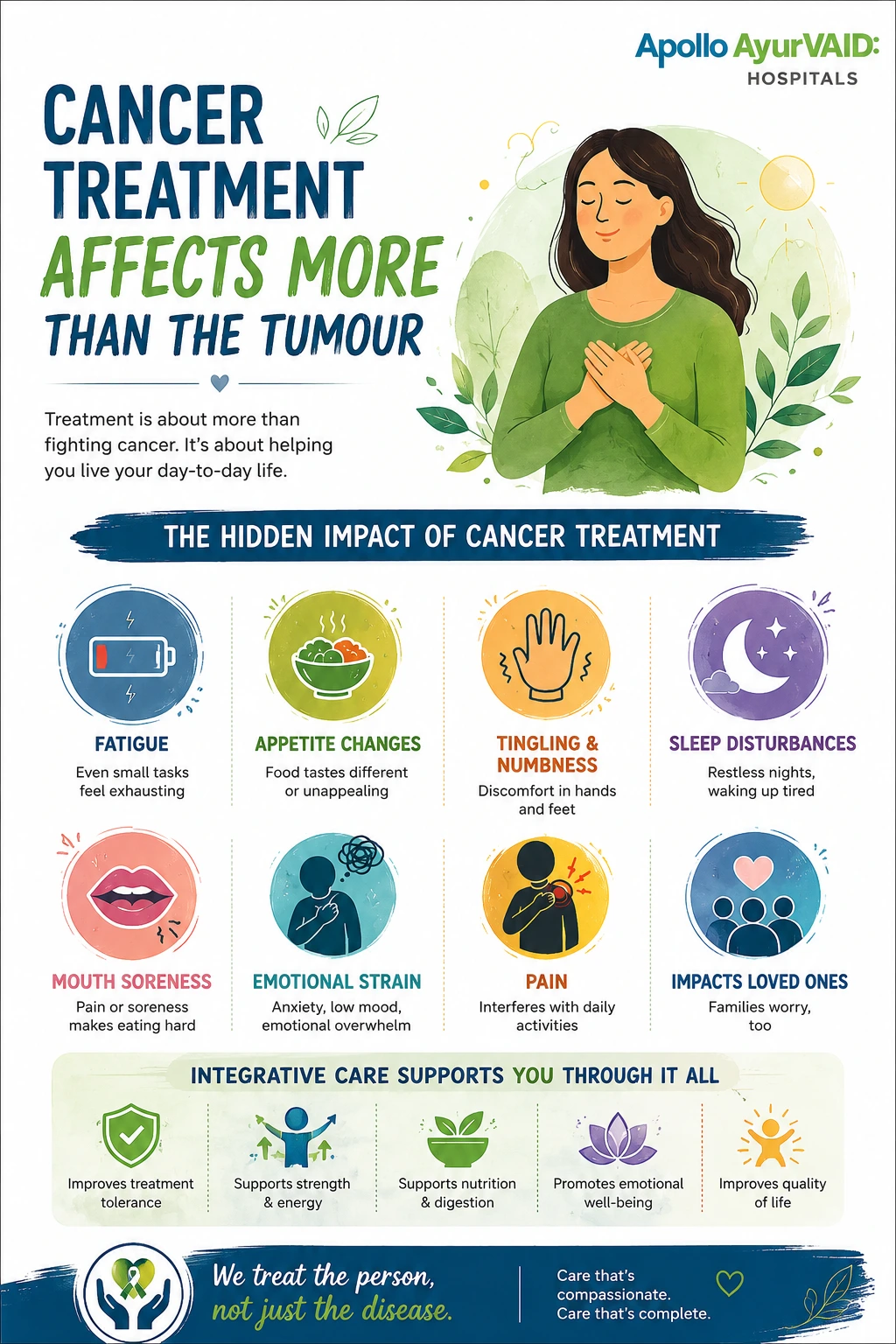
During active treatment, attention often shifts toward concerns that can quietly interfere with everyday life:
- The fatigue that makes even small tasks feel unusually difficult
- Tingling, numbness, or neuropathy that affects comfort and movement
- Digestive changes because suddenly eating no longer feels simple
- Sleep disturbances that leave people feeling tired even after resting
- Mouth soreness and mucositis that make swallowing painful
- Appetite changes that families often notice before patients do themselves
- Pain that interferes with routine activities
- Emotional well-being because treatment affects much more than the body alone
People sometimes imagine recovery as a straight line.
Diagnosis➡Treatment➡Recovery.
Real life is usually less tidy. Some patients complete treatment but continue feeling exhausted for months. Others notice changes in appetite long after treatment has ended. Food tastes different. Things they enjoyed for years suddenly feel unpleasant or heavy. Some patients recover physically but still tell us that something feels “off,” even when scans look reassuring. Sometimes it is tiredness that simply stays longer than expected. Sometimes sleep returns slowly. And sometimes people look better from the outside while quietly carrying emotional exhaustion that nobody around them immediately notices. Healing rarely moves in straight lines. It doesn’t always follow treatment calendars either.
At Apollo AyurVAID’s ICC, care is designed around this reality. Recovery is viewed as a process that continues across different stages of cancer care, not as something that begins only after treatment ends.
For some people, the journey starts much earlier, with prevention and risk factor identification. This becomes particularly important in individuals with chronic inflammation, obesity, metabolic disorders, a strong family history of cancer, or known genetic susceptibility. These ideas also closely reflect broader principles of cancer prevention in Ayurveda, which place importance on reducing long-term imbalance and strengthening overall health before disease develops.
During active treatment, attention often shifts toward concerns that can quietly interfere with everyday life:
Onco Nutrition: When eating becomes unexpectedly difficult
Food seems simple until suddenly it isn’t. A patient who loves food may begin avoiding meals. Someone else says everything tastes metallic. Others become full after just a few bites.
Families often respond in familiar ways.
“Please eat a little more.” “Try this instead.” “You need strength.”
The concern comes from love. But eating during cancer treatment can become surprisingly complicated. Apollo AyurVAID’s approach to onco nutrition begins with a practical question:
“What can this person tolerate today?”
Not next month. Not theoretically. Today.
Nutrition during cancer treatment is not simply about calorie intake. The body is changing continuously, and nutritional needs change with it. General principles often include:
- Warm and easy-to-digest meals when digestion becomes sluggish
- Smaller and more frequent meals during periods of poor appetite
- Seasonal fruits and vegetables, where appropriate
- Supportive use of spices such as turmeric, ginger, and cumin
- Hydration strategies
- Dietary support principles commonly used alongside Ayurvedic treatment for cancer
- Avoiding incompatible food combinations that increase digestive burden
Some days, patients eat comfortably. Some days, they cannot. Both realities need room within care plans. Supportive therapies may also include carefully selected Ayurvedic medicine for cancer patients, depending on clinical needs and ongoing treatment status. Traditional restorative approaches, such as Rasayana therapy for cancer, may be considered for improving vitality and recovery.
Herbs, including Ashwagandha for cancer support and Guduchi for cancer care, are being explored within integrative settings for their traditional role in resilience and wellbeing.
How Apollo AyurVAID's ICC creates personalised care
No two people experience cancer in the same way. Two individuals may carry the same diagnosis, receive the same chemotherapy protocol, and still move through treatment very differently. One person struggles with fatigue. Someone else develops severe digestive discomfort. Another may continue eating well but lose sleep entirely. Cancer rarely follows a predictable script, and neither do people.
That is why care at Apollo AyurVAID’s Integrative Cancer Care (ICC) begins with understanding the person first and the disease second.
The process starts with a detailed medical evaluation. Doctors review the patient’s overall health, previous medical history, tumour characteristics, disease severity, associated illnesses, and, when relevant, genetic predispositions such as BRCA mutations or Lynch syndrome. These details matter because cancer does not exist in isolation. The body that is experiencing the disease matters just as much.
Ayurveda assessment adds another layer of understanding. Rather than looking only at diagnosis labels, it attempts to understand patterns within the individual. Classical methods such as Ashta Sthana Pariksha, Dasha Vidha Pariksha, and Srotas assessment help identify underlying disturbances, disease pathways, and functional imbalances that may influence recovery and treatment tolerance.But assessment is only one part of the process.
Patients and their oncology teams are also involved in deciding practical goals. Sometimes the goal is straightforward: improving treatment tolerance and reducing side effects. Sometimes it helps appetite return, improves sleep, restores strength, reduces fatigue, or simply helps someone get through the next phase of treatment with a little more comfort.
These conversations shape the plan that follows. The care itself is designed to work alongside ongoing cancer treatment, not against it. Oncologists, dietitians, physiotherapists, and Ayurveda physicians remain closely connected throughout care so that treatment remains coordinated and consistent. This becomes important because people often worry about one question: “Will this interfere with my cancer treatment?”
The intention is exactly the opposite.
ICC is designed as a complementary approach that supports conventional cancer treatment rather than replacing it. The focus remains on helping patients tolerate treatment better, experience fewer treatment-related difficulties, maintain quality of life, and support longer-term recovery.
Progress is followed carefully along the way. Changes in appetite, sleep, energy levels, digestion, symptom burden, and laboratory findings are monitored regularly. Updates are shared with the primary oncology team so that everyone involved in care is moving in the same direction. Because personalised care is rarely about adding more treatment. Often, it is about making treatment easier to live with.
Final thoughts
References