Key Takeaways:
- Winter aggravates skin problems: Cold weather, low humidity and increased Vata can worsen dryness, eczema, psoriasis, itching and cracked heels.
- Skin health needs more than moisturising: Ayurveda focuses on skin nourishment, digestive health, Dosha balance and restoring the skin barrier.
- Seasonal Ayurvedic therapies can help: Abhyanga, Lepa, Mukhalepa and Dhara therapies may help support skin hydration, soothe irritation and improve skin comfort.
- Diet and lifestyle matter: Warm, nourishing foods, adequate hydration, gentle skincare and stress management can help reduce winter skin flare-ups.
- Chronic skin conditions need personalised care: Eczema and psoriasis may require a tailored treatment plan, including physician-supervised Panchakarma and conventional medical care when indicated.
As temperatures drop and cold winds blow, family clinics see a marked increase in patients presenting with skin problems. Winter is a physiological stressor that tends to exacerbate the chronic skin conditions of all age groups. In children and young people, seasonal changes can trigger eczema flare-ups, causing intense itching, redness, and sometimes moist, oozing patches, especially in the folds of the elbows and knees. In adults, winter tends to bring about the thick, erythematous plaques of psoriasis and the painful palmoplantar scaling. In the elderly, xerosis (dry skin) is very common, with severe scaling and fissured heels due to the natural thinning of the skin with age.
Most cases are treated with steroid creams or synthetic moisturisers, which provide only temporary relief. However, prolonged use of steroid creams can thin the skin and may sometimes lead to flare-ups when treatment is stopped. There are a growing number of families who are now looking for a more sustainable, healing approach and are turning to Ayurvedic treatment for skin problems with the aim of achieving true healing, restoring the skin’s natural balance and repairing the skin barrier to bring about lasting relief from seasonal distress.
Understanding Winter Physiology and Tvak Rukshata
In Ayurveda, winter is called Hemanta (early winter) and Sisira (late winter). Vata is cold (sheeta), dry (ruksha), light (laghu) and rough (khara). In winter, the peripheral vessels constrict to conserve internal body heat. This results in a marked reduction in sebum and lipid production, leaving the epidermis exposed, dry, and flaky. Low atmospheric humidity accelerates water loss from the skin surface and rapidly depletes natural moisture reserves. When Vata is in combination with Kapha, aggravated in the winter, it produces Tvak Ruksata (extremely dry skin), loss of elasticity, micro-fissuring and increased cutaneous nerve sensitivity. People with Vata skin (skin dominated by Vata) are particularly prone to seasonal cracking, scaling and roughness. The approach to dealing with dry skin problems in winter is therefore to address them at the level of internal metabolism, using metabolic warmth, Snehana (internal oleation), and topical lipid replenishment, rather than simply relying on occlusive coating.
Kushtha Roga Classification & Pathogenesis
Ayurveda considers all cutaneous disorders under the heading of Kushtha Roga. The classical texts categorise Kushtha into seven Maha Kushtha (major skin diseases) and eleven Kshudra Kushtha (minor skin diseases). Rather than seeing skin disorders as simply localised lesions of the skin, Ayurveda sees them as the expression of an imbalance of the Tridosha (three doshas) in the four constituent entities of Sapta Dravya (the seven substances) i.e. Twak (skin), Rakta (blood), Mamsa (muscle tissue) and Lasika (lymphatic fluid). When digestive fire (Agni) is impaired through diet, stress, or the changing of the seasons, the uneliminated digestive waste (Ama) enters the bloodstream. This Ama then obstructs the nutrient channels (Srotas) and the skin tissues are starved of their nourishment, resulting in inflammation.
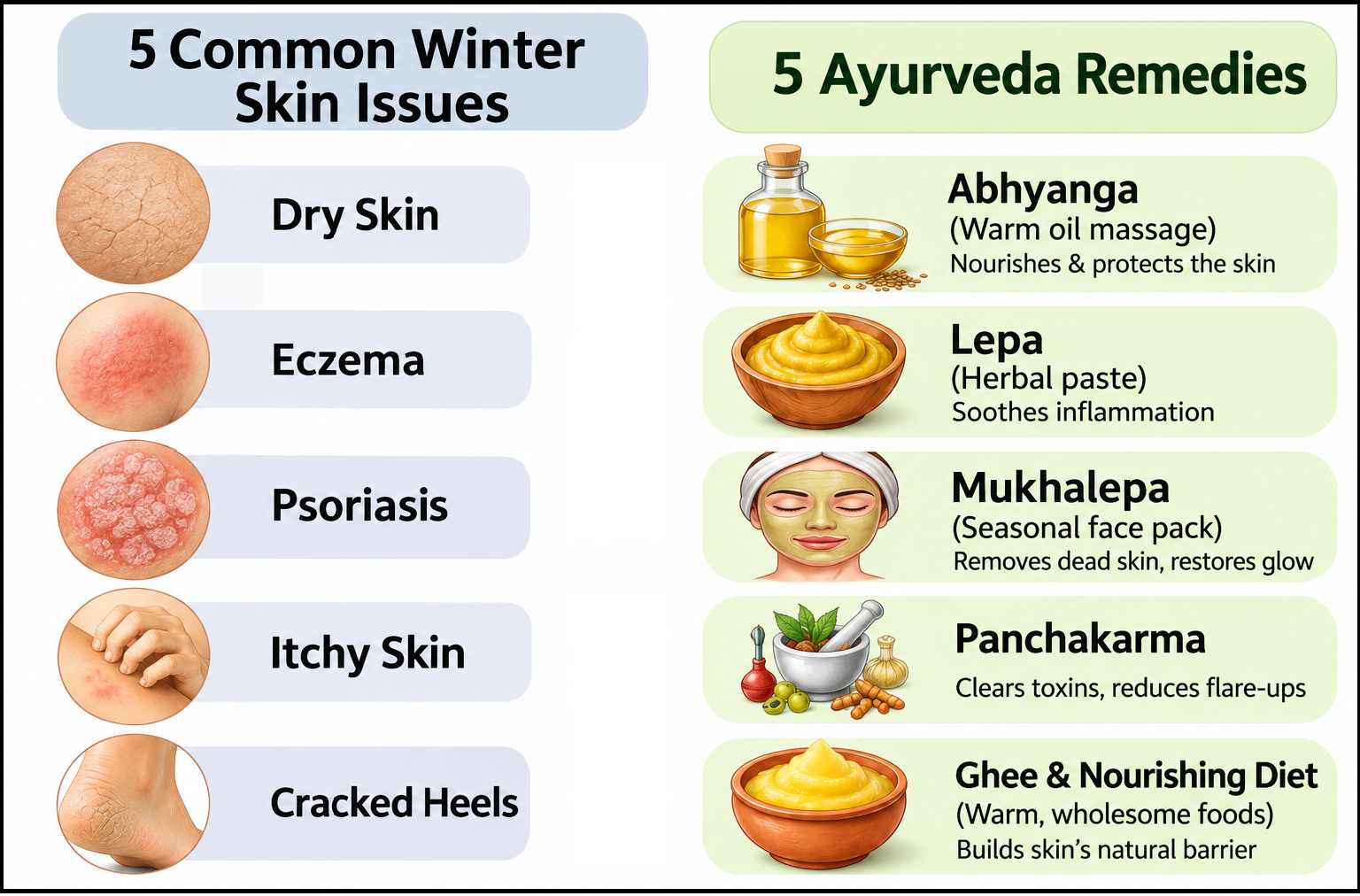
- Eczema (Vicharchika): This condition is primarily a Kapha-Pitta or Tridoshaja Kushtha with intense itching (kandu), papular eruptions (pidika), hyperpigmentation (shyava), weeping/oozing (srava) and lichenification. Successful eczema Ayurvedic treatment is about calming the systemic inflammation and rebuilding the damaged skin barrier.
- Psoriasis (Kitibha): Psoriasis is a Vata-Kapha predominant Kushtha. It presents as silvery fish scale desquamation (matsyashakalopamam), raised red plaques and epidermal thickening. Vipadika is the form that affects the palms and soles and is characterised by painful, bleeding fissures. A complete psoriasis Ayurveda approach looks at the hyperkeratosis, the auto-immune reactivity and the joint problems and treats at the cellular level via deep cleansing.
Daily Rituals & Topical Remedies
Restoring epidermal integrity in winter requires a dual internal and external therapeutic approach. Your daily self-care regimen is going to be essential in protecting the cutaneous lipid barrier against the depleting effects of the environment.
- Daily Abhyanga (Warm Oil Massage): The daily application of warm medicated oil is the most effective skin dryness winter home remedy. Massaging warm sesame or medicated oil into the skin before bathing will calm aggravated Vata, improve cutaneous microcirculation, and strengthen tissue elasticity. The deep penetration of sesame oil allows the active botanicals to enter the Dhatus and thus alleviate itchy skin discomfort and counteract nocturnal pruritus.
- Classical Lepas and Hydration Rituals: For localised inflammation and severe dryness topical herbal pastes (Lepa) are highly valuable. The classical formulations are lipid-based emollients with anti-inflammatory herbs such as manjistha (Rubia cordifolia), haridra (Curcuma longa), and Lodhra (Symplocos racemosa) to heal fissures and suppress scaling.
- Mukhalepa: In the Ashtanga Hridaya text (Sutrasthana, Chapter 22), we find Mukhalepa described (seasonal facial applications for the purpose of balancing the skin texture). For early winter (Hemanta Ritu), herbs along with yellow mustard seed can be ground up with milk or warm oil to nourish the dry tissues. For late winter (Sisira Ritu), a mixture of black sesame seeds, Twak (cinnamon), Darvi (berberis), and husked barley can be used to clear away dead scales while preserving essential lipids. An Ayurvedic face pack for dry skin, applied 2 to 3 times a week, removes keratinised debris without depleting the skin of moisture.
The Role of Panchakarma
While external therapies will only deal with the superficial symptoms, the chronic eczematous and psoriatic conditions require systemic purification via Panchakarma.
- Poorvakarma: Before purification, the patient is given Deepana-Pachana to stimulate Agni and neutralise circulating Ama. This is then followed by internal oleation (Snehapana) with a bitter medicated ghee. The oleation helps eliminate ama through purgation or emesis.
- Virechana (Therapeutic Purgation): It is the main Panchakarma procedure for Pitta-predominant and Rakta-vitiated dermatological disorders. It removes accumulated Pitta and metabolic waste from the liver, gallbladder, and vascular system. Clinical studies have shown that Virechana leads to significant reductions in EASI and PASI scores, with significant reduction in scaling, erythema and pruritus and a massive reduction in relapse rates compared to conventional steroid therapy.
- Adjunct Therapies: In addition to Virechana, we have therapies such as Takradhara (pouring medicated buttermilk on the forehead or body), Kashayadhara (pouring of a herbal decoction), and Jalaukavacharana (leech therapy), which resolve the localised microvascular stasis and the stress-induced neurodermatitis. Post Shodhana, Rasayana herbs are used to rebuild tissue immunity and promote long-term skin health.
Diet and Lifestyle Modification
Food and lifestyle are crucial in managing skin flare-ups effectively. The following general advice should be followed:
Diet: Eat warm, easily digestible foods (ghee, green gram, barley, warm ginger tea) and avoid incompatible combinations (like milk with fish), as well as sour, salty, deep-fried, and fermented items.
Lifestyle: Perform a daily warm sesame oil massage before bathing, moisturise damp skin, protect against cold winds, avoid daytime sleep, and practise stress-relieving yoga or pranayama.
Conclusion
References