Introduction
Living with migraine can feel exhausting. It is not just a headache. It affects sleep, mood, concentration, occupation, the digestive system and daily activities. For many patients, a series of episodes leads to a state of continuous fear and tiredness. In Ayurveda, this disease is viewed as a disturbance of the doshas( Vata and Pitta). One of the most calming therapies used in such cases is Shirodhara for migraines. This treatment is not simply a relaxation technique. It is a structured Ayurveda procedure designed to soothe the nervous system, reduce stress and support long-term balance.
What is Shirodhara?
Shirodhara involves a gentle, continuous stream of warm, medicated liquid poured rhythmically over the forehead. The word comes from:
Shiro – head
Dhara – flow or stream
In Ayurveda, this area is considered deeply connected to the mind, senses and nervous system. The aim is to calm mental overactivity and reduce the internal stress that often worsens migraine.
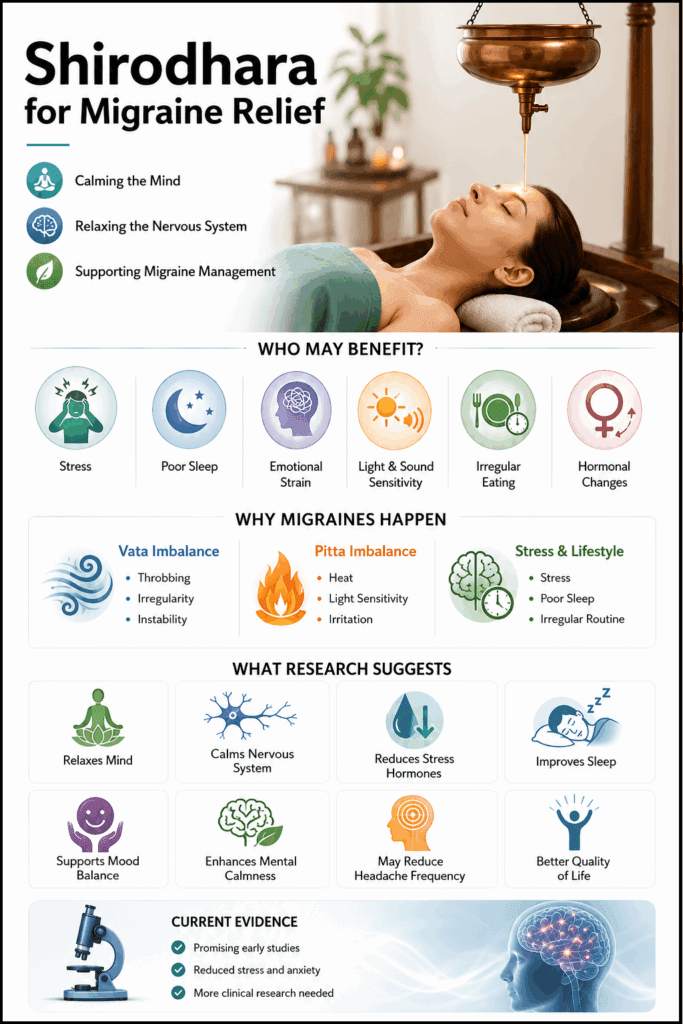
This is why Ayurvedic treatment for migraine, shirodhara, is often recommended for people whose headaches are linked with:
- Stress
- Poor sleep
- Emotional strain
- Sensitivity to light and sound
- Irregular eating habits
- Hormonal fluctuations

Why migraines happen
Ayurveda views migraine as a condition of disturbed balance rather than a single isolated symptom. Common factors as per Ayurveda include:
- Vata aggravation: causes throbbing, movement, instability and irregularity
- Pitta aggravation: causes heat, burning, irritation, light sensitivity and inflammation
- Mental stress: increases nervous tension and lowers the body’s tolerance to triggers
- Poor digestion and sleep: weaken the body’s resilience
- Lifestyle irregularity: makes attacks more frequent
This is why shirodhara headache relief may be helpful. It addresses not just pain but also the deeper nervous and stress-related patterns that often drive migraine.
What does modern research suggest?
Many patients ask about shirodhara clinical evidence migraine. While more large-scale studies are still needed, available research and clinical observation suggest that Shirodhara may help by:
- Induces relaxation: Shirodhara induces a state of relaxed alertness akin to meditation, helping reduce hyperactivity of the nervous system.
- Moderates the autonomic nervous system: Studies indicate a decrease in sympathetic activity, a state usually increased in chronic migraine patients.
- Decreases stress hormones: Physiological markers of stress, such as cortisol and noradrenaline plasma, have been found to be reduced.
- Increases brain waves: It has been found that there is an increase in activity of alpha and theta waves, thereby inducing relaxation and increased mental calmness.
- Regulates hypothalamus activity: It is believed that this practice may influence the working of the hypothalamus that regulates sleep patterns, emotions, and stress reactions.
- Balances neurotransmitters: Rhythmic application may aid in regulating serotonin and adrenaline, which have roles to play in migraines.
- Lowers anxiety and emotional stress: Various clinical trials have revealed improved levels of anxiety, stress, and mood disorders which trigger migraines.
- Aids headache outcomes: Some small clinical trials have found reduced headache severity, incidence, and accompanying symptoms.
- Improves quality of life: Reports indicate improved sleep patterns and mood for individuals using the Shirodhara therapy.
- Recommends combination therapies: Studies where Shirodhara and Nasya were combined with other medications have shown to be effective in treating migraines.
Present shortcomings of scientific evidence
- The majority of existing scientific studies are small-sample and observational studies.
- The need for larger randomised control trials (RCTs) is felt necessary.
- Treatment protocols vary widely in terms of oils, liquids, duration and frequency.
- More high-quality clinical research is needed to establish standardised guidelines.
Choosing the right shirodhara oil for migraine
The liquid used in treatment is selected according to the patient’s condition and dosha pattern. The choice of shirodhara oil for migraine is important because different migraine patterns need different properties.
Common options include:
- Cooling oils for heat, burning, and strong light sensitivity
- Grounding oils for anxiety, instability, and throbbing pain
- Medicated milk for soothing and cooling effects
- Buttermilk in selected cases where internal heat or stress is prominent
A qualified Ayurveda physician will decide the most appropriate medium after assessing the patient. The right shirodhara oil for migraine can improve the overall effect of the therapy.
What happens during the procedure?
A typical session of Shirodhara for migraine is calm, structured and deeply soothing.
Before the procedure
- The doctor evaluates your symptoms, sleep, digestion, stress and migraine pattern
- You may be advised to come on a light stomach
- A gentle head, neck, or shoulder massage may be given
- Cotton may be placed near the ears or eyes for protection
During the procedure
- You lie comfortably on a treatment table
- A vessel containing warm medicated liquid is suspended above the forehead
- The flow is kept steady and rhythmic
- The liquid is poured across the forehead in a controlled manner
Most patients begin to feel deeply relaxed within minutes. Some describe the experience as calming, meditative, and mentally quieting.
After the procedure
- The excess liquid is gently wiped away
- Rest is usually advised for a short period
- A warm bath may be recommended later
- A light diet and proper hydration are often suggested
This makes Shirodhara migraine treatment a restorative therapy rather than a rushed one.
How many sessions does a migraine usually need?
The number of sessions depends on how long the migraine has lasted, its severity, and its triggers.
In general:
- Mild or moderate cases may need a short series
- Chronic or recurrent cases may need a longer course
- Maintenance sessions may be suggested after the main course
Typical schedules may include:
- 3 to 7 sessions on consecutive or alternate days
- 14 to 21 days in more persistent cases
- Monthly maintenance in selected patients
There is no one fixed number for everyone. The physician usually decides based on the person’s response and overall condition.
Benefits patients often report
With proper selection and supervision, shirodhara headache relief may include:
- Reduced headache intensity
- Fewer attacks over time
- Better sleep
- Less irritability
- Improved mental calmness
- Reduced sensitivity to stress
- Better concentration
- A general sense of lightness and relaxation
For many people, the biggest benefit is not only less pain but also a greater sense of control over their body and triggers.
When Shirodhara may be useful
Ayurvedic treatment for migraine shirodhara may be especially helpful when migraine is associated with:
- Stress and emotional strain
- Poor sleep
- Hormonal fluctuation
- Mental overwork
- Vata-Pitta imbalance
- Tension in the head, neck, and shoulders
Recurrent attacks not fully controlled by routine measures
It is often best suited for people who want a gentle, non-invasive therapy that supports the body as a whole.
Precautions and when it may not be suitable
Although Shirodhara is usually safe and non-invasive, it is not suitable for everyone.
It may be postponed or avoided in:
- Severe acute migraine attack
- Fever
- Indigestion or ama
- Extreme weakness
- Situations where the patient cannot tolerate the procedure comfortably
In menstruation or pregnancy, the decision should always be individualised and made by a qualified physician. The goal is always safety first.
Key points to remember
- Shirodhara for migraine is an Ayurveda therapy that helps calm the nervous system
- It is more than a spa treatment; it is a clinical procedure
- Shirodhara migraine treatment may help reduce stress-related and recurrent migraine
- The choice of shirodhara oil for migraine depends on the dosha pattern and symptoms
- Shirodhara clinical evidence migraine is encouraging, though more research is still needed
- Shirodhara sessions for migraines depend on severity and chronicity
- Shirodhara headache relief is best when combined with proper lifestyle correction
Conclusion
Migraines can be physically draining and emotionally overwhelming. It often requires more than temporary pain relief. Shirodhara for migraine provides a more holistic way by trying to bring about calmness, lowering the level of stress and achieving a state of equilibrium.
Shirodhara treatment can become an essential element of the treatment program for migraine patients. Provided all these criteria are met, it can produce effective results and help eliminate the symptoms of migraines.
For those looking beyond short-term fixes, Ayurvedic treatment for migraine shirodhara offers a gentle path toward steadiness, recovery, and improved quality of life.
References