Introduction
For many women, migraine is not just a headache. It is a monthly pattern of pain, fatigue, irritability, nausea and sensitivity that often arrives around the menstrual cycle. When this pattern occurs repeatedly, it can affect work, family life, sleep, and emotional well-being.
Migraines in women are not a random event. The condition is caused by a greater problem related to hormones, digestion, stress, sleep and doshas. When these elements are involved, they can lead to repeated headaches that become more severe during the menstrual period.
Why migraines occur during the menstrual period
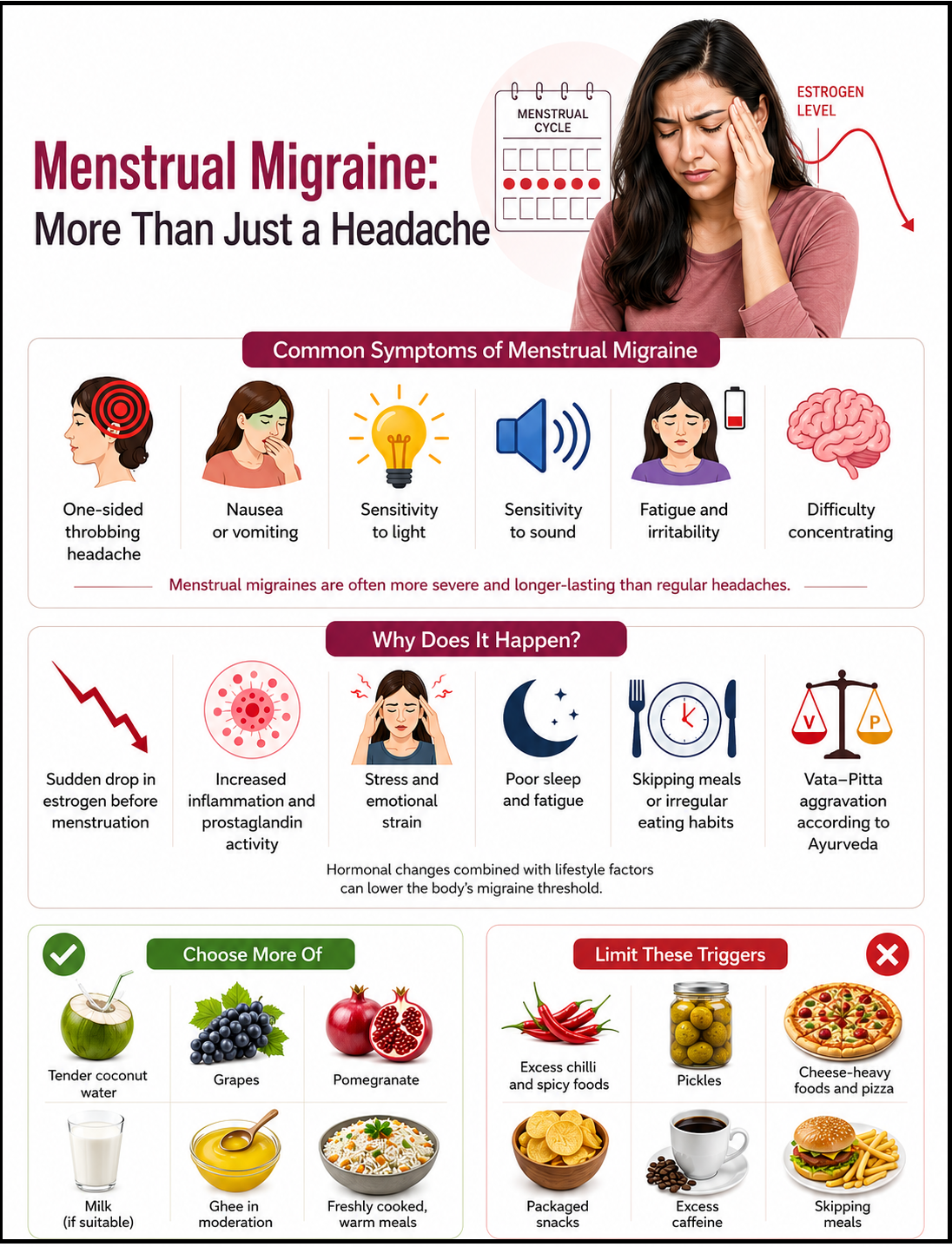
- The fall in oestrogen levels before the menstrual period is usually the main cause of this.
- The change in hormones could impact brain activity, blood flow and pain sensitivity.
In Ayurveda, this is often seen as a flare-up ofVata and Pitta in the head region.
That is why oestrogen migraine Ayurveda is often linked to heat, irritation, throbbing pain, and nervous system sensitivity.
When the body is already tired, stressed, undernourished, or sleep-deprived, the monthly hormonal change can become a migraine trigger.

What is a menstrual migraine?
Menstrual migraine refers to migraine attacks that occur around the menstrual window.
- They may start two days before the period, on the first day of bleeding, or during the first three days of menstruation.
- Some women get migraines only during this period.
- Others get them then and also at other times of the month.
- These attacks are often stronger than regular headaches, long-lasting, more difficult to manage and associated with nausea, vomiting, light sensitivity and sound sensitivity.
Common symptoms to notice
- Throbbing or pulsating head pain
- Pain on one side of the head
- Nausea or vomiting
- Sensitivity to light
- Sensitivity to sound
- Worsening before or during periods
- Irritability, heaviness, or exhaustion after the attack
Ayurveda understanding of the root cause
Ayurveda looks beyond hormones and asks: what has made the system so sensitive?
- Irregular meals can disturb Vata.
- Excess spicy, processed, fermented, or heavy food can increase Pitta and metabolic waste production (Ama).
- Poor sleep weakens the nervous system.
- Mental stress increases internal heat and instability.
- Dehydration, constipation and screen overload can also worsen the condition.
- Over time, these habits lower the migraine threshold.
This is why migraine before period, Ayurveda does not treat the period alone as the cause. It sees the cycle as the time when a pre-existing imbalance becomes visible.
Menstrual Headache and Special Ayurveda Patterns
Headaches in Ayurveda are known by the term Shiroroga and these can be of various types. Among the classical headache types, some are especially important in the context of menstruation:
- Ardhavabhedaka – one-sided, piercing headache that closely resembles migraine and is commonly seen around periods
- Pittaja Shirashoola – often overlaps with menstrual headache when the pain is fiery, throbbing, and linked to hormonal heat.
- Vataja Shirashoola – common when menstrual headache is triggered by stress, sleep loss, or irregular food habits
- Sannipataja – may be seen when symptoms are mixed and the woman experiences multiple triggers together
In clinical practice, menstrual headache often shows a Vata-Pitta pattern. The cycle creates a hormonal shift, and if the body is already weak, overheated, or stressed, the pain becomes more pronounced.
A practical Ayurveda view
- A headache that begins just before the period often points to hormonal sensitivity
- Burning pain suggests Pitta involvement
- Sharp, stabbing, or migrating pain suggests Vata involvement
- A severe, congestive headache suggests Kapha involvement
- When the headache repeats every cycle, it is important to look at digestion, sleep, stress, and food habits, not only for pain relief
In this way, Ayurveda sees a menstrual headache as a signal from the body — a sign that the cycle, hormones and internal balance need support.
Menstrual migraine vs other headaches
- Migraines are usually one-sided, pulsating and associated with nausea or light sensitivity.
- Tension headache is usually a tight, band-like pressure across both sides.
- Sinus-related headache often comes with facial heaviness, congestion, or pressure.
- Some women may think they have “just a headache”, but the monthly pattern often points clearly to migraine.
- “Pure” menstrual migraines only happen around your period. “Menstrually-related” migraines occur around your period but also at other times of the month.
Ayurveda treatment approach
- The goal of hormonal migraine Ayurvedic treatment is not only to reduce pain but also to correct the pattern causing it.
1) Shodhana or cleansing therapies
- Nasya – Medicated oil is administered through the nostrils. It helps support the head region and clear blocked channels. It is often used in head and neck complaints.
- Virechana – Gentle therapeutic purgation. Useful when Pitta is high. Helps reduce heat, irritation and inflammatory tendency.
- Basti – Administered for long-term relief and to avoid recurrence.
These therapies are administered during a non-menstruating period.
2) Shamana or palliative care
- Shirodhara – A steady stream of medicated liquid over the forehead. Helps calm the mind and nervous system. Often useful when stress and sleep disturbance are major triggers.
- Internal medicines
These therapies should always be chosen based on the woman’s constitution, symptoms, cycle pattern and digestive strength.
The role of shatavari for migraine
Shatavari for migraine is often considered when hormonal imbalance, dryness, depletion, or heat are important features.
It is traditionally known for:
- cooling action,
- nourishing support,
- and gentle rejuvenation.
It may be especially useful when migraine is accompanied by:
- exhaustion,
- irritability,
- heat,
- or menstrual sensitivity.
- It is not a quick painkiller.
- It is better understood as a supportive herb within a broader treatment plan.
Simple daily measures that help
For women struggling with migraine before period, Ayurveda often emphasises routine as much as medicine.
- Eat meals on time.
- Do not skip breakfast or remain hungry for long hours.
- Sleep early and consistently.
- Reduce late-night screen exposure.
- Stay well hydrated.
- Avoid excessive spicy, oily, fermented, packaged, and junk foods.
- Notice personal triggers such as cheese, pickles, excess coffee, or certain fast foods.
- Keep the body cool and the mind steady.
Helpful home measures
- Apply a cool compress to the forehead during heat-type pain.
- Rest in a dark, quiet room.
- Practise slow breathing.
- Anuloma Viloma can help calm the nervous system.
- Shavasana can reduce stress-related aggravation.
- Gentle oiling or nasal support should be done only under proper guidance.
Foods that may support recovery
- Fresh, light, home
- cooked meals
- Coconut water
- Ghee in moderate amounts
- Milk if it suits the individual
- Sweet fruits like grapes and pomegranate
- Warm, easily digestible food
- Simple food patterns that support digestion and reduce Ama
Foods and habits to reduce
- Pickles
- Excess chilli and pepper
- Papads
- Pizza and very cheesy foods
- Packaged snacks
- Skipping meals
- Irregular sleep
- Emotional suppression
- Overwork without rest
Why keeping a migraine diary helps
A diary is one of the most practical tools in women migraine treatment.
Track:
- date of headache
- relation to the menstrual cycle
- pain location
- severity and duration
- nausea, aura, or vomiting
- food eaten
- sleep pattern
- stress level
- medicines taken
- any repeated trigger
This process helps identify the exact pattern and makes treatment much more precise.
When medical review is important
Not all headaches are migraines. Not all migraines are hormonal.
Seek proper evaluation if there is:
- sudden severe headache
- visual loss
- numbness
- weakness
- speech trouble
- change in headache pattern
- headaches unrelated to periods but becoming frequent
- aura with new symptoms
Key Takeaways
- Migraine during the menstrual cycle is common, but it should not be ignored.
- Migraine in women teach us that the body is asking for balance, not just pain relief.
- Ayurveda focuses on the person, not only the symptom.
- Hormonal migraine Ayurvedic treatment works best when it combines internal balance, digestive care, stress reduction and proper lifestyle.
- Shatavari for migraine may support women whose symptoms are linked to depletion, dryness, and hormonal sensitivity.
- With the right plan, migraines can become less frequent, less intense and more manageable.
References