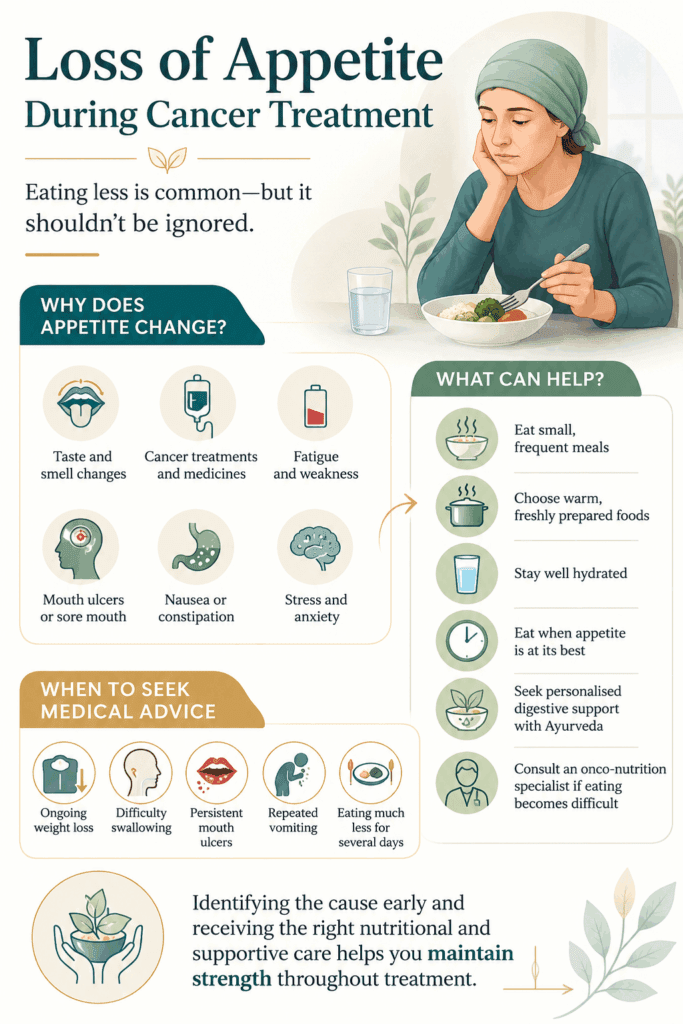
FAQs
I don't feel like eating at all. Should I still try to have regular meals?
You don't have to finish full meals if it is overwhelming. Even a few bites taken regularly throughout the day can be better than waiting until you feel hungry.
Is it okay if I eat only the foods I can tolerate during treatment?
For now, yes. The priority is maintaining nourishment, and your diet can be adjusted gradually as your appetite and digestion improve.
Why do I feel full after just a few spoonfuls?
Cancer treatment can temporarily slow digestion and affect how quickly your stomach empties. This is why many patients feel satisfied much sooner than they did before treatment.
Can loss of appetite happen even if I don't have nausea?
Yes. Many patients experience reduced appetite without feeling nauseous. Taste changes, fatigue, medicines, and slower digestion can all contribute.
Will eating more make my strength come back faster?
Not necessarily. Eating beyond what your body can comfortably tolerate may leave you feeling more uncomfortable. Small, consistent meals are often more practical than forcing larger portions.
Can caregivers do anything to make meals easier?
Yes. Offering smaller portions, avoiding pressure at mealtimes, and preparing foods the patient finds easier to tolerate can make eating much less stressful.
Is every patient with cancer expected to lose their appetite?
No. Some people continue eating normally throughout treatment, while others notice changes only during certain treatment cycles. Appetite changes vary from person to person.
How long can poor appetite continue after chemotherapy?
For many people, appetite begins to improve between treatment cycles, but recovery differs for everyone. If poor appetite persists or keeps getting worse, it should be discussed with the treating team
Can Ayurveda be used alongside chemotherapy?
Supportive Ayurveda care may be considered as part of an integrative approach, but it should always be planned by a qualified Ayurveda physician in coordination with your oncologist.
Can Ayurveda be used alongside chemotherapy?
One common mistake is focusing only on eating more. Understanding why appetite has reduced and addressing the underlying cause is often just as important as increasing food intake.
REFERENCES
Bendale Y, et al.
Exploring the potential of the traditional Indian system of medicine, Ayurveda, for developing an evidence-based integrative model of cancer care in elderly patients with cancer.
J Clin Oncol. 2024;42(16 Suppl):e13527.
Available from:
Buch Z.
Classical Ayurveda management of TCH (Taxane, Carboplatin, and Herceptin)-based chemotherapy induced peripheral neuropathy: A case report.
J Ayurveda Integr Med. 2024.
Available from:
Singh RH.
An assessment of the Ayurvedic concept of cancer and a new paradigm of anticancer treatment in Ayurveda.
J Altern Complement Med. 2002;8(5):609-614.
Available from: