Introduction
Many women with PCOS keep thinking, “I am eating carefully. I’m exercising regularly. Yet my weight keeps increasing.”
The type of weight gain in PCOS is far different from ordinary weight gain. The underlying reason is a complex combination of metabolic and hormonal alterations that cause the body to store fat despite efforts to burn it. This is why the hormonal weight gain women experience in PCOS often feels frustrating and unfair.
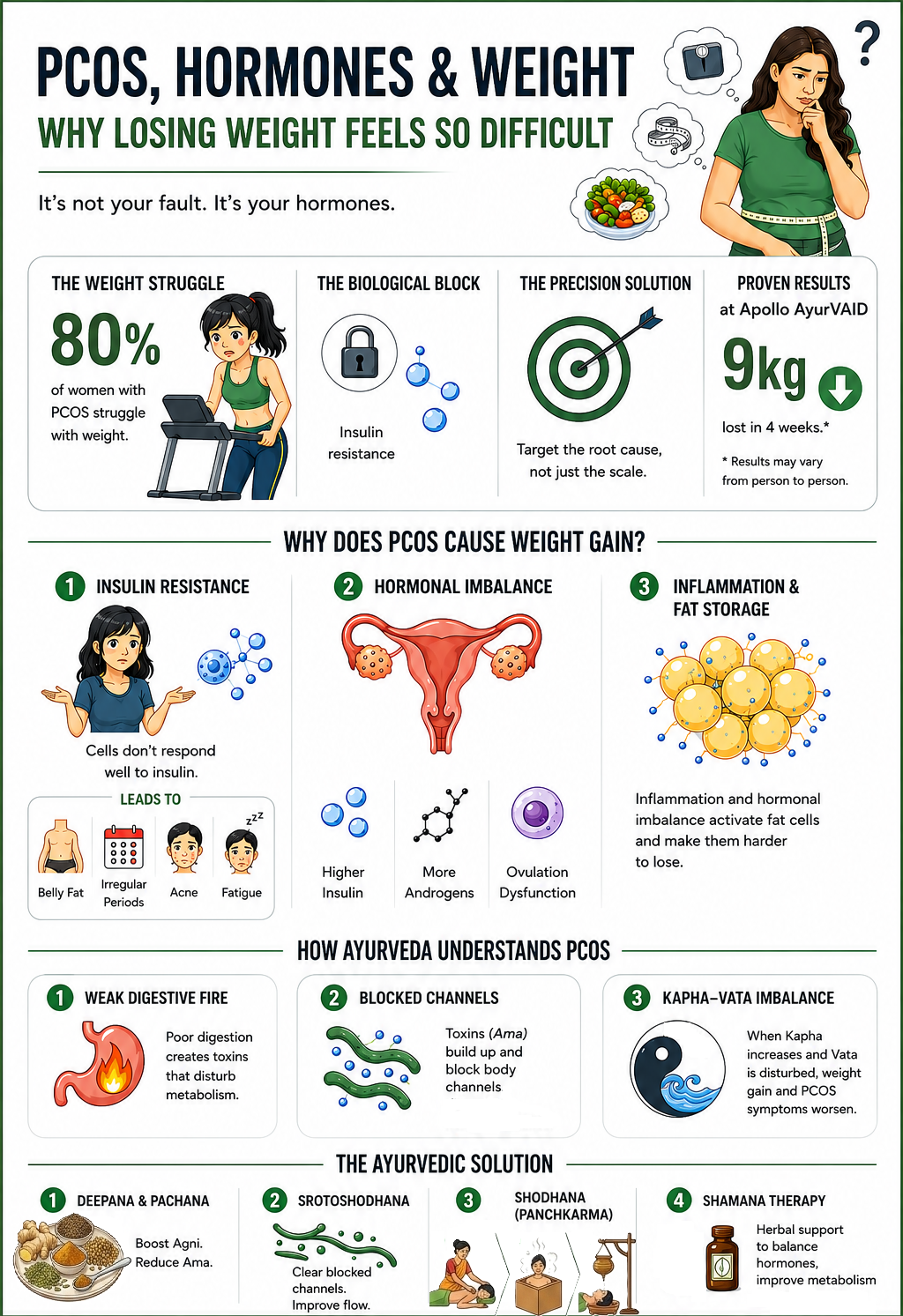
Nearly 70–80% of women with PCOS struggle with excess weight or find it unusually difficult to lose weight. The encouraging news is that once we understand why this happens, we can begin to address the root cause rather than merely chasing the numbers on the weighing scale.

Why Does PCOS Cause Weight Gain?
PCOS is not merely a disorder of the ovaries. It impacts the whole metabolic process within the body.
1. Insulin Resistance – The Invisible Force at Work
Insulin resistance is one of the major issues that people with PCOS deal with. Insulin is normally responsible for transporting glucose into the cells of our body. In PCOS, the body’s cells become less responsive to insulin. To compensate, the pancreas produces even more insulin.
Persistently high insulin levels encourage the body to store fat while preventing it from efficiently burning existing fat reserves. This is one of the biggest reasons why weight loss becomes so difficult.
2. Hormonal Imbalance
Higher levels of insulin cause the production of androgens in the ovaries.
The above hormonal changes cause:
- Abdominal obesity
- Menstrual irregularities
- Acne
- Excessive facial hair
- Weight loss difficulties
This condition leads to a vicious circle, as the weight gain contributes to the worsening of insulin resistance.
3. Fat Tissue Becomes Metabolically Active
Body fat is far more than a storage depot.
Fat cells release inflammatory agents and affect the production of hormones in women with PCOS and this chronic inflammation worsens insulin resistance and fat deposition.
It has recently been suggested by the medical community that PCOS be renamed to Polyendocrine Metabolic Ovarian Syndrome (PMOS) to better reflect that the condition is a systemic metabolic disorder, not just an “ovarian” issue.
How Does Ayurveda Understand PCOS?
From an Ayurveda perspective, PCOS is not viewed as an isolated disease affecting only the reproductive organs.
It reflects a deeper disturbance involving Agni, Doshas , Dhatus and Srotas.
The condition is often understood under descriptions such as Artava Dushti, Pushpaghni Jataharini and related disorders affecting female reproductive health.
1. Weak Digestive Fire (Agnimandya)
Everything begins with impaired digestive and metabolic fire.
When Agni becomes weak, food is not metabolised efficiently, leading to the formation ofAma —metabolic toxins and incompletely processed substances.
Ama interferes with normal metabolism and gradually affects multiple systems of the body.
2. Impairment of the Channels (Srotorodha)
With an increase in Ama, the transport channels of the body get blocked.
There is an obstruction of the Medovaha Srotas and Artavavaha Srotas in women with PCOS.
These blockages disturb hormonal balance, ovulation, menstrual regularity and healthy fat metabolism.
3. Kapha and Vata Imbalance
The pattern of PCOS weight gain Ayurveda describes most often involves an imbalance of Kapha and Vata.
Aggravated Kapha contributes to
- Weight gain
- Sluggish metabolism
- Cyst formation
- Fluid retention
- Increased body heaviness
Disturbed Vata affects movement within the body, resulting in irregular ovulation, menstrual disturbances and hormonal instability.
The combination creates the typical picture seen in many women with PCOS.
The Ayurveda Approach to PCOS-Related Weight Gain
The goal of PCOD treatment in Ayurveda is not simply to reduce body weight.
It should be the restoration of normal metabolism and proper hormonal balance.
At Apollo AyurVAID, we adopt a protocol-based approach to Precision Ayurveda that involves treating the underlying cause.
1. Deepana and Pachana
The initial treatment involves boosting the functioning of Agni and cutting down on the production of Ama.
Efficient digestion is usually the first step in restoring normal metabolism.
2. Srotoshodhana
As soon as the metabolism starts showing signs of improvement, treatment is aimed at clearing the blocked channels.
Improved flow of fluids in the body channels leads to better hormonal communication and metabolism.
3. Shodhana (Panchakarma)
In appropriately selected patients, Panchakarma plays an important role.
Procedures such as:
- Vamana
- Virechana
- Basti
are recommended based on individual assessment.
These therapies help reduce aggravated Kapha, improve metabolic efficiency, support liver function and promote hormonal balance.
4. Shamana Therapy
Individualised herbal formulations are prescribed to:
- Improve metabolism
- Reduce excess adipose tissue
- Correct Dosha imbalance
- Support reproductive health
- Improve insulin sensitivity
Treatment is always personalised according to the patient’s constitution, stage of disease and associated health conditions.
Diet Matters—But It Must Be Individualised
One of the biggest misconceptions is that every woman with PCOS should follow the same diet.
Ayurveda teaches us that nutrition must be tailored to the individual.
In general, women with PCOS benefit from:
Include
- Low glycaemic whole grains such as barley and millets
- Freshly prepared warm meals
- Moong, masoor, and chickpeas (soaked and well-cooked).
- Non-starchy varieties (bottle gourd, leafy greens, broccoli, beans).
- Berries, apples, pears, cherries, and grapefruit—eaten whole (not juiced).
- Ginger, turmeric, cinnamon, fenugreek (seeds), and cumin — many support glycaemic control and digestion.
Reduce
- Refined sugars
- White flour
- Processed foods
- Sugary beverages
- Excessively cold foods and drinks
- Heavy foods that aggravate Kapha
When digestion improves, metabolism gradually follows.
A Patient's Journey
One of our patients, a 28-year-old woman, came to Apollo AyurVAID Hospitals with multiple health concerns—PCOS, obesity and rheumatoid arthritis.
Irregular periods have been her concern since her teenage years and even after several dieting attempts, she has faced progressive weight gain issues.
She was found to have substantial insulin resistance apart from stiffness and inflammation in various parts of the body.
She received a comprehensive PCOD treatment in Ayurveda that comprised personalised remedies, Panchakarma treatments, including Virechana and Basti, physiotherapy as well as a well-thought-out Kapha-reducing diet regime.
In less than four weeks’ time, there was weight reduction from 105 kg to 96 kg. Other than weight loss, there were improvements in terms of a reduction in joint pain and a balanced appetite, along with increased energy and overall well-being.
Though everyone responds differently to the course of treatment, this is a classic example of how, in the case of metabolic disturbances, weight loss is a natural outcome of treatment. You can read more about such transformative results in our extended patient stories.
To Conclude
If you have PCOS and feel that your body is resisting every attempt to lose weight, do not assume that you simply need more discipline. In most cases, your body is responding to a complicated interaction between hormones, metabolism and inflammation.
This is precisely why the hormonal weight gain women experience in PCOS cannot be managed through calorie restriction alone.
The PCOS weight gain Ayurveda approach looks beyond the weighing scale. It seeks to improve Agni, eliminate Ama, restore healthy metabolic pathways and rebalance the Doshas through personalised treatment, diet and lifestyle interventions.
When you correct the internal imbalance, sustainable weight management becomes not only possible but healthier and more lasting.
References