Introduction
The Ayurveda term Pakshaghata is related to stroke-induced paralysis and may affect the ability to walk, speak, swallow and perform daily activities independently. One in four strokes occurs in people under 65, and stroke is a leading cause of death and disability worldwide.
Recovery is not just waiting for your strength to come back. It needs structured rehabilitation, continuous practice, medical supervision and support to the patient and his carer. At Apollo AyurVAID, stroke rehabilitation is a combination of personalised Ayurveda care and modern neurological rehabilitation which includes physiotherapy, speech therapy and occupational therapy to promote functional recovery and improve the quality of life.

What is a stroke? Understanding Pakshaghata in Ayurveda
A stroke happens when the blood supply to the brain is cut off, either because of a blockage (ischaemic stroke) or because a blood vessel bursts (haemorrhagic stroke). The injury that results can affect movement, balance, speech, memory, swallowing and mental health. Some people have a weakness on one side of the body. Others have trouble coordinating movements or doing everyday activities.
A stroke is a medical emergency. Sudden facial drooping, arm weakness or difficulty speaking requires immediate emergency medical attention. Ayurvedic treatment for stroke must never delay emergency assessment or acute stroke treatment. Rehabilitation begins once the patient is medically stable and the treating team confirms that therapy is appropriate.
In Ayurveda, Pakshaghata is classified among Vata Vyadhi, conditions understood through disturbances involving Vata Dosha, which governs movement and related functions. Classical descriptions also refer to obstruction inSrotas (channels). This is an Ayurveda explanatory framework; it is not a direct equivalent of the modern mechanisms of a blood clot or brain haemorrhage.
What to expect from Ayurvedic stroke rehabilitation
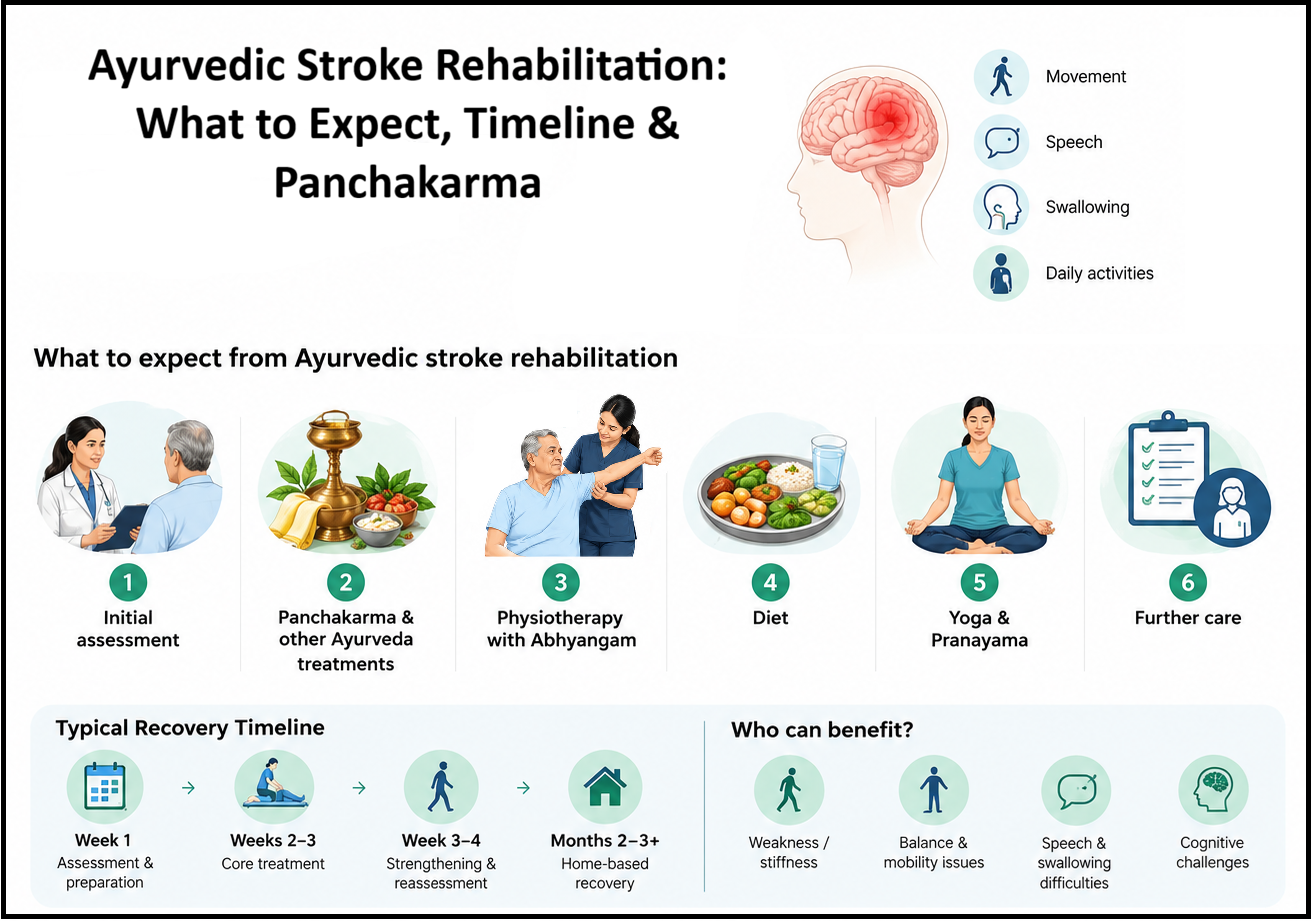
At Apollo AyurVAID, the rehabilitation plan is individualised according to the nature of the stroke, existing impairments, medical history and recovery goals. The process typically involves six components.
1. Initial assessment: The physician considers brain scans, laboratory tests, medications, blood pressure, other diseases, and motor, speech and swallowing functions of the patient. Ayurveda assessments, such as Prakriti (personal characteristics), may inform an individualised approach. The level of functioning and the realistic goals of recovery are set.
2. Panchakarma and other Ayurveda treatments: Some therapies are chosen in accordance with the state of health and strength of the patient. Preparation, external treatments and cleansing procedures are individualised. Panchakarma is not an obligatory therapy for all stroke patients.
3. Physiotherapy with Abhyangam: Physiotherapy treats strength, balance, coordination, joints and mobility. If appropriate, Abhyangam (oil massage) can supplement the effects of physiotherapy through relief and treatment of stiffness. Massages do not substitute rehabilitation exercises.
4. Diet: The food intake is organised based on nutritional needs, digestion, diabetic issues, hypertension and other diseases. Patients who have trouble swallowing will have a formal swallowing assessment and proper consistency of their food so as to avoid choking and aspiration.
5. Yoga and Pranayama: Proper yoga and breathing exercises may assist the patient in relaxation, body perception and comfortable breathing. These exercises have to be performed based on the patient’s balance, strength and respiratory capacity. Unassisted standing, excessive postures and breath-holding are prohibited unless approved by the treating team.
6. Further care: The patient’s progress is evaluated and the treatment plan is modified as needed depending on the patient’s capabilities. Such measures as the Fugl-Meyer scale, the Barthel Index and the Modified Rankin Scale can be helpful in assessing motor function and disability levels. Educating the caregivers and developing a realistic home regimen will be useful for further rehabilitation.
Panchakarma therapies used in stroke rehabilitation
Panchakarma procedures may form part of Stroke treatment in Ayurveda, but the selection, intensity and duration must be decided by a qualified physician following an individual assessment.
- Abhyangam: Warm medicated oil is applied using appropriate massage techniques. It may help with comfort, muscle stiffness and preparation for movement-based therapy. Medicated oils are also considered depending on the condition of the patient and the assessment of the physician. Massage alone cannot restore damaged brain tissue or guarantee motor recovery.
- Shirodhara: A continuous flow of liquid is poured over the head. This therapy may be used to promote relaxation and to support rest and mental health when appropriate. It shouldn’t be marketed as a therapy that will restore the brain or clear neurological blockages.
- Nasya: It is the process of administering specific medicines through the nostrils under expert guidance. In classical Ayurveda it is used for head and neck related conditions. Not a real brain cleanse. It may not be right for all patients, particularly those with problems swallowing or breathing. First, evaluate clinical suitability.
In selected cases, other Panchakarma procedures such as Vasti (medicated enema) or Virechana (therapeutic purgation) may be considered. They are not suitable for everyone and should not be attempted at home.
Ayurvedic formulations that may be considered
Depending on the patient’s health and prescribed medicines and treatment goals, an Ayurveda physician may consider classical formulations like
- Brahmi Ghrita: A medicated ghee, which is traditionally used to support mental functions and cognitive wellbeing.
- Ashwagandha: An ancient herb used to help promote strength and resilience. Whether it is appropriate depends on the medical condition of the patient and the concomitant medicines.
- Bala: Traditionally used to help with strength and function, such as in cases of weakness.
- Dashamula: A combination of ten roots used in Ayurvedic preparations, including for Vata disorders.
- Saraswatarishta: A classical fermented formulation traditionally used to support mental and cognitive functions.
These medicines are not proven cures for stroke and are not prescribed routinely to every patient. The treating physician must review the formulation, dose, duration, potential interactions and product quality. Do not stop prescribed stroke-prevention medicines or start herbal products without medical advice.
AyurVAID Kochi: Stroke Rehabilitation Program, Duration and Daily Routine
Kadavanthra, Kochi, the centre of Apollo AyurVAID, provides personalised inpatient and outpatient Ayurveda care, including neurological care and stroke rehabilitation. The hospital has inpatient rooms and dedicated facilities for Ayurveda therapies.
If a patient needs close supervision, coordinated therapies and carer training, an inpatient program is designed. Patients who are medically stable and can travel safely and continue rehabilitation at home may be candidates for outpatient care. The choice depends on the patient’s mobility, medical needs, support system and ability to engage in therapy.
How long does Ayurvedic stroke rehabilitation take?
Suitable patients may be considered for an initial treatment phase in the form of a 21-28 day inpatient program. The usual healing time is 21 to 45 days and the follow-up is individualised to the patient. Recovery and home-based practice can continue for several months or longer.
| Timeline | What may happen |
| Week 1: Assessment and preparation | Medical review, baseline functional assessment, recovery goals, dietary planning and preparation for selected therapies. |
| Weeks 2–3: Core treatment | Individualised Panchakarma procedures, where appropriate, alongside physiotherapy, mobility exercises and other rehabilitation needs. |
| Week 3–4: Strengthening and reassessment | Progressive movement practice, daily-activity training, cognitive or speech support as required and review of functional goals. |
| Months 2–3: Home-based recovery | Continued prescribed exercises, safe daily activities, diet and lifestyle guidance, caregiver support and scheduled follow-up. |
This is just an example timeline that could be modified depending on how well the patient responds and his/her medical condition.
The day of the inpatient stay might entail a visit by a doctor, recommended Ayurveda treatments, physiotherapy and other forms of rehabilitation as well as time for meals and rest.