- AyurVAID Pharmacy
Herbal formulations are an important part of Ayurveda treatment. Rather than administering medicinal substances in their raw form, Ayurveda prepares them into different dosage forms to improve stability, ease of administration, suitability, and shelf life. Depending on the clinical requirement, a medicinal herb may be prepared as a fresh juice, decoction, powder, medicated ghee, medicated oil, fermented preparation, or another classical formulation.
The principles governing the preparation of these formulations are described in Bhaisajya Kalpana, the branch of Ayurveda that deals with the preparation, preservation, standardisation, and therapeutic application of medicines. It includes formulations derived from herbal, mineral, animal, and herbo-mineral sources. Although this discipline encompasses all categories of Ayurveda medicines, herbal formulations remain the most widely used in routine clinical practice.
The term ‘Bhaisajya Kalpana’ is derived from two Sanskrit words: ‘Bhaisajya’, meaning medicine or that which relieves disease, and ‘Kalpana’, meaning preparation or formulation. Together, the term refers to the science of preparing medicines for therapeutic use. In clinical practice, the physician does not choose a medicinal substance just based on symptoms. Equal importance is given to the form in which it is prepared. Even when the same medicinal ingredient is used, different methods of preparation can produce different therapeutic effects.
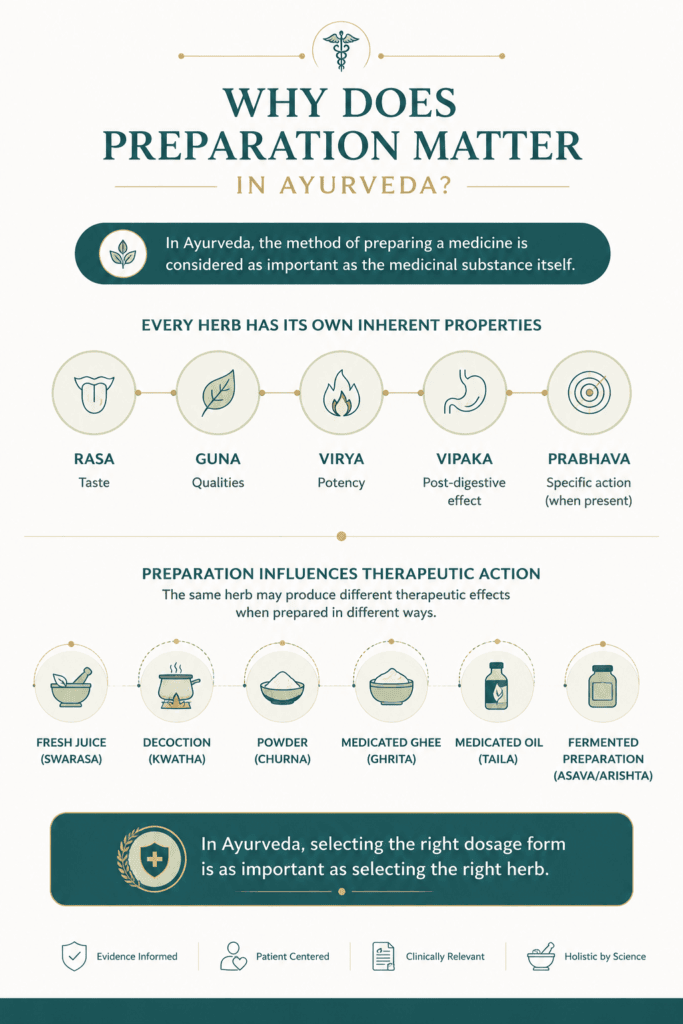
Ayurveda considers the method of preparing a medicine to be as important as the medicinal substance itself. Every herb possesses its own Rasa (taste), Guna (qualities), Virya (potency), Vipaka (post-digestive effect), and sometimes Prabhava (specific action). These inherent properties remain the basis of therapeutic action, but the pharmaceutical process influences how they are expressed after administration. For this reason, the same herb does not always behave in the same way when prepared in different dosage forms.
A simple example is ginger. Fresh ginger juice, dry ginger powder, and ginger processed in medicated ghee are all prepared from the same plant, yet they are not prescribed interchangeably. The method of preparation changes the nature of the final formulation by affecting the constituents extracted, their stability, and the way they become available to the body. Heating, grinding, fermentation, or processing with ghee or oil each produces a preparation with its own therapeutic characteristics.
The choice of a herbal formulation also depends on the patient’s Agni, as digestion determines how well a medicine is processed and utilised. A preparation that is appropriate for one individual may not suit another if digestive capacity is reduced. For example, medicated Ghrita is valuable in many chronic conditions, but it is generally introduced only when Agni is capable of digesting lipid-based preparations. If given too early in a patient with impaired digestion, it may not be properly assimilated and can contribute to heaviness or other digestive complaints.
The dosage form also influences the way a medicine acts. Liquid preparations are usually preferred when a quicker response is required or when digestion is weak. Medicated ghees and oils are more often selected in chronic conditions where prolonged tissue nourishment is needed. Fermented preparations are not appropriate for every patient or every condition. They are selected when the characteristics produced by fermentation are considered beneficial, particularly improved preservation and extraction of certain medicinal constituents.
Ayurveda recognises several types of herbal formulations, each prepared in a different way. The physician selects the formulation based on the herbs or ingredients used, the patient’s condition, and the treatment objective. The method of preparation affects the properties of the final formulation, its stability, and its clinical use.
Fresh preparations include Swarasa (fresh juice) and Kalka (herbal paste). These are prepared from fresh plant material and are generally used when fresh medicinal constituents are required. Because they contain little or no preservative, they are usually prepared immediately before administration.
Water-based formulations are among the most commonly prescribed dosage forms in Ayurveda. Kwatha (decoction) is prepared by boiling herbs in water to concentrate water-soluble constituents, whereas Phanta (hot infusion) and Hima (cold infusion) are used when milder extraction is more appropriate. The method of preparation varies according to the properties of the medicinal substances being used.
Medicines may also be processed with ghee or oil to prepare Ghrita and Taila. These formulations are prescribed for internal or external use according to the clinical requirement, and the choice between them depends on the nature of the medicine and the purpose of treatment.
Although these dosage forms differ in their methods of preparation, they are all intended to deliver medicinal substances in a form appropriate to the patient’s clinical condition. The physician selects the formulation according to factors such as digestive capacity, stage of disease, constitution, and the overall objectives of treatment.
The dosage form is integrated with diet, lifestyle measures, Panchakarma, and medicinal therapy rather than being chosen independently. Diet and medicine both depend on efficient digestion. When Agni is impaired, lighter formulations are usually combined with dietary measures that reduce the digestive workload. As digestion improves, more nourishing preparations may be introduced when clinically appropriate.
Lifestyle has a direct influence on the response to medicines. Irregular meals, inadequate sleep, and habits that repeatedly impair digestion often reduce the effectiveness of treatment, even when the medicine itself is appropriate.
The purpose of treatment also influences the pharmaceutical approach. Medicines selected for Shamana are intended to pacify aggravated Doshas. In Shodhana, different preparations are required before, during, and after purification, each serving a specific purpose in the procedure.
This is seen clearly in Panchakarma. Medicated Ghrita is commonly used for internal oleation before purification, whereas medicated oils, decoctions, powders, and other preparations are introduced as required during the different procedures.
The dosage form is not always fixed. A patient who begins treatment with a light aqueous preparation may later receive the same medicine as a medicated Ghrita or another formulation once digestion has improved and the focus shifts towards tissue support. As the patient’s condition changes, the dosage form may also be modified even when the medicine itself remains unchanged.

Herbal formulations are used in Ayurveda not only for the treatment of disease but also to help maintain normal physiological function when selected according to an individual’s needs. Their preventive value lies less in the routine use of medicines and more in choosing the appropriate formulation before minor functional disturbances progress into established disease. Early recognition of impaired Agni often allows relatively simple changes in formulation and treatment strategy. A preparation that is appropriate under one set of circumstances may not remain suitable as these factors change. Periodic reassessment, therefore, forms an important part of Ayurveda prescribing.
In contemporary clinical practice, patients frequently present with irregular dietary habits, disturbed sleep, sedentary lifestyles, chronic psychological stress, and metabolic risk factors. These factors influence digestion, metabolism, and tissue function, making the selection of an appropriate dosage form an important aspect of treatment planning. Rather than relying on routine or prolonged use of medicines, Ayurveda emphasises matching the formulation to the individual’s current physiological condition. The preventive role of herbal formulations therefore, lies in preserving digestive capacity, supporting normal tissue nutrition, and adapting pharmaceutical preparations to the patient’s changing clinical needs. Careful selection of the dosage form allows medicines to be used appropriately throughout different stages of health and disease.
As we work hard to improve our services, your feedback is important to us. Please take a moment to help us serve you better.
Subscribe to our hospital newsletter for the latest health tips, updates on services, patient stories, and community events. Sign up today and stay informed!

Report Problem
Popular Searches: DiseasesTreatmentsDoctorsHospitalsWhole person careRefer a patientInsurance

