Nadi Pariksha denotes the examination of the pulse as a diagnostic method. The term combines Nadi (pulse) and Pariksha (clinical examination). In Ayurveda, pulse examination is used to assess the condition of Dosha, Agni (digestive and metabolic activity), Dhatu (body tissues) and Srotas (body channels). For this reason, the pulse is viewed as more than a simple measure of heart rate. It provides clues about physiological balance, developing disturbances and the overall condition of the patient.
Much of Ayurveda diagnosis focuses on functional disturbances that appear before clear structural changes develop. Nadi Pariksha evolved within this clinical approach. Through careful observation of pulse qualities such as movement, rhythm, force and stability, the physician attempts to understand the nature of Dosha imbalance and the direction in which a disease process is progressing.
Since these Doshas regulate all physiological activities in the body, any disturbance in their balance is expected to influence the pulse. For this reason, the pulse is examined as an indicator of both health and disease.
All three Doshas move in the body through Rasa and Rakta Dhatu. Changes occurring within the body are therefore believed to be reflected in the pulse. The physician attempts to identify these changes through careful examination. Several pulse characteristics are assessed, including Gati (movement), Vega (rate), Tala (rhythm), Bala (force), Akruti (volume and tension), Tapamana (temperature) and Kathinya (hardness of the vessel wall). These findings are interpreted together rather than separately. A pulse may be rapid but weak, slow but forceful, or irregular yet stable in volume. Interpretation depends on the overall pattern.
A physician performing Nadi Pariksha should remain calm, focused, and mentally stable, as accurate interpretation requires concentration and sensitivity. The examination is usually performed over the radial artery using the index, middle and ring fingers. Traditionally, the index finger is associated with Vata, the middle finger with Pitta and the ring finger with Kapha. The objective, however, is not simply to identify an individual Dosha. The physician evaluates the relative influence and interaction of all three. Pulse examination is avoided immediately after food, a bath, a massage, or sleep, or during extreme hunger or thirst. Similarly, a distracted or mentally unstable physician may not obtain accurate readings.
Although the radial artery is the primary site, classical descriptions mention multiple pulse locations such as the ankle, neck, nose, eye, tongue, and others. These are collectively referred to as Shodasha Pranabhodhaka (sixteen diagnostic sites) and are used in specific clinical conditions.
Pulse examination is also carried out at different depths. Superficial palpation is commonly used to assess Vikriti (current imbalance), while deeper palpation helps in understandingPrakriti (constitutional nature). In actual clinical practice, however, the two are not always easy to separate. The pulse may carry features of the patient’s natural constitution alongside changes produced by the disease.

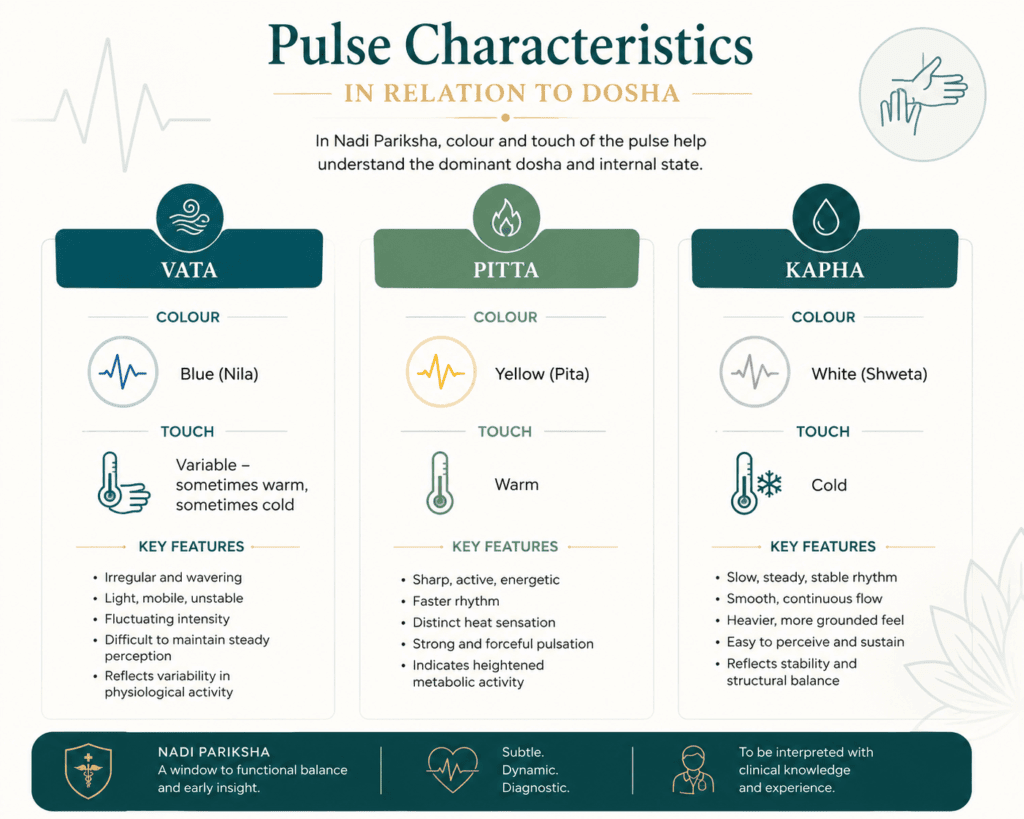
Nadi Pariksha is influenced by time of day, season, and age. Dosha dominance changes naturally throughout the day — Kapha in the morning, Pitta in the afternoon, and Vata in the evening. Similarly, pulse characteristics vary with seasonal and age-related physiological changes. The normal pulse is often compared to Gandupada Gati (earthworm-like movement), indicating a smooth and uniform pulsation. Variations in pulse characteristics are observed according to constitution.
Most patients demonstrate mixed patterns. A pulse may combine the instability of Vata with the heat of Pitta , or the heaviness of Kapha with underlying Vata irregularity. Interpretation therefore depends upon recognising dominant tendencies.
Pulse examination is described at seven distinct levels in Nadi Vigyana.The superficial levels are used to assess Vikriti (current imbalance), Manas Vikriti (mental disturbances) and Subdoshas (functional subdivisions of the Doshas). Intermediate levels provide information regarding Ojas (vital essence), Tejas (metabolic principle), Prana (vital life force) and the status of the Dhatus (body tissues), while the deepest levels are associated with Manas Prakriti (mental constitution) and Prakriti (constitutional nature). The physician gradually varies finger pressure and observes changes in the pulse at each level. Knowledge of Subdosha involvement assists in evaluating Samprapti (pathogenesis) and helps the physician understand the progression of a disorder.
Changes in the pulse often accompany the development of disease. In the initial stages, the pulse may show subtle alterations even when symptoms are mild. As the Dosha disturbance progresses, the pulse becomes more variable and is difficult to classify under a single Dosha.
In conditions involving all three Doshas, known as Sannipata, the pulse may continually change its character, displaying features of Vata, Pitta and Kapha at different times.
An important aspect of Nadi Pariksha is its use in assessing Sadhya-Asadhyata (prognosis). Classical texts describe various pulse characteristics that were considered helpful in estimating the course and outcome of disease. Particular attention was given to pulses that became weak, irregular, thread-like, or difficult to palpate. Changes in the usual position of the pulse were also regarded as significant. Such findings were often interpreted as signs of declining strength and vitality.
The concept of Arishta Lakshana (ominous signs) occupies an important place in this regard. A pulse that becomes irregular, disappears intermittently or continually changes its character is considered unfavourable. Similar importance was given to pulses that were excessively weak, cold or difficult to perceive.
Classical descriptions of Asadhya Nadi (pulse associated with incurable conditions) include marked irregularity, progressive weakening and abnormal pulsation. These findings were regarded as indicators of severe disease and poor prognosis.
Ayurveda texts also describe Mrityu Suchaka Nadi (death-indicating pulse). Such pulses may be extremely weak, cold, intermittently absent or constantly changing in character. One classical comparison likens this pulse to the rhythm of a Damaru (two headed drum), where the pulsation is prominent at one moment and barely perceptible the next.
These descriptions highlight the importance of Nadi Pariksha not only in diagnosis but also in understanding the probable outcome of a disease.
Nadi Pariksha remains an important part of Ayurveda diagnosis. It is used to assess Dosha activity, understand the progression of disease and evaluate the overall condition of the patient. Rather than identifying a disease through a single pulse pattern, the examination helps the physician understand the underlying pathological changes.
Nadi findings are interpreted along with Darshana (inspection), Sparshana (palpation), Prashna (clinical questioning) and other methods of examination. For this reason, pulse examination is not used in isolation but as a part of comprehensive clinical assessment.
Repeated examination is often more useful than a single observation. Changes in Gati (movement), Tala (rhythm), Bala (force) and other pulse characteristics may indicate changes in the disease process and response to treatment. This dual role in diagnosis and prognosis distinguishes Nadi Pariksha from many other methods of clinical examination described in Ayurveda.
As we work hard to improve our services, your feedback is important to us. Please take a moment to help us serve you better.
Subscribe to our hospital newsletter for the latest health tips, updates on services, patient stories, and community events. Sign up today and stay informed!

Report Problem
Popular Searches: DiseasesTreatmentsDoctorsHospitalsWhole person careRefer a patientInsurance

