Introduction
Breathing is a basic act of life, but for millions suffering from chronic respiratory conditions who seek Ayurvedic medicine COPD and asthma care, every breath can be an uphill struggle. Wheezing, chest tightness, coughing, and never-ending shortness of breath disturb sleep, limit everyday activities and diminish overall quality of life. Traditional inhalers and bronchodilators provide quick relief in acute exacerbations but do little to explain the recurrence of mucus and airway sensitivity; they only suppress symptoms.
Ayurveda provides a time-tested, root cause approach to the treatment of asthma. By seeing respiratory distress through the lens of doshas and tissue metabolism, Ayurvedic treatment for asthma aims to clear clogged airways, strengthen digestion, eliminate metabolic toxins and restore long-term lung function.

Tamaka Shwasa (Asthma) – Etiopathogenesis: How Asthma Develops
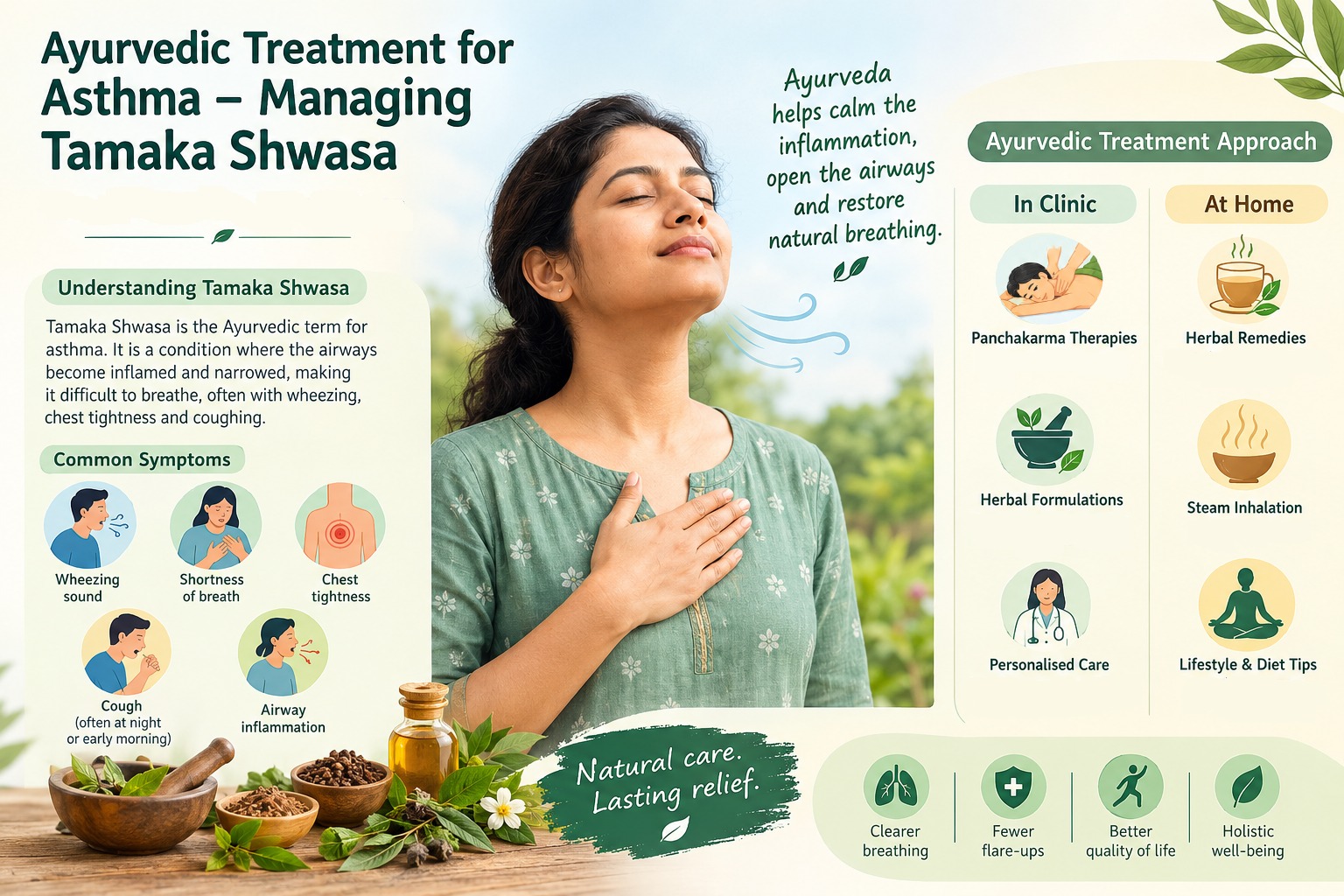
Classical Ayurveda texts correlate bronchial asthma with Tamaka Shwasa, a subtype of respiratory illness (Shwasa Roga) affecting the Pranavaha Srotas (respiratory channels). The word Tamaka is derived from Tamas (darkness) and refers to the feeling of “entering into darkness” or extreme panic that is experienced in severe breathlessness.
In classical Ayurveda, the disease process starts in the digestive tract (Amashaya). Weak digestive fire (Mandagni) leads to incomplete digestion and formation of metabolic waste called Ama. If a person with this underlying imbalance eats cold, heavy or mucus-forming foods, or is exposed to dust, smoke, cold winds or emotional stress, the Vata and Kapha doshas become extremely aggravated.
- Channel Obstruction (Srotorodha) – Vitiated Vata enters the respiratory passages and forces excess Kapha (mucus) from the chest and stomach into the airways. Pranavaha Srotas are coated and blocked with thick sticky mucus.
- Pratiloma Gati of Vata – Accumulated Kapha blocks the normal downward movement of Prana Vata and forces it to move in a reverse upward direction (Pratiloma Gati).
- Bronchospasm & Wheezing (Ghurghuraka) – The forced air passing through narrowed, mucus-filled bronchial passages produces a characteristic rattling or wheezing sound (Ghurghuraka), chest constriction (Urah Peeda) and severe cough.
This pathology is the reason why symptoms are often worse at night, when it is damp or cloudy or after cold food – when Kapha is naturally increased. Understanding these mechanisms helps practitioners to apply protocols of asthma treatment in Ayurveda management aimed at both airway constriction and chronic inflammatory hyper-responsiveness.
Clinical Therapies
Tamaka Shwasa is a Kapha-Vata disease originating mainly in Amashaya (stomach/chest area). Therefore in its clinical management, active purification therapies (Shodhana) is given priority over passive management (symptom suppression). Direct removal of phlegm buildup opens up the airway passages.
Vamana Karma (Therapeutic Vomiting)
It is the gold standard Panchakarma therapy for elimination of vitiated Kapha from the upper gastrointestinal and respiratory tract. Vamana removes the deep-seated mucus from the bronchial tree physically rather than by temporary bronchodilation.
Preparation (Purvakarma) – The patient undergoes 3 to 7 days of Deepana-Pachana (herbal appetisers to digest Ama) and Snehapana—taking increasing doses of medicated ghee to loosen toxins that have adhered to tissue walls. Then external oleation (Abhyanga) and herbal steam (Swedana) move these liquefied toxins toward the digestive tract.
Procedure (Pradhana Karma) – Emetic decoctions are given under strict medical supervision. Vomiting under control expels thick, stagnant mucus.
Therapeutic Benefits – Clinical research has demonstrated that Vamana leads to a significant reduction in total serum IgE levels, lowers eosinophil counts, relieves chest tightness, and dramatically decreases the use of rescue inhalers.
Nasya Chikitsa (Nasal Administration)
Nasya is the administration of medicated oils or herbal drops in the nasal passages. Being the door to the head and respiratory system (Nasa Hi Shirso Dwaram), the nose is the gateway to the head and respiratory system. Nasya removes the residual Kapha from the paranasal sinuses and upper airways, thus relieving rhinitis, sneezing and post-nasal drip that precipitate asthmatic attacks.
Clinical Adjunctive Treatments
- Chest Abhyanga & Swedana: This includes massaging the chest and back with warm medicated oils or mustard oil infused with Ajwain. It is followed by localised steam (Nadi Sweda) which liquefies sticky bronchial secretions and relaxes spastic intercostal muscles.
- Marma Chikitsa: Applying gentle, rhythmic pressure on important energy points can help unblock chest energy, leading to reduced anxiety and improved airflow.
Important Herbal Remedies
Clinical procedures clear structural blockages but targeted botanical formulations offer sustained anti-inflammatory, bronchodilatory and immunomodulatory support. Herbal remedies are an important companion in asthma Ayurvedic medicine.
- Vasaka (Adhatoda vasica) – It is praised in Ayurveda pulmonology. It contains active quinazoline alkaloids, vasicine and vasicinone which are powerful bronchodilators and mucolytic expectorants. Vasaka relaxes bronchial smooth muscle spasm, thins tenacious phlegm and facilitates expectoration. Vasaka is an essential ingredient of classic remedies like Vasavleha and Vasaka granules.
- Piper longum (Pippali) – Pippali is a powerful rejuvenative (Rasayana) herb for the respiratory system. Pippali is rich in piperine. It has Ushna (warming) and Kapha-Vata Shamaka properties that suppress chronic coughing, digest Ama and improve systemic bioavailability of other remedies. Pippali Rasayana is an immunomodulator that reduces bronchial hyper-reactivity and protects against seasonal allergic flare-ups when taken regularly.
- Turmeric (Curcuma longa) – Curcumin is the active ingredient in Haridra (Turmeric). Curcumin is a powerful anti-inflammatory, antioxidant, and anti-allergic agent. Clinical trials show that curcumin add-on therapy significantly improves Forced Expiratory Volume, decreases white blood cell count and ESR and stabilises mast cells against allergen-induced histamine release. This is an effective Ayurvedic medicine for asthma and allergy.
AyurVAID Clinical Protocol: Personalised Care at Home and Clinic
At Apollo AyurVAID, asthma management is provided through Precision Ayurveda, a structured protocol that considers the individual’s constitution (Prakriti), disease stage (Vikriti), digestive fire (Agni) and specific environmental triggers.
Nidana Parivarjana (Avoidance of the trigger)
The first step in preventing asthma attacks is to identify and remove environmental and dietary causes:
- Avoid cold water, ice cream, curd, heavy dairy, fried items, fermented items and unboiled milk.
- Minimise exposure to dust, smoke, aerosol sprays, chemical fumes and cold damp air.
- Keep your living space clean and dust-free. Do not suppress natural bodily urges (Vegadharana).
Palliative Care (Shamana Chikitsa)
Classical formulations for daily symptom management balancing Kapha and Vata, without causing sedation or dryness include:
- Herbal powders: When appropriate, selected herbal preparations mixed with honey may help soothe throat irritation and cough.
- Classical liquid preparations: Certain traditional formulations are used to manage respiratory symptoms, but their safety and effectiveness vary. They should not be relied upon to relieve acute breathing difficulty.
- Formulations: Some traditional formulations are used in respiratory care but require careful medical supervision due to potential safety risks. They should never replace prescribed asthma medication or emergency treatment.
Rejuvenation (Rasayana Chikitsa)
When the acute inflammation subsides, rejuvenative preparations are prescribed. These tonics restore structural integrity to respiratory tissues, strengthen lung capacity and reduce future disease recurrence.
Home Care & Breathwork
- Warm Diet: Eat light, freshly prepared, warm food like mung dal khichdi, peya (rice gruel), thin vegetable soup, warm water and digestive spices (ginger, black pepper, cumin, turmeric).
- Home Steam Inhalation: Eucalyptus oil, mint or camphor is mixed with the water and inhaled. Steam inhalation helps dissolve stubborn phlegm during mild chest tightness.
- Pranayama: Practising slow, diaphragmatic breathing techniques when stable – such as Nadi Shodhana (alternate nostril breathing), Anuloma Viloma and Bhramari (humming breath) – improves ventilatory efficiency, enhances nasal nitric oxide production, lowers anxiety-induced bronchospasm and relaxes intercostal muscles. Active attacks should not be accompanied by forceful breathing practices like fast Kapalbhati or Bhastrika.
Conclusion
You don’t have to let chronic asthma run your life. The conventional emergency inhalers are still essential for acute attacks, but adopting the classical Ayurveda principles paves a sustainable way for long-term respiratory health. Ayurveda tackles the root causes of Tamaka Shwasa with a combination of bio-purification (Vamana and Nasya), potent herbal medicines (Vasaka, Pippali, Haridra), dietary discipline and therapeutic breathwork. You will be able to clear your lungs and reduce dependence on rescue medications and breathe freely again.