Some discomforts don’t really demand attention. They just stay. You notice them in passing. While getting up from a chair. While turning a little too quickly. Sometimes, only at the end of the day, when everything slows down, and your body is no longer distracted. It is not sharp pain. Not something that makes you stop what you are doing. But it is there often enough to feel familiar. Most people let it pass.
In Ayurveda, though, this kind of pattern is not usually ignored. When something repeats itself in the body, even quietly, it often points to vata dosha. Especially when the discomfort shows up around joints, muscles, or anything that involves movement. It does not arrive all at once. It builds slowly. A little dryness here. A little stiffness there. This is usually where formulations like Mahanarayana Thailam are used. Not as a last step. More like something that comes in early, when the signs are still manageable.
Mahanarayana thailam uses are often discussed in detail. What’s talked about less is which format people continue using over time. Because in the end, something only works if it becomes part of your routine. And that usually depends on how easy it is to apply, carry, and come back to without thinking too much about it. In this blog, we’ll go through what makes Mahanarayana Thailam useful, what it contains, and how AyurVAID’s Mahanarayana Thailam Ointment offers a more convenient way to use it while staying true to the classical preparation.
What is Mahanarayana Thailam
Mahanarayana Thailam is one of those formulations that has stayed relevant without needing much change.
It comes from taila kalpana (the Ayurveda method of preparing medicated oils), where herbs are processed into a base oil through a slow, deliberate method. The idea is not just to combine ingredients, but to let the oil absorb and carry their properties properly. That process makes a difference. Even if you do not notice it immediately.
Traditionally, it has been used in vata vyadhi (conditions that arise from an imbalance in the Vata dosha). These usually involve joints, muscles, and sometimes nerve pathways. The herbs used here are often described using terms like balya (supporting strength) and brimhana (nourishing and building tissues). These are not quick-action categories. They work gradually, with regular use.
That is why most Mahanarayana taila benefits are not about instant relief. They are about making movement feel a little easier over time. Less resistance. Less effort.
Mahanarayana Thailam Ointment vs Oil
When looking at Mahanarayana Tailam uses, the format usually becomes relevant only after you start using it regularly. The oil is generally used over a larger area or as part of a massage. It spreads easily but usually needs a bit more time.
The ointment is more contained. It stays where you apply it, which makes it easier for smaller areas and quicker use.
Format | Application | Mess and staining | Carry and use | Where it fits |
Oil | Needs a bit of time, often involves a massage | Can feel messy, may stain clothes if not absorbed | Less convenient to carry around | Larger areas, slower routine |
Ointment | Quick, direct application | More controlled, less chance of staining | Easy to carry and reapply | Targeted, everyday use |

Ingredients & Benefits of Each Herb
What goes into the formulation is important. But how it is prepared matters just as much.
Before the main process begins, the oil often undergoes Taila Murchana (a preparatory refinement step). In simple terms, this involves processing the oil with selected herbs and water over controlled heat until the water content is fully evaporated. It is a slow step, but it changes the quality of the oil in a few important ways. It helps remove ama (undesirable or impure components), along with moisture and any residual odour from the raw oil. The oil becomes more stable, less prone to going rancid, and easier to work with over time. More importantly, it improves the yogavahi effect (ability to carry and deliver active properties). Once processed, the oil is better able to absorb and hold the qualities of the herbs added later. It is not something visible once the formulation is ready, but it plays a role in how well the oil performs. Let us explore the key ingredients one by one.
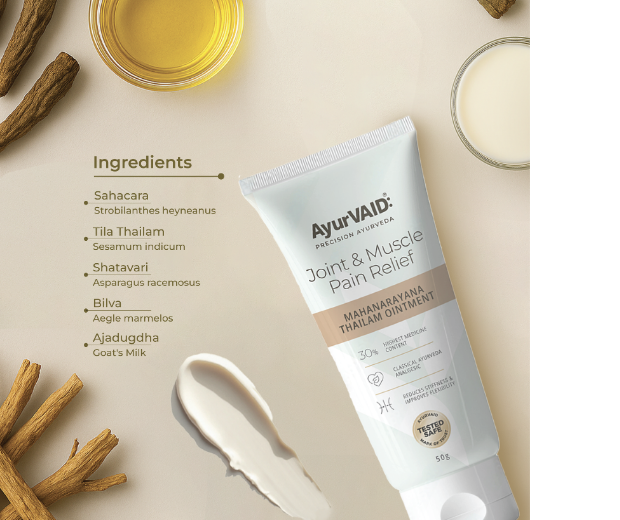
- Sesame oil forms the base. It is known for its ability to support lubrication, especially where dryness is involved.
- Sahachara (Strobilanthes ciliatus) is often included where stiffness affects movement, particularly in the lower body.
- Shatavari (Asparagus racemosus) adds nourishment. It is associated with balya (strength-promoting) and brimhana (tissue-building), which makes it useful when the body feels slightly depleted rather than just tight.
- Vilva (Aegle marmelos) brings a sense of stability. It is used when joints feel unreliable or strained.
Individually, these ingredients have specific roles. Together, they create something more balanced. That is usually how Mahanarayana ingredients are understood.
Top 10 Uses of Mahanarayana Thailam Ointment
Mahanarayana Thailam Ointment is used across a wide range of everyday discomforts related to movement, strain, and stiffness. It can help relieve things like:
- Morning stiffness in the joints. That slow feeling when you first start moving
- Lower back discomfort that builds up after long sitting or poor posture
- Neck and shoulder tightness, especially by the end of the day, if you’ve been on a screen a lot
- Muscle fatigue after activity. Not exactly pain, more like your muscles have had enough
- General body aches from overuse or long working hours
- That radiating discomfort from the lower back into the legs, often seen in sciatica
- Joint pain linked to arthritis, commonly in the knees or fingers
- Mild sprains or muscle strain after sports or sudden movement
- Ligament tightness that shows up after overexertion or awkward motion
- A general sense of stiffness or reduced ease in movement, often associated with vata imbalance
These aren’t always treated as “conditions”. A lot of people simply start using it when these patterns show up more often than they used to. Lower back discomfort and sciatica are probably the most common reasons.
Mahanarayana Thailam Ointment for Back Pain & Sciatica
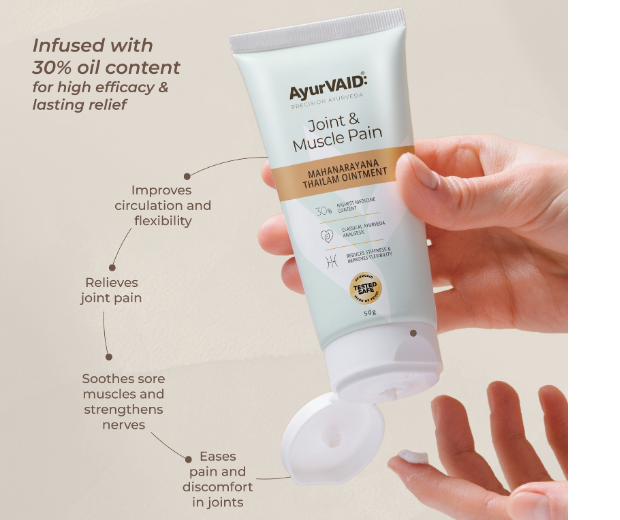
Lower back issues are where this ointment is most commonly used. In Ayurveda, this condition is usually linked to vata in the lumbar region. Over time, it shows up as stiffness, tightness, or a slight restriction in movement. Nothing sudden, but it builds.
Sometimes the discomfort stays in the lower back. Sometimes it travels down the leg, as seen in gridhrasi.
For back pain:Applied directly over the lower back area
- Some people prefer a light massage, mainly for comfort
- With regular use, movement t
- ends to feel a bit easier over time
For sciatica (gridhrasi):
- Application usually follows the path of discomfort, not just one spot
- Since the sensation travels, the coverage is a bit more spread out
- Consistency matters more than how much pressure you use
This is not about quick relief. It works better when used regularly.
Mahanarayana Thailam Ointment for Arthritis & Joint Pain
In Ayurveda, joint-related discomfort is often described as sandhi gata vata. It doesn’t appear suddenly. It builds over time. Usually starts with mild stiffness after rest. Then you begin to notice it during movement, too.
This is where the ointment is commonly used:
- Knee stiffness, especially with age or repeated strain
- Shoulder tightness from posture or daily use
- Joints that feel less “smooth” in movement than before
With continued use:
- Morning stiffness may feel less pronounced
- Movement tends to feel more comfortable
- That constant “tight joint” feeling gradually reduces
Mahanarayana Thailam Ointment for Sports Injuries & Muscle Recovery
- Muscle soreness after workouts or training
- Mild sprains from sudden or awkward movement
- Tightness in legs, shoulders, or arms after exertion
- General fatigue after physical overuse
Mahanarayana Thailam for Head, Nerve and Sensory Health
Not all discomfort is visible. Sometimes it shows up as heaviness in the head, occasional tingling, or a sense of strain that builds up quietly. These are often linked to vata imbalance, especially when the nerves feel overworked or the body is running low on rest.
Mahanarayana Thailam is traditionally used in these situations. It is known for its grounding and nourishing qualities, especially when applied regularly over time.
In practice, it is used across a few common concerns:
• Head heaviness and tension
It helps ease tightness in the scalp and promotes a feeling of relaxation.
• Nerve-related discomfort
Supports the nervous system and helps reduce sensations like tingling or mild numbness.
• Sensory fatigue (eyes, ears, scalp)
It helps calm overstimulation caused by long hours of strain or screen exposure.
• Sleep-related restlessness
Encourages relaxation and supports better sleep when used as part of a routine.
The way it is used can vary depending on the need:
• Shiro Abhyanga (head massage)
Gently massaged into the scalp to relax the head and improve circulation.
• Local application
Applied over areas like the neck or temples where strain is felt.
• Regular use
It is used consistently, either daily or a few times a week, for sustained benefit.
How to Apply Mahanarayana Thailam Ointment
There’s nothing complicated here.
- Apply a small amount over the affected area
- Spread it gently so it absorbs into the skin
- If needed, use a light massage, but don’t overdo it
- In acute soreness, a lighter application usually feels better than pressure
Side Effects and Precautions
Mahanarayana Thailam Ointment is generally safe for external use.
- Side effects are uncommon
- Some people may notice mild irritation, especially with sensitive skin
- A patch test is always a good idea before regular use
Response can vary depending on prakriti (individual body constitution).
Mahanarayana vs Other Pain-Relief Creams
Apollo AyurVAID Mahanarayana Thailam Ointment
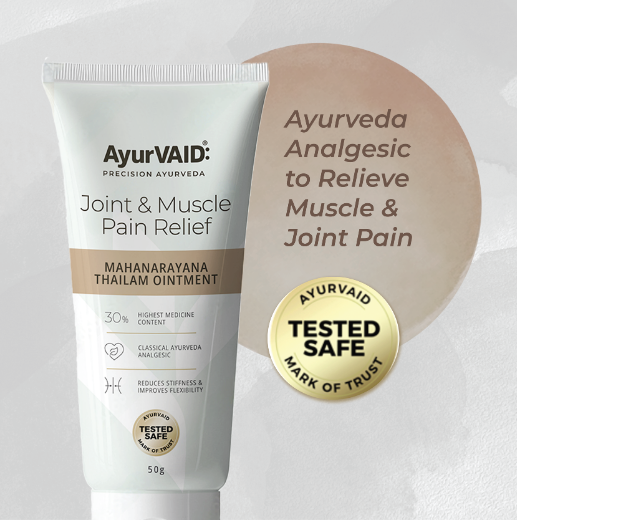
Mahanarayana-based external formulations are available across different commercial preparations, where the proportion of classical oil content may vary depending on formulation standards. In comparison, Apollo AyurVAID Mahanarayana Thailam Ointment is formulated with around 30% Mahanarayana Thailam as the active medicinal base, making it relatively richer in classical oil content than many standard topical preparations. It is part of India’s TESTED SAFE Ayurveda range, where heavy metals and microbial load are well within permissible limits, adhering to API standards—ensuring purity, safety, and therapeutic integrity. The formulation is designed to retain a strong classical oil base presence, ensuring that the therapeutic identity of Mahanarayana Thailam is preserved while still allowing convenient topical application.
Final Thoughts
References
- Paralkar, Sumedh & Patil, R. (2022). FORMULATION AND EVALUATION OF MAHANARAYANA OIL FOR PAIN RELIEF AND MUSCLE TONE. 10.36673/AJRCPS.2021.v09.i01.A02.
- Mangal G, Garg G, Shyam SR; From the proceedings of Insight Ayurveda 2013, Coimbatore. 24th and 25th May 2013. OA03.18. “A comparative study of kati basti with sahacharadi taila and maha narayana taila in the management of gridhrasi (Sciatica)”. Anc Sci Life. 2013 Jan;32(Suppl 2):S41. doi: 10.4103/0257-7941.123856. PMCID: PMC4147512.
- Dr. Aishwarya Joshi, Dr. Seethadevi P, (2025) A Comprehensive Review of Commonly used Taila Yogas in the Management of Vatavyadhi. Journal of Neonatal Surgery, 14 (2s), 557-567.
- Purnendu Panda, Banamali Das, DS Sahu, SK Meher, GC Bhuyna, BK Das, MM Rao. Taila kalpana (Medicated Oil) in Ayurveda. Research Journal of Pharmacology and Pharmacodynamics. 2016; 8(1): January -March, 39-41. doi: 10.5958/2321-5836.2016.00008.2
- Singh, Azad & Desale, Varun. (2018). REVIEW ON MANUFACTURING PROTOCOL FOR MAHANARYAN OIL. WORLD JOURNAL OF PHARMACY AND PHARMACEUTICAL SCIENCES. 7. 10.20959/wjpps20184-11231.