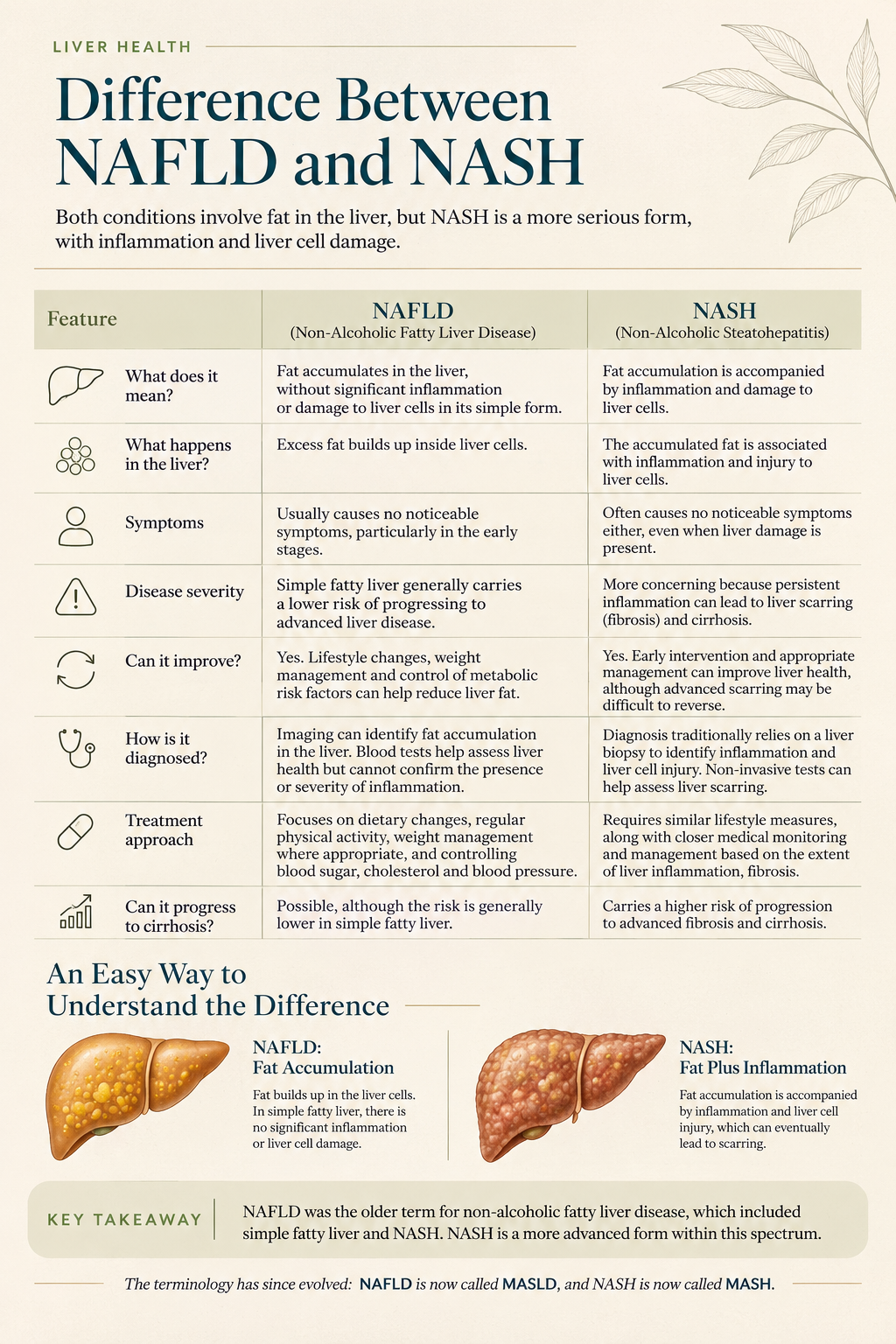
The liver is the body’s largest gland and metabolises almost all nutrients. Disturbances in liver lipid metabolism, caused by various underlying factors, can lead to fatty liver. When it is associated with heavy alcohol use, the condition is called alcohol associated liver disease. But when this buildup of fat (steatosis) is not associated with heavy alcohol use, it is referred to as Non Alcoholic Fatty Liver Disease (NAFLD). It is an umbrella term for a range of liver conditions characterised by steatosis. One of these conditions is Non Alcoholic Steatohepatitis (NASH), in which fat accumulation is accompanied by inflammation and liver cell injury. In this blog, we will look at how NAFLD differs from NASH, what these changes mean for liver health, and non-alcoholic fatty liver disease Ayurveda treatment.
NAFLD has two variants: Non-Alcoholic Fatty Liver (NAFL) or Metabolic Dysfunction-Associated Steatotic Liver (MASL) and Non Alcoholic Steatohepatitis (NASH) or Metabolic Dysfunction-Associated Steatohepatitis (MASH). A fatty liver occurs when excess fat builds up in liver cells without serious inflammation. It may cause pain because the liver enlarges.
While simple fatty liver generally has a more favourable course, Non Alcoholic Steatohepatitis (NASH) is a more serious and life-threatening form of the condition. It involves fat accumulation along with inflammation (hepatitis) and liver cell injury. In some cases, this may be accompanied by varying degrees of fibrosis. Over time, advanced fibrosis may progress to cirrhosis, resulting in scarring and, in some cases, irreversible liver damage.
What Causes Fatty Liver Disease?
NAFLD is more commonly seen in people with the following conditions:
Obesity, particularly excess abdominal fat.
Prediabetes (insulin resistance) and Type 2 diabetes, with studies suggesting that one-third to two-thirds of people with the condition have NAFLD.
Ayurvedic treatment for NAFLD includes Agnideepana (Stimulation of digestive fire), Rookshana (Drying and pacification of Kapha and Meda), and Srotoshodhana (Removal of channel blockages). When Fatty Liver progresses to the next stage and Dhatus get involved, NASH Ayurveda treatment should focus on Prasadana of Rasa and Rakta and Yakritshothahara (reducing hepatic inflammation).
Nidana Parivarjana
Reduce your intake of fats and high-calorie foods that cause Kapha-medo dushti.
Apatarpana chikitsa
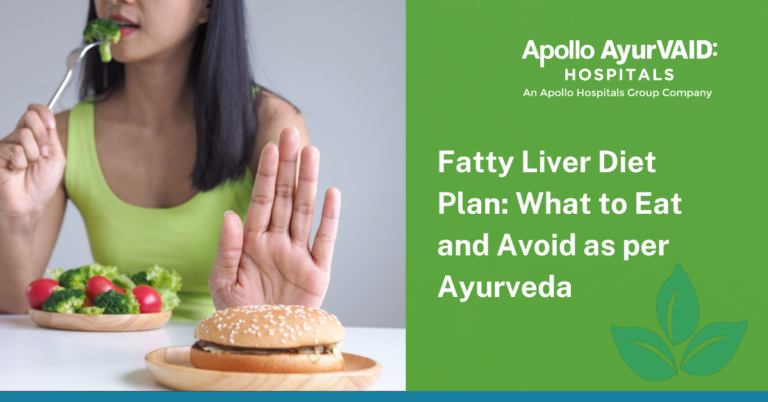
Along with avoidance of causative factors, changing a person’s diet based on their metabolic profile and helping them lose weight is one of the first steps. A diet of whole foods, lean proteins, and moderate physical activity can help achieve the desired body weight.
Shodhana
Panchakarma procedures such as Lekhaniya vasti or Virechana using Churnas and kashayas help in reducing excessive Dosha accumulation and Srotorodha. It also supports rasa and rakta prasadana (nourishing and improving the quality of Rasa Dhatu and Rakta Dhatu).
Samshamana
In the early stages, deepana-pachana, or carminative, herbs can help improve metabolism. Using katu-tikta (pungent and bitter) drugs helps reduce accumulated Ama in the hepatocytes. Herbs like Sharapunkha, Bhoomiamla, Katuki, Giloy, Vasa, Haritaki, and Pippali are commonly used but should be taken only under the guidance of an Ayurveda doctor. Since the liver is already compromised in NAFLD or NASH, consuming herbs without a prescription can worsen the condition.
Rasayana
Rasayana Chikitsa can also be adopted with herbs like Triphala, Shilajatu, Guggulu, etc., to help reduce fat accumulation and improve liver function under a doctor’s guidance.
Lifestyle changes
Eat freshly prepared food and avoid junk food, excessive sugary foods, and oily, fatty foods. A sedentary lifestyle, excessive daytime sleep, smoking and suppression of natural urges have to be avoided. Avoid alcohol and smoking.
Conclusion
Non alcoholic fatty liver disease Ayurveda treatment works the same way for everyone. The treatment plan depends on the person’s condition, how much the liver is affected, and any other health problems. It may include dietary changes, physical activity and chosen therapies under the advice of an Ayurveda physician. Fatty liver needs attention as it may remain undetected for a long time. Many people have no obvious symptoms and only find out on a routine scan or blood test. If it’s found early, you can identify contributing factors and take steps to address them. Regular follow-up and attention to metabolic health is as important as the fatty liver Ayurvedic treatment itself.
References
Hui P, Jena S, Mishra S,
Conceptual study of Non-Alcoholic Fatty Liver Disease and its management in Ayurveda.
J Ayu Int Med Sci. 2024;9(8):53-59.
Available from:
Sahu AK, Upadhyay A, Bhakuni H, Attanayake AMHS, Sharma P.
Effect of Ayurveda interventions in non-alcoholic grade II fatty liver associated with obesity – A case report.
J Ayurveda Integr Med. 2022 Jul-Sep;13(3):100605. doi: 10.1016/j.jaim.2022.100605. Epub 2022 Jul 19. PMID: 35868134; PMCID: PMC9307675.
Rohini H.D., Prashanth A.S.
A critical review on etio-pathogenesis (Naidanika Samprapti) of Non-Alcoholic Steatohepatitis (Yakrit Roga),
J of Ayurveda and Hol Med (JAHM).2020; 8(6):67-74
Pouwels S, Sakran N, Graham Y, Leal A, Pintar T, Yang W, Kassir R, Singhal R, Mahawar K, Ramnarain D.
Non-alcoholic fatty liver disease (NAFLD): a review of pathophysiology, clinical management and effects of weight loss.
BMC Endocr Disord. 2022 Mar 14;22(1):63. doi: 10.1186/s12902-022-00980-1. PMID: 35287643; PMCID: PMC8919523.
Duseja, Ajay & Singh, Shivaram Prasad & Saraswat, Vivek & Acharya, Subrat & Chawla, Yogesh & Chowdhury, Subhankar & Dhiman, Radha & Jayakumar, Rohinivilasam & Madan, Kaushal & Misra, Sri & Mishra, Hrudananda & Modi, Sunil & Muruganathan, A. & Saboo, Banshi & Sahay, Rakesh & Upadhya, Rajesh. (2015).
Non-alcoholic Fatty Liver Disease and Metabolic Syndrome – Position Paper of the Indian National Association for the Study of the Liver, Endocrine Society of India, Indian College of Cardiology and Indian Society of Gastroenterology.
Journal of Clinical and Experimental Hepatology.
FAQ
What is the main difference between NAFLD and NASH?
NAFLD refers to fat accumulation in the liver, while NASH involves fat along with inflammation and liver cell injury. NASH is more serious because the ongoing injury may lead to fibrosis and, in some cases, cirrhosis.
Can fatty liver occur in people who do not drink alcohol?
Yes, fatty liver can develop even in people who rarely or never consume alcohol. It is often associated with obesity, insulin resistance, Type 2 diabetes, high cholesterol and other metabolic conditions.
Does fatty liver cause any noticeable symptoms?
Not always, especially in the early stages, which is why many people discover it during a routine blood test or scan. Some may experience abdominal discomfort, bloating, changes in appetite or general tiredness, but these symptoms can have other causes too.
Can NAFLD progress to NASH?
In some people, simple fatty liver can progress to NASH, where inflammation and liver cell injury develop. However, this does not happen to everyone, and the risk depends on several factors, including metabolic health and lifestyle.
How does Ayurveda understand fatty liver?
Ayurveda views fatty liver through the concepts of Santarpanajanya Vyadhi, Agnivikruti and Meda Dushti, involving disturbances in digestion, metabolism and fat tissue. It also considers the involvement of Kapha, Pitta, and Vata when understanding how the condition may progress.
Which Ayurvedic treatments are used for NAFLD?
Treatment may involve Agnideepana, Rookshana, Srotoshodhana, dietary changes and selected therapies such as Virechana or Basti. The choice depends on the individual's condition and should be made by an Ayurveda physician after proper assessment.
Are Ayurvedic herbs safe for people with fatty liver?
Herbs such as Bhoomiamalaki, Katuki, Giloy, Vasa and Pippali are used in Ayurveda practice, but they are not suitable for everyone. Since the liver is already affected, taking herbal preparations without medical guidance may carry a risk of further liver injury.
Can lifestyle changes help manage NAFLD and NASH?
Yes, changes such as eating freshly prepared meals, limiting sugary and fatty foods, staying physically active and avoiding alcohol can support metabolic and liver health. These habits are important alongside medical follow-up and any treatment prescribed by the healthcare team.