In today’s world, our eyes are more strained than ever. From the time we wake up until the time we switch off the screen just before sleeping, screens have silently invaded our lives. Work, study, entertainment, communication, and even shopping and banking now happen through digital devices. While technology has made life easier in many ways, it has also brought a new kind of exhaustion that many people ignore until it becomes difficult to bear.
That exhaustion often begins as digital eye strain.
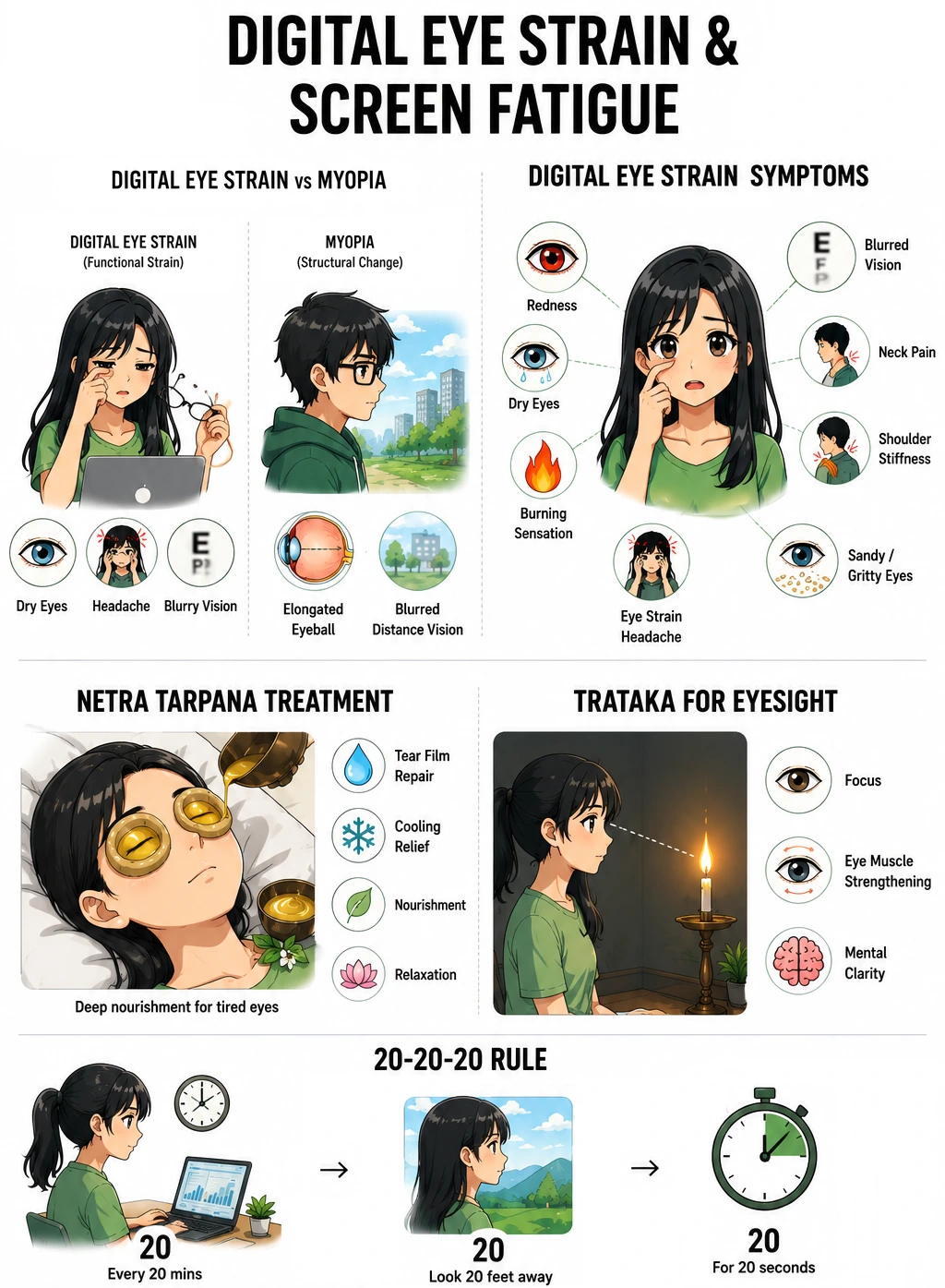
Dryness. Blurred vision. Heaviness around the eyes. Burning sensation. Difficulty focusing. An all-too-familiar eye strain headache. These are no longer occasional complaints. They have become part of everyday life for students, professionals, and even children. What makes the situation more concerning is that many people accept these symptoms as normal, when in reality they are early warning signs that the eyes are under stress.
Ayurveda does not look at the eyes as isolated organs. That is why an effective screen fatigue eye treatment in Ayurveda goes beyond temporary relief. It restores balance, nourishes, and provides rest.
Reasons for Rapid Increase in Myopia

Digital Eye Strain Is Different from Myopia
It is important to understand that digital eye strain and myopia are not the same thing.
Digital eye strain is usually functional. It develops because the eyes are overworked, often from prolonged screen exposure, poor blinking, incorrect posture, dry air, or inadequate rest. The symptoms may improve when the eyes are given proper care.
Myopia, however, is a structural refractive error. It affects how clearly distant objects are seen. While the two are different, chronic strain and poor visual habits can worsen eye fatigue and may contribute to the burden on developing eyes.
This is why we should not wait for the eyes to “get used to it”. The body is speaking early. We only need to listen.
What are the initial symptoms?
Many patients describe the same set of symptoms. Their eyes feel dry or gritty. They blink more often. Screens start to blur after some time. Headaches appear in the evening. The neck stiffens. The shoulders tighten. Concentration drops.
These are not small complaints. They are signs that the visual system, along with the nervous system, is under pressure. A recurring eye strain headache is often the body’s way of saying that the eyes have been pushed beyond their natural capacity.
A thoughtful screen fatigue eye treatment should therefore address not just the eyes, but the person as a whole.
The Ayurveda View of Eye Health
In Ayurveda, the eyes are governed by Alochaka Pitta, the subdosha responsible for vision and visual perception. When heat, dryness, excessive screen exposure, irregular sleep, stress, and poor diet disturb this balance, eye health begins to decline.
This imbalance often resembles the classical picture of dryness, irritation, and visual fatigue. That is why Ayurveda approaches eye care with cooling, lubricating, and rejuvenating therapies rather than suppression of symptoms alone.
A proper Ayurvedic medicine for eyesight plan does not begin with one remedy. It begins with understanding the person’s habits, constitution, and daily strain.
Netra Tarpana Treatment — Nourishment for Overworked Eyes
Among the most respected therapies for tired, dry, and strained eyes is netra tarpana treatment. This classical Ayurveda procedure is deeply restorative. A small ring of black gram dough is prepared around the eyes, and warm medicated ghee is gently retained over them.
The purpose is not simply comfort. It is nourishment.
The ghee helps soothe dryness, calm irritation, support the ocular surface, and provide a cooling effect after long screen exposure. For people who spend hours on computers or mobile devices, netra tarpana treatment can be a powerful part of a wider screen fatigue eye treatment plan.
For those searching for how to improve eyesight naturally, this therapy offers one of Ayurveda’s most elegant and time-tested answers.
Trataka for Eyesight — A Simple Practice with Deep Benefits
Modern life trains the eyes to jump constantly from one screen to another. Our attention is fragmented, and our visual focus is rarely steady for long. This is where trataka for eyesight becomes beautifully relevant.
It is the practice of steady gazing at a fixed point, usually a candle flame or another simple object. It helps train concentration, supports eye coordination, and gives the visual system a chance to rest from constant shifting.
Beyond the physical benefit, Trataka also brings stillness to the mind. And that, in itself, is healing. In today’s overstimulated world, one of the best forms of Ayurvedic medicine for eyesight improvement is not always a product or procedure. Sometimes, it is a disciplined pause.
Classical Eye Care That Still Matters
Everyday Habits That Make a Real Difference
Diet and Eye Health
A Final Thought
We cannot completely escape screens. That is the reality of modern life. But we can choose to care for our eyes more consciously.
If you are experiencing digital eye strain, recurring eye strain headaches, dryness, or fatigue after long screen hours, do not dismiss it. These are early signs that your eyes need support. Ayurveda offers a gentle and meaningful path through screen fatigue eye treatment, netra tarpana treatment, trataka for eyesight, and a complete approach to Ayurvedic medicine for eyesight improvement.
References
- Singh S, Ashu, Thakur P. Ayurvedic perspective of Shushkakshipaka w.s.r. to computer and visual display terminal vision syndrome: a review article. IJAYUSH. 2025;14(12):99-109.
- Bhutada RS, Lahankar MA. The effect of eye exercise and Triphala Kwatha eye wash on computer vision syndrome. AYURPUB. 2018;3(3):862-870.
- Pandey N, Jain N, Rajvanshi P, Maurya S. Clinical efficacy of Padabhyang (foot massage) as Chkshuhya (eye sight promoter) w.s.r to Timira-refractive error. TANG. 2020;10(1):e6.
- Rai VG, Raghuwanshi S, Patel M, Ahuja S. Assessing the efficacy of 20-20-20 rule in eliminating the symptoms of digital eye strain. Int J Acad Med Pharm. 2026;8(1):177-180.
- Zayed HAM, Saied SM, Younis EA, Atlam SA. Digital eye strain: a comprehensive review. PMC; 2021.