The health of women is greatly impacted by the delicate balance of hormones. They not only regulate reproduction but also affect mood, digestive processes, sleep, joint health, and even the sensation of pain. Therefore, when there is a hormone imbalance, its effect goes beyond reproductive health alone. The reason for the cyclical nature of pain caused by hormonal imbalances is that it happens at predictable times in one’s menstrual cycle and can be misinterpreted as “normal” menstrual cramping.
In Ayurveda, the interaction between the three main forces, which are Vata, Pitta, and Kapha, determines whether the person experiences pain. As mentioned above, Vata is responsible for movement, sensitivity of nerves, and pain perception. The aggravation of Vata usually causes hormonal imbalance pain and makes it unpredictable. In addition, a patient’s sensations become more intense.
Why Women Experience Pain Differently
Pain is never perceived in isolation. Its perception depends on inflammation, nerve sensitivity, tissue health, stress, sleep, and hormonal communication. Small shifts in oestrogen and progesterone can change how the body responds to discomfort. This is why two women with similar symptoms may feel pain very differently.
From an Ayurveda perspective, hormonal activity is closely linked with Vata-like functions because it governs movement, communication, coordination, and responsiveness in the body. When Vata is disturbed, the nervous system becomes more reactive, and even mild triggers can feel intense. That is one reason hormonal imbalance pain often becomes more noticeable before periods, during ovulation, or in themenopausal transition.

The Monthly Pain Map: How Hormones Shape the Cycle
A woman’s monthly cycle can be understood as four distinct phases, each with its own hormonal pattern and pain sensitivity.
During the menstrual phase, hormone levels are low. This is often a time of inward withdrawal, fatigue, and cramps. In the follicular phase, oestrogen rises and many women feel lighter, more energetic, and less pain-sensitive. Ovulation can bring a mid-cycle surge in oestrogen and LH, which in some women causes one-sided pelvic discomfort or sharp cramps. Then comes the luteal phase, where progesterone dominates and oestrogen begins to fall. This phase often brings bloating, irritability, breast tenderness, body aches, and premenstrual joint pain.
This monthly rhythm explains why pain is not random. It is closely tied to hormonal transitions.
Period Pain and Ayurveda’s View on Dysmenorrhoea
One of the most frequent complaints among women is painful menstruation. This condition is dysmenorrhoea. In Ayurveda this is often linked to Udavartini Yonivyapad, which occurs when Apana Vata is moving in the opposite direction. Normally, Apana Vata should move downwards, helping to expel the menstrual blood smoothly. However, where this flow process is hindered due to factors such as stress, indigestion, constipation, disharmony of daily activities, or mental disturbances, severe pain or cramping may be experienced.Hence, the approach for dysmenorrhoea according to Ayurveda is to treat the disease from its roots. The objective is to pacify aggravated Vata, improve digestion, remove obstruction in the channels and restore the natural downward movement of Apana Vata. In practical terms, period pain Ayurvedic treatment may include warm foods, gentle rest, digestive support, medicated oils, and individualised herbal formulations.
Why Knees and Muscles Ache Before Periods
Many women are surprised when their pain is not limited to the uterus. Premenstrual joint pain and muscle aches are common during the days before menstruation. This phenomenon is due to changes in the level of oestrogen, which influences connective tissues, inflammation, and pain perception.
Oestrogen acts as a joint and tissue protector. Its reduction during the luteal phase may cause joint stiffness, backache, heaviness of the extremities, or body pains in general. From an Ayurveda standpoint, this may be viewed as a Vata aggravation in the asthi and mamsa dhatus, leading to hormonal imbalance joint pain. In women with a long history of stress, poor sleep, or tissue depletion, this discomfort may be more pronounced.
Hormonal Migraines and the Estrogen Drop
A sudden fall in oestrogen just before menstruation is a well-known trigger for migraines. These headaches are often throbbing, one-sided, and may come with nausea, light sensitivity, or irritability. In Ayurveda, this pattern links to disturbances in the head region caused by Vata and Pitta.
The hormonal change in the body is so quick that the balance in the body’s internal environment is disrupted. The Prana Vata and Sadhaka Pitta systems, which control the nervous system and mental activity, are affected. For many women, these migraines are part of a broader picture of hormonal imbalance pain, not just an isolated headache.
Endometriosis Pain vs Regular Period Pain
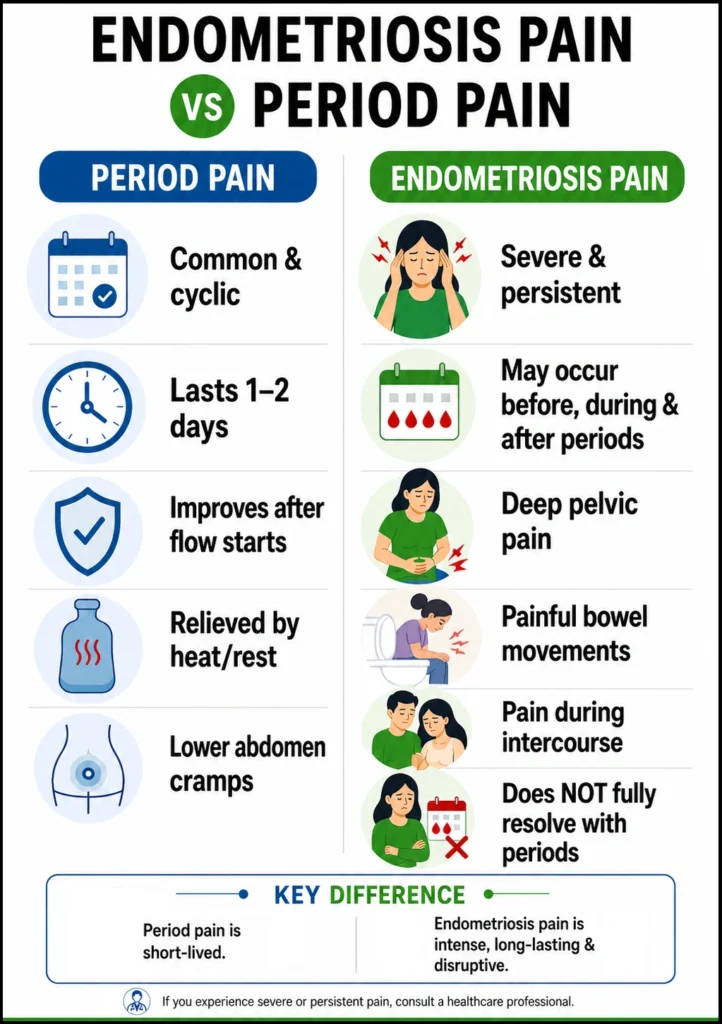
It is important to distinguish common menstrual cramps from more severe pelvic pain. Pain associated with a typical menstrual period would usually subside after menstrual bleeding. But if there is endometriosis, it would cause more painful episodes, which could persist for a long time and hinder the person from completing her daily activities, such as passing stools or engaging in sexual intercourse, pelvic heaviness, or severe cramping that does not follow the usual pattern.
While both conditions may overlap in symptoms, endometriosis requires careful evaluation. Ayurveda approaches this condition with a comprehensive strategy that may include reducing inflammation, improving circulation, supporting the reproductive tissues, and clearing obstruction. For certain cases, treatment measures like Yoga Basti may be prescribed.
Perimenopause and Chronic Pain
With the onset of the perimenopausal phase in females, the hormonal balance is not maintained anymore. The oestrogen level goes up and down, while there will be a decrease in the progesterone level. There may be pain that develops because of the changes happening during this period.
Perimenopause joint pain, stiffness when getting out of bed in the morning, fatigue, and even heightened stress sensitivity are experienced by women during the perimenopausal period.
Ayurveda views this stage as a time when Vata naturally increases. Dryness, weakness, and depletion may become more visible. For that reason, the need for nutrition, stabilisation, and rejuvenation is common during this time. The use of rasayana treatment along with sleep support, routine, warmth in food, and light exercise can all help.
The Apollo AyurVAID Approach with Precision
At Apollo AyurVAID, frozen shoulder is not approached as a routine complaint. It is managed as a staged condition that needs careful evaluation, clear sequencing, and consistent follow-up.
Every care journey begins with a detailed clinical assessment. The shoulder is examined for range of movement, pain pattern, and functional limitation. The stage of the condition is identified, because what works in one phase may not be appropriate in another.
At the same time, associated conditions such as diabetes, thyroid imbalance, or prolonged immobility are reviewed. These are not secondary concerns. They often influence stiffness, healing, and overall recovery time.
Based on these factors, a personalised treatment plan is created. It is not a combination of therapies applied together. The goal is to restore strength, improve coordination, and prevent recurrence. Therapies are reduced gradually, while exercises and daily routines take a more central role. Lifestyle and posture are addressed to help maintain the improvement achieved over time.
Ayurveda Herbs Useful for Painful Periods
Panchakarma and Lifestyle Support
For women with deeper imbalances, Ayurveda recommends Panchakarma therapies under expert guidance. Yoga Vasti is traditionally considered very effective for pelvic pain. Abhyanga, or warm oil massage, can be deeply grounding and nourishing. Yonipichu and Uttara vasti may be used in selected reproductive conditions by experienced physicians.
Alongside treatment, cycle-synced living can make a major difference. During menstruation, rest and warm, light meals are important. In the follicular phase, movement and lighter foods can support renewal. Ovulation often benefits from cooling foods and emotional calm. During the luteal phase, nourishing fats, steady routines, and stress reduction can help reduce hormonal imbalance pain before it builds.
A More Balanced Way Forward
Pain that follows a hormonal rhythm is not something women should simply tolerate. Whether it appears as cramps, migraines, joint aches, or fatigue, the body is sending a clear message. By understanding the hormonal pattern and the root cause, it becomes possible to support healing more intelligently.
With the right combination of diagnosis, diet, herbs, lifestyle changes, and individualised care, the hormonal pain women experience can become far more manageable. Ayurveda offers a compassionate and holistic path for those seeking relief from period pain, dysmenorrhoea, joint pain due to perimenopause, hormonal imbalance, and the premenstrual phase.
References
- Jadhav SS. Ayurveda management of large endometrioma – A case report. J Ayurveda Integr Med. 2023;14(1):100669.
- Bandewar J. Menopausal Transition and the Effect of Ayurvedic Treatment – Case Report. Eastern J Med Sci. 2026.
- Tripathi A, Pandey VK, Bhushan R, Sahu AN, Dubey PK. Phthalate and ovarian physiology: A brief review of therapeutic potential of Shatavari (Asparagus racemosus). Int J Herb Med. 2017;5(5):225-227.
- Pandya N, Baraiya HP. Ayurvedic Management on Dysmenorrhoea: A Case Study. Int J Appl Ayurved Res. 2018;3(11):1558-1560.
- Katole UM, Ovar DD, Shinde MM, Deshmukh GS. Ayurveda view on common menstrual disorders, causes, symptoms and management. World J Pharm Med Res. 2021;7(9):1630749873.