Most conversations about breastfeeding focus on the baby. Is the baby feeding enough? Sleeping enough? Gaining enough weight? In the middle of all these questions, many quietly ignore another important question: How is the mother recovering?
Ayurveda has always viewed the Sutika kala or postpartum period as a crucial phase in which the mother’s nourishment, rest, and recovery directly influence the baby’s early health and development. A healthy start for the child begins with the mother’s strength, digestion, and emotional balance. This is why Ayurveda for breastfeeding is not limited to increasing milk supply. It is a broader approach that supports maternal recovery, healthy lactation, and the baby’s overall development.
This year’s World Breastfeeding Week 2026 theme, “Breastfeeding for a sustainable start in life: strengthen what works,” also reflects the Ayurveda view that lasting infant health begins with supporting maternal recovery and nourishment.
In clinical practice, it is common to meet mothers who are trying exceptionally to do everything right. They are feeding frequently, waking repeatedly through the night, and worrying about whether the milk is sufficient. Yet when asked about their own meals, hydration, sleep, or digestion, many admit that they have barely had time to care for themselves. Ayurveda reminds us of something simple but often forgotten: a nourished mother is better able to nourish her baby.

Breastfeeding is natural, but it is not always effortless
One of the most reassuring things for a new mother to hear is that breastfeeding can take time to settle. ‘Natural’ does not always mean ‘easy’. Some babies latch immediately, while others need patience and support. Some mothers feel their milk comes in quickly; others worry during the first few days that only a small amount is available. Some feel confident, while others become anxious each time the baby cries.
Ayurveda recognises this period as a major transition rather than a test of perfection. The emphasis is not on “bouncing back” but on rebuilding strength gradually, which forms the foundation of postpartum care and Ayurveda lactation.
What is Stanya in Ayurveda?
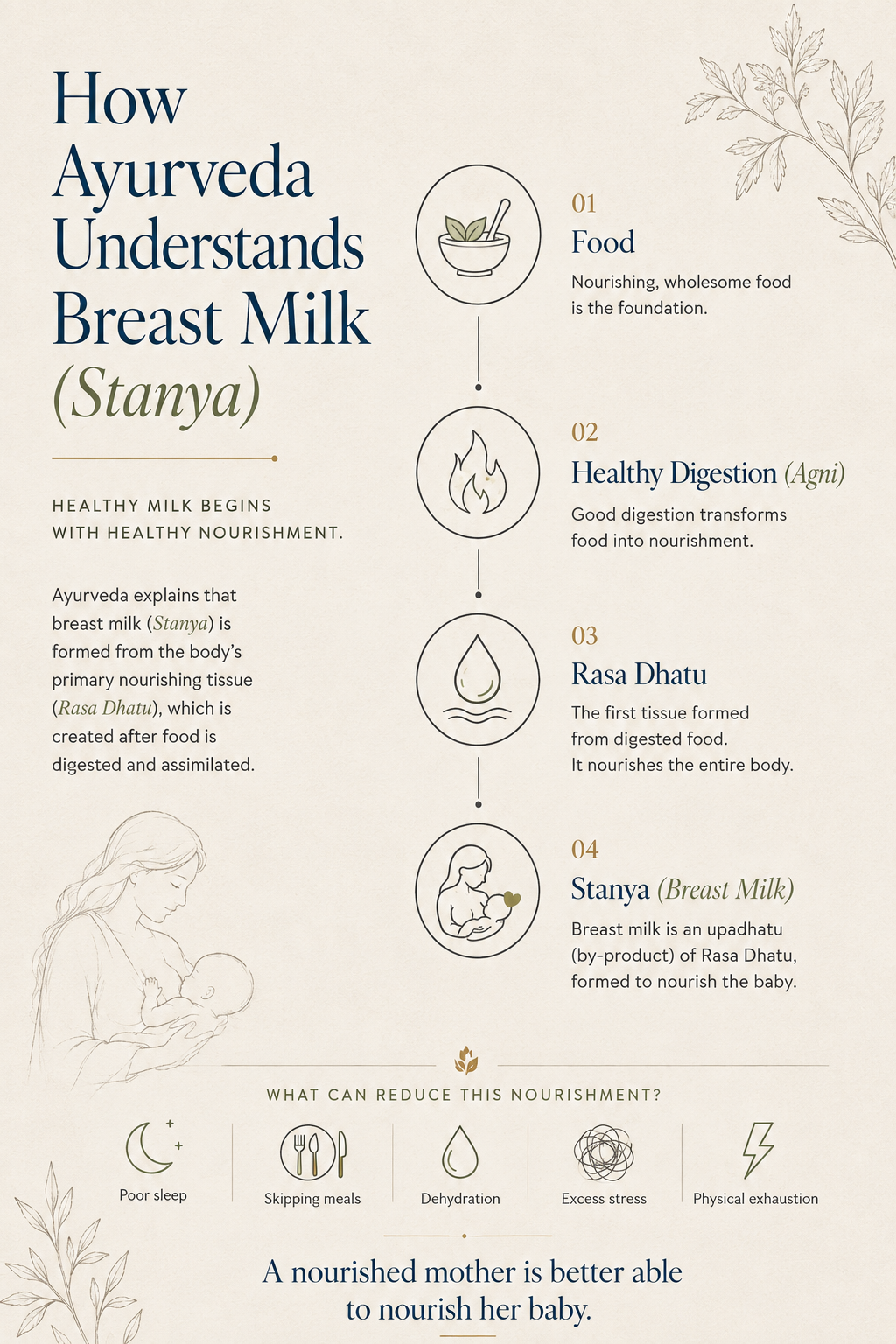
In Ayurveda, breast milk is called ‘Stanya’ and is considered a reflection of the mother’s overall nourishment. It is described as an upadhatu of Rasa dhatu, meaning it is formed from the body’s primary nourishing tissue that develops after digestion. From this perspective, breastfeeding is viewed as part of the mother’s whole postpartum recovery rather than as an isolated issue of milk production. Many mothers who worry about low milk supply are also dealing with irregular meals, poor appetite, bloating,constipation, acidity, or significant fatigue. They may be eating enough on paper, but they do not feel truly nourished. This is why Ayurveda for breastfeeding often begins with supporting the mother’s digestion and recovery rather than immediately focusing on lactation supplements.
After delivery, the body enters a remarkable phase of repair. The same body that has gone through labour must heal itself while also producing nourishment for another human being. Ayurveda views this as a whole-body process in which properly digested food contributes to healthy tissue nourishment, and from that nourishment, Stanya is supported. Frequent suckling by the baby naturally helps stimulate the flow of milk, but the mother’s condition still matters greatly. When she is severely sleep-deprived, dehydrated, emotionally overwhelmed, eating irregularly, and physically exhausted, the body’s nourishing capacity comes under strain. Supporting her overall recovery is therefore an essential part of supporting lactation.
Why Vata increases after delivery
Ayurveda gives special importance to Vata dosha during the postpartum period. Consider what happens after childbirth:
- Physical exertion during labor
- Loss of blood and fluids
- Sudden emptiness in the abdomen
- Interrupted sleep
- Irregular meals
- Emotional fluctuations
These are all factors that tend to increase Vata. Excess Vata may show up as the following:
- Anxiety or restlessness
- Dryness
- Poor sleep
- Variable appetite
- Constipation
- Feeling ungrounded or overwhelmed
Many mothers describe this feeling without knowing the Ayurveda explanation behind it. Traditional Ayurveda postpartum care, often called Sutika Paricharya, also emphasises easy-to-digest foods, emotional support, and gradual recovery rather than a hurried return to normal activity. Warm meals, ghee, gentle oil massage, adequate fluids, a medicated warm water bath, and a predictable routine are not merely cultural rituals; they are ways of calming excess Vata and supporting recovery.
Nourishing the mother to nourish the baby
A common mistake in the early weeks is trying to lose pregnancy weight too quickly. From an Ayurveda perspective, the first postpartum phase is primarily a time for rebuilding tissues and restoring strength. Warm, freshly prepared foods are generally preferred because they are easier to digest. Commonly used foods include:
- Rice
- Moong dal
- Ghee
- Cooked vegetables
- Milk if well tolerated
- Mild spices such as cumin, fennel, carom, dill seeds and ginger
The goal is not a restrictive breastfeeding diet. The goal is steady nourishment. In practice, mothers often feel better when they stop skipping meals and begin eating at regular times. Sometimes this simple change improves energy, digestion, and confidence more than any elaborate postpartum recipe.
Hydration and lactation
Breastfeeding increases fluid requirements, but Ayurveda usually prefers warm or room-temperature fluids rather than very cold drinks, especially in the early postpartum period. Helpful options may include:
- Warm water
- Thin soups
- Light herbal infusions
- Warm milk if suitable for the mother
Many mothers become so occupied with feeding that they forget to drink enough fluids. Keeping water or a warm drink within reach during feeds can be surprisingly helpful.
The emotional side of breastfeeding
Ayurveda has always acknowledged the connection between the mind and the body. A mother who is constantly worried, criticised, unsupported, or exhausted may find breastfeeding much more difficult. This does not mean that stress automatically causes low milk supply, but it can affect appetite, sleep, digestion, confidence, and the overall feeding experience.
Sometimes the most healing intervention is emotional reassurance. Newborns often feed very frequently. Cluster feeding in the evening is common. Crying does not always mean the milk is insufficient. Many mothers become anxious because relatives repeatedly ask, “Is the baby getting enough milk?” This is where Ayurvedic care for breastfeeding mothers extends beyond herbs and diet. It includes creating a calm environment, reducing unnecessary pressure, and ensuring that the mother feels supported rather than evaluated. A partner who helps at night, a family member who brings warm food, a workplace that allows time for breastfeeding, or a friend who listens without judgement can make a meaningful difference. Sustainable breastfeeding is rarely the work of a single mother.
Traditional Ayurveda support for lactation
Ayurveda traditionally describes certain foods and herbs as stanyajanana (supportive of lactation). Common examples include:
- Shatavari
- Fennel
- Cumin
- Fenugreek
- Dill seeds
- Sesame preparations
However, Ayurveda is rarely about giving the same remedy to every mother. A mother with poor digestion may not tolerate heavy milk-based preparations, while a mother with excessive heat, acidity, or loose stools may need a very different approach from someone dry, constipated, and anxious. This is why individualised assessment is important, and any Ayurveda herbs or lactation-supporting preparations are best used under the guidance of a qualified Ayurveda physician, especially during the postpartum and breastfeeding period.
Colostrum: the baby’s first protection
In the first few days after birth, many mothers worry that “only a few drops” are coming. Those few drops are extremely valuable. Colostrum is thick, concentrated, and designed for the newborn’s tiny stomach. Ayurveda has long regarded the first milk as especially important for the baby’s strength and protection. Early and frequent breastfeeding helps stimulate the natural transition to mature milk and supports bonding between mother and baby.
Sometimes the baby reflects the mother’s state
Ayurveda often observes the mother and baby together rather than separately. When a baby feeds well, passes stools comfortably, sleeps reasonably, and gains weight appropriately, it usually reassures us about the overall breastfeeding process. At the same time, not every unsettled baby indicates a problem with the milk. Newborn behaviour can be wonderfully unpredictable. Some feed every two hours; others seem to feed almost continuously during certain parts of the day. A compassionate approach is important. Mothers should not be made to feel that every cry, every wake-up, or every difficult evening is their fault.
A gentle Ayurveda routine for a breastfeeding mother
A simple supportive routine may look like this:
Morning
- Abhyanga followed by warm water bath
- Light nourishing breakfast
- A few minutes of quiet breathing
Through the day
- Feed on demand
- Eat regular warm meals
- Drink adequate fluids
- Rest whenever possible
Evening
- Light dinner
- Reduce excessive stimulation
- Warm bath or gentle foot massage if comfortable
Night
- Keep essentials nearby
- Avoid unnecessary exertion
- Accept help when available
This routine is intentionally gentle. Ayurveda is often more sustainable when it supports the body quietly rather than adding more pressure.
When to seek medical help
A balanced Ayurveda approach also recognises when additional medical care is needed. Seek professional evaluation if there is:
- Fever
- Severe breast pain
- Redness or swelling of the breast
- Significant nipple bleeding
- Poor baby weight gain
- Signs of dehydration in the baby
- Persistent low mood or thoughts of self-harm
Ayurveda and modern medical care can complement each other in supporting both mother and baby.
The heart of Ayurveda postpartum care
The deeper message of Ayurveda for breastfeeding is not perfection. It is restoration. When we speak about postpartum care and Ayurveda lactation, we are speaking about digestion, warmth, nourishment, rest, emotional support, and gradual recovery. And when we speak about Ayurvedic care for breastfeeding mother, we are acknowledging that the mother is not only feeding a baby. She is healing, adapting, learning, and becoming a mother at the same time.
Some days will feel easier than others. Some feeds will go smoothly; some will not. A healthy start for a baby is not created by a perfect breastfeeding journey. It is created by a mother who is cared for with patience, nourishment, reassurance, and compassionate support. That is the essence of Ayurveda: caring for the whole person, gently and consistently, during one of the most demanding and meaningful transitions of life.
References