""

Loss of Appetite in Cancer

Table of Contents

Introduction

Cancer treatment changes many things that people don’t expect. Appetite is often one of them. Some patients notice that food tastes different after the first few chemotherapy sessions. Others feel hungry but lose interest after two or three bites. A few have no nausea at all, yet their appetite gradually disappears. Families are usually the first to notice it. Meals become smaller, favourite foods are left untouched, and reminders to eat become part of the daily routine. When this pattern continues for weeks, it affects more than body weight. The body has less energy to recover, muscle strength slowly reduces, and treatment itself can become harder to tolerate. This is why onco-nutrition is considered an important part of cancer care. Along with treating the disease, it focuses on helping patients maintain adequate nutrition throughout treatment.

Ayurveda looks at appetite loss from the perspective of digestion. Instead of asking only how much someone is eating, it also asks whether the body is able to digest and utilise that food properly. This forms the basis of the loss of appetite-cancer Ayurveda approach, where reduced appetite is viewed as part of a broader disturbance in digestion rather than an isolated symptom.

Why Appetite Changes During Cancer Treatment

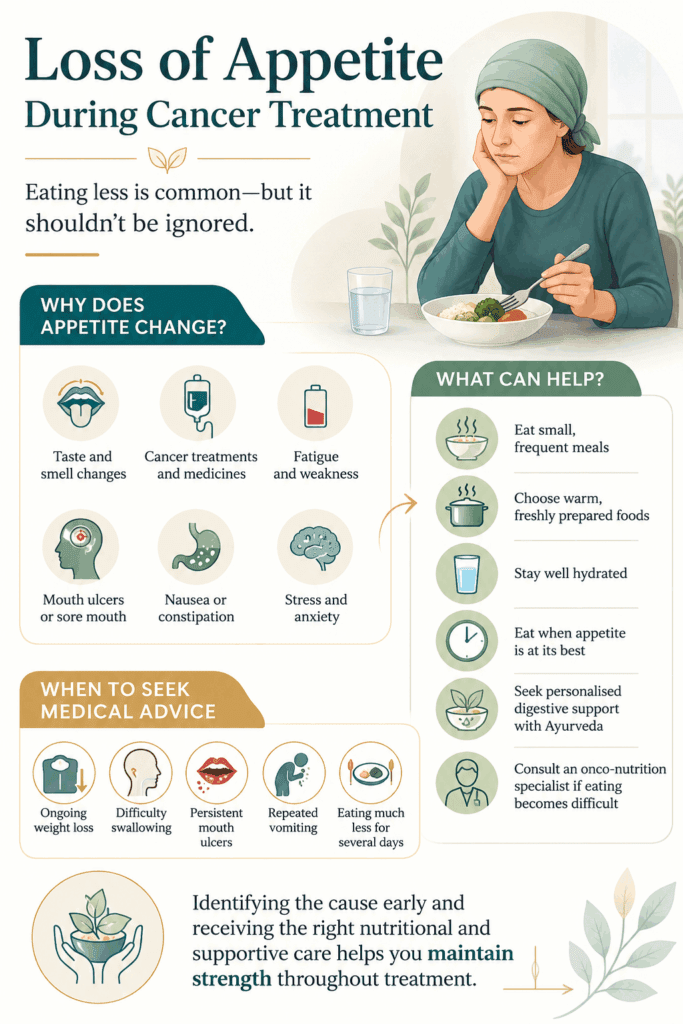
There is no single reason why appetite reduces during cancer treatment. It usually happens because several factors come together. Chemotherapy affects rapidly dividing cancer cells, but it also temporarily affects healthy cells lining the mouth and digestive tract. Some patients develop mouth ulcers that make eating painful. Others notice that food tastes metallic, bitter, or unusually bland. Even familiar smells from the kitchen can become unpleasant for a few days after treatment. Fatigue adds to the problem. Cooking, serving a meal, or sitting down to eat may feel tiring when the body is already using much of its energy to recover. Medicines given for pain, nausea, or constipation can also reduce appetite. Emotional stress often contributes as well. Worry, poor sleep, and anxiety may make eating feel less important than it normally would.

For this reason, appetite loss during chemotherapy does not look the same in every patient. One person may struggle because of taste changes. Another because eating has become painful. Someone else may simply stop feeling hungry without knowing why.

Appetite Through the Ayurveda Lens

Ayurveda describes reduced interest in food as Aruchi. It is not simply the absence of hunger. It reflects a change in the way the digestive system responds to food. Many patients say they feel hungry in their minds, but lose interest once the meal is in front of them. Others become full after just a few spoonfuls or feel that food simply doesn’t sit well anymore. It can be discouraging, especially when everyone around them is asking them to eat more. Ayurveda doesn’t begin by increasing the quantity of food. It first looks at supporting digestion, because when the digestive system starts functioning better, eating often becomes a little easier. This is the principle followed in cancer anorexia Ayurvedic treatment.

Insurance Backed

Precision Ayurveda
Medical Care

When someone with cancer begins eating less, the first reaction at home is usually to encourage them to eat more. Families prepare favourite dishes, offer nutritional drinks, or keep asking them to have “just one more spoon”. It comes from concern, but it does not always help. If digestion has slowed, larger meals can leave the patient feeling heavier than before. Some people feel full within minutes. Others complain of bloating or a feeling that food is “just sitting” in the stomach. In these situations, eating more is often harder than it sounds. This is where the principles of Deepana and Pachana become important. Deepana is used to gently support Agni, while Pachana helps clear Ama, which is believed to accumulate when digestion slows. As digestion becomes more settled, eating often starts feeling a little easier, too. Together, these approaches aim to make digestion more efficient before asking the body to handle larger amounts of food.

Among these, Trikatu for cancer appetite is often discussed, as it has traditionally been used when digestion is sluggish and appetite is reduced. That does not mean it is suitable for everyone. A patient recovering from chemotherapy, someone with mouth ulcers, and another receiving immunotherapy may all need different approaches. People searching online for an Ayurvedic appetite stimulant for cancer often expect a single medicine that works for everyone. In practice, treatment is never that straightforward. Ayurveda does not treat poor appetite as an isolated symptom. It looks at why the patient is eating less before deciding what support is appropriate.

For the same reason, Ayurvedic medicine for loss of appetite should never be started without professional guidance. During chemotherapy, radiation therapy, targeted therapy, or immunotherapy, even herbal medicines need to be prescribed carefully and in coordination with the oncology team.

Onco-Nutrition and Everyday Eating

Poor appetite does not always mean the patient needs a special diet. More often, meals need to be adjusted to match what the body can comfortably tolerate. This is where onco-nutrition becomes important. It focuses on maintaining nutritional intake despite treatment-related changes in appetite, digestion, taste, and energy levels.

Many patients find warm, freshly prepared food easier to eat than refrigerated or heavily processed meals. Soft foods such as khichdi, lightly cooked vegetables, thin dals, vegetable soups, idlis, or simple rice preparations are often better accepted on days when appetite is poor. A practical answer to how to improve appetite during cancer treatment is not always increasing portion size. Some days, even finishing half a meal can feel like an achievement. That’s alright. Rather than focusing on how much is eaten at one sitting, it often helps to make the most of the moments when eating feels easier. A small bowl of warm food, eaten without pressure, is usually better tolerated than a large meal that feels overwhelming.

When Appetite Loss Needs More Attention

A reduced appetite for a few days after chemotherapy is common and often improves before the next treatment cycle. What needs more attention is when eating continues to become difficult over several weeks or when food intake keeps reducing. Patients sometimes adjust to eating very little without realising how much this has changed. Families may notice loose-fitting clothes, increasing weakness, or that everyday activities are becoming more tiring than before. If eating keeps becoming more difficult, it is worth mentioning it to the treating team instead of waiting until the next review. Many patients assume that poor appetite is simply something they have to live with during treatment, but that is not always the case. Sometimes a treatable problem, such as mouth ulcers, nausea, constipation, pain while swallowing, or dehydration, is making meals harder than they need to be. Addressing these issues early can make a meaningful difference to comfort as well as nutrition. Supportive Ayurveda care also needs to begin with understanding why appetite has changed. There is rarely a single explanation. Treatment itself, changes in digestion, medicines, emotional stress, altered taste, and the disease can all play a part. Looking at the whole picture helps ensure that care is directed towards the underlying cause rather than simply trying to increase appetite.

At AyurVAID’s Integrative Cancer Care (ICC), appetite is assessed alongside digestion, nutritional status, ongoing cancer treatment, and the patient’s day-to-day concerns. Onco-nutrition and Ayurveda are integrated with conventional oncology care so that supportive therapies complement treatment while keeping patient safety at the centre of every decision.

When to Seek the Doctors

A reduced appetite for a few days after chemotherapy is common and often improves before the next treatment cycle. What needs more attention is when eating continues to become difficult over several weeks or when food intake keeps reducing. Patients sometimes adjust to eating very little without realising how much this has changed. Families may notice loose-fitting clothes, increasing weakness, or that everyday activities are becoming more tiring than before. If eating keeps becoming more difficult, it is worth mentioning it to the treating team instead of waiting until the next review. Many patients assume that poor appetite is simply something they have to live with during treatment, but that is not always the case. Sometimes a treatable problem, such as mouth ulcers, nausea, constipation, pain while swallowing, or dehydration, is making meals harder than they need to be. Addressing these issues early can make a meaningful difference to comfort as well as nutrition. Supportive Ayurveda care also needs to begin with understanding why appetite has changed. There is rarely a single explanation. Treatment itself, changes in digestion, medicines, emotional stress, altered taste, and the disease can all play a part. Looking at the whole picture helps ensure that care is directed towards the underlying cause rather than simply trying to increase appetite.

At AyurVAID’s Integrative Cancer Care (ICC), appetite is assessed alongside digestion, nutritional status, ongoing cancer treatment, and the patient’s day-to-day concerns. Onco-nutrition and Ayurveda are integrated with conventional oncology care so that supportive therapies complement treatment while keeping patient safety at the centre of every decision.

Conclusion

The loss of appetite during cancer treatment is often much more than simply feeling less hungry. For many patients, eating stops feeling natural. Food may not taste the same, a few bites may be enough to feel full, or the thought of another meal may feel exhausting. This can be upsetting, both for patients and for families who are trying to help. Asking someone to “eat a little more” is rarely enough because the difficulty often lies in how the body is responding to treatment, not in a lack of willingness to eat. It is about understanding why appetite has changed, maintaining nutrition through practical dietary measures, and improving digestive comfort wherever possible. Along with onco-nutrition, Ayurveda offers a way of looking at appetite through digestion. In an integrative setting, this allows supportive care to be tailored to the individual while continuing standard oncology treatment. The goal is not to restore appetite overnight but to help patients maintain strength and nutrition as they move through treatment and recovery.

FAQs

I don't feel like eating at all. Should I still try to have regular meals?
You don't have to finish full meals if it is overwhelming. Even a few bites taken regularly throughout the day can be better than waiting until you feel hungry.
Is it okay if I eat only the foods I can tolerate during treatment?
For now, yes. The priority is maintaining nourishment, and your diet can be adjusted gradually as your appetite and digestion improve.
Why do I feel full after just a few spoonfuls?
Cancer treatment can temporarily slow digestion and affect how quickly your stomach empties. This is why many patients feel satisfied much sooner than they did before treatment.
Can loss of appetite happen even if I don't have nausea?
Yes. Many patients experience reduced appetite without feeling nauseous. Taste changes, fatigue, medicines, and slower digestion can all contribute.
Will eating more make my strength come back faster?
Not necessarily. Eating beyond what your body can comfortably tolerate may leave you feeling more uncomfortable. Small, consistent meals are often more practical than forcing larger portions.
Can caregivers do anything to make meals easier?
Yes. Offering smaller portions, avoiding pressure at mealtimes, and preparing foods the patient finds easier to tolerate can make eating much less stressful.
Is every patient with cancer expected to lose their appetite?
No. Some people continue eating normally throughout treatment, while others notice changes only during certain treatment cycles. Appetite changes vary from person to person.
How long can poor appetite continue after chemotherapy?
For many people, appetite begins to improve between treatment cycles, but recovery differs for everyone. If poor appetite persists or keeps getting worse, it should be discussed with the treating team
Can Ayurveda be used alongside chemotherapy?
Supportive Ayurveda care may be considered as part of an integrative approach, but it should always be planned by a qualified Ayurveda physician in coordination with your oncologist.
Can Ayurveda be used alongside chemotherapy?
One common mistake is focusing only on eating more. Understanding why appetite has reduced and addressing the underlying cause is often just as important as increasing food intake.

REFERENCES

Bendale Y, et al. Exploring the potential of the traditional Indian system of medicine, Ayurveda, for developing an evidence-based integrative model of cancer care in elderly patients with cancer. J Clin Oncol. 2024;42(16 Suppl):e13527. Available from: external link
Buch Z. Classical Ayurveda management of TCH (Taxane, Carboplatin, and Herceptin)-based chemotherapy induced peripheral neuropathy: A case report. J Ayurveda Integr Med. 2024. Available from: external link
Singh RH. An assessment of the Ayurvedic concept of cancer and a new paradigm of anticancer treatment in Ayurveda. J Altern Complement Med. 2002;8(5):609-614. Available from: external link
Buch ZM. Role of Ayurveda in Integrated Cancer Rehabilitation: AyurVAID’s Integrated Cancer Rehabilitation Program (ICRP) – A Role Model (Kayachikitsa). International Ayurvedic Medical Journal. 2014. Available from: external link
Joffe L, Ladas EJ. Nutrition during childhood cancer treatment: Current understanding and a path for future research. Lancet Child Adolesc Health. 2020 Jun;4(6):465-475. doi: 10.1016/S2352-4642(19)30407-9. Epub 2020 Feb 13. PMID: 32061318. Available from: external link
Did the information meet your needs?

As we work hard to improve our services, your feedback is important to us. Please take a moment to help us serve you better.

Stay Connected to Health and Wellness

Subscribe to our hospital newsletter for the latest health tips, updates on services, patient stories, and community events. Sign up today and stay informed!

Homepage B RCB

Please fill out the form below to Request a call back

Patient details

Select Preferred Center

Last updated on:

Do you have concerns with the content?

Report Problem

Table of Contents

Last updated on:

Do you have concerns with the content?

Report Problem

Popular Searches: DiseasesTreatmentsDoctorsHospitalsWhole person careRefer a patientInsurance

Follow Apollo AyurVAID hospitals

We’d Love to Hear from You!

Feedback form(disease page)

Can we help?

Something wrong with our medical content?
 
Report Problem form