Introduction
If you’ve ever tried to lose weight, you already know how overwhelming the advice can be.
Eat fewer calories. Skip carbohydrates. Try intermittent fasting. Drink a detox juice. Take a fat-burning supplement.
Some of these strategies may help for a while. Many even produce impressive results initially. Yet, for countless people, the weight quietly returns—often bringing fatigue, digestive discomfort, cravings and frustration along with it.
Most people are not simply looking to lose weight. They want to understand why they gained it despite eating “healthy,” exercising regularly, or following every popular diet.
This is where Ayurveda for weight loss offers an entirely different perspective.
Our body is an intelligent biological system where digestion, metabolism, hormones, sleep, emotions and daily routines constantly influence one another. When these systems are in harmony, maintaining a healthy weight becomes much easier. When they fall out of balance, the body naturally begins to hold on to excess fat.
The goal of Ayurveda weight loss is therefore not simply reducing numbers on the weighing scale—it is restoring metabolic health and making it sustainable.

It Is Not Just About Calories. It Is About Your Metabolism.
Weight doesn’t just revolve around calories consumed versus calories burned. While energy balance certainly matters, it doesn’t explain why two people eating similar diets can have completely different metabolic outcomes. Nor does it explain why some people struggle to lose weight despite eating very little.
Ayurveda answers these questions through the concept of Agni—the digestive and metabolic fire. The function of Agni includes each phase of transformation from digestion of food in the intestines through transforming the nutrients into energy, hormones, muscles, immune functions and even healthy fat tissue.
In traditional Ayurveda, twelve types of Agni work in synergy to maintain the proper functioning of physiology. The main digestive fire (Jatharagni) triggers the process, whereas metabolic fires (Dhatvagni) guarantee proper metabolism of the nutrients in each tissue.
If Agni is powerful, the food transforms into nourishment. If it is slow, the food may not be digested properly. The result is a slowdown of metabolism and accumulation of waste and, therefore, the body starts storing unnecessary fats.
This is why Ayurveda for weight loss focuses first on improving digestion and metabolism—not merely restricting food intake.
Why Does Weight Become So Stubborn?
People often ask – “Doctor, I hardly eat. I walk every day. Why am I still unable to lose weight?”
From an Ayurveda perspective, the answer often lies in Ama.
Ama is not simply “toxins,” although that is the easiest translation.
It refers to incompletely digested or poorly metabolised material that the body cannot efficiently eliminate. When digestion remains weak for months or years, this sticky metabolic residue begins to accumulate throughout the body.
Over time, it obstructs the body’s transport channels (Srotas), interferes with normal tissue metabolism and contributes to sluggish energy production.
Modern science recognises similar processes involving chronic low-grade inflammation, altered gut microbiota, impaired insulin sensitivity and metabolic dysfunction.
Ayurveda described these disturbances centuries ago using the concept of Ama.
When Ama accumulates within Medo Dhatu (fat tissue), losing weight becomes increasingly difficult.
The body is no longer simply carrying excess fat—it is carrying impaired metabolism.
This explains why many people hit frustrating weight-loss plateaus despite doing everything right.
Why Crash Diets Rarely Create Lasting Change
Crash diets usually promise one thing:
Lose more weight in less time.
Unfortunately, the body doesn’t always cooperate. Severe calorie restriction often slows metabolism as the body shifts into conservation mode. Hunger hormones increase, cravings intensify, energy declines and once normal eating resumes, weight often returns rapidly.
Most importantly, the underlying metabolic imbalance remains unchanged.
Ayurveda takes a very different path.
Instead of starving the individual, Ayurveda aims to correct the processes that created obesity in the first place.
This approach, known as Apatarpana Chikitsa, is carefully individualised and may include:
- Deepana-Pachana to kindle digestive fire and eliminate toxins.
- Langhana or methods to lighten the body, which could be done through a light diet, fasting or improvement in dietary timings and not necessarily through fasting for long durations.
- Shodhana treatments that include Panchakarma treatments like Virechana or Lekhana Basti, if indicated, to induce metabolic reset and eliminate the accumulation of Ama under physician supervision.
The emphasis is on helping the body function the way it was designed to.
That is one of the reasons Ayurveda weight loss tends to produce sustainable improvements rather than short-lived results when combined with appropriate dietary and lifestyle changes.
There Is No Universal Weight-Loss Diet
One of Ayurveda’s greatest strengths is that it recognises individuality.
Two people may have the same BMI, yet the reasons for their weight gain can be completely different.
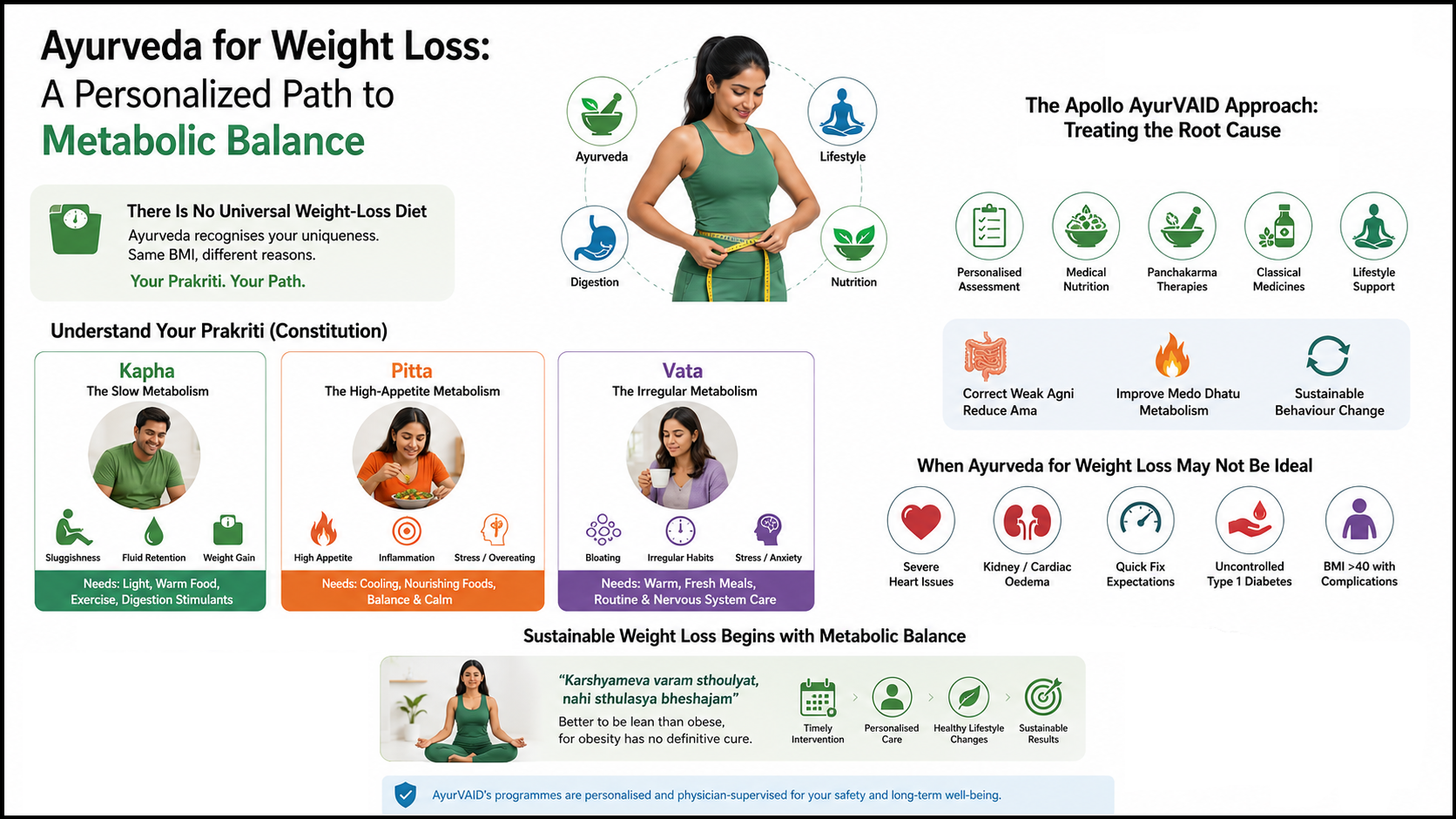
Kapha predominant
Individuals with a Kapha constitution tend to gain weight gradually. They have a slower metabolism, and they can feel sluggishness, lethargy, fluid retention, and more fat deposits.
In case of Kapha constitution, Ayurveda for weight loss aims at stimulating their metabolism through light and warm food, exercises, digestion stimulants, and minimising consumption of oily, cold, sweet, and heavy foods.
Pitta predominant
People with a Pitta predominant constitution have a greater appetite and relatively active metabolism. Gaining weight can be due to inflammation, hormonal imbalances, stress, or overeating due to hunger.
Consumption of cooling and nourishing foods helps in maintaining balance in their metabolism without increasing internal fire.
Vata predominant
People with Vata imbalance usually feel surprised to gain weight because they do not look obese at all. Irregular eating habits, disturbed sleep, chronic stress and anxiety can weaken digestion and contribute to bloating, fluid retention and poor metabolic efficiency.
Warm, freshly cooked meals, consistent routines and nervous system regulation become central to their treatment.
This personalised approach is one reason Ayurveda weight loss cannot be reduced to a single diet chart or a miracle herb.
The treatment should always match the individual—not the diagnosis alone.
The Apollo AyurVAID Approach: Treating the Root Cause
At Apollo AyurVAID, weight management is viewed as a marker of underlying metabolic health.
Every treatment plan begins with understanding the individual—their digestive strength, tissue metabolism, constitution, existing medical conditions, lifestyle, stress levels, sleep quality, and long-term health goals.
The focus is on correcting weak Agni, reducing Ama, improving Medo Dhatu metabolism, restoring healthy routines, and supporting sustainable behavioural change through personalised medical nutrition, lifestyle interventions, classical medicines and physician-guided Ayurveda therapies.
Formulations can be used appropriately where necessary, not as “fat burners”, but rather as an integrated approach to increasing efficiency in one’s metabolism, improving insulin resistance, and improving overall fat metabolism for good health.
Panchakarma treatments conducted under the supervision of a physician will further assist in treating the underlying metabolic imbalances and not just aim at achieving weight loss.
Although our unique treatment works well for many people, there are certain conditions under which Ayurveda for weight loss might not work so well:
- Those with extensive cardiovascular problems.
- Those suffering from severe oedema owing to severe kidney or cardiac problems.
- People seeking rapid weight loss without a commitment to an Ayurveda diet for weight loss and sustainable
- lifestyle changes.
- Individuals with uncontrolled Type 1 diabetes or complex metabolic disorders requiring specialised medical care.
- People with severe morbid obesity (BMI >40 kg/m²) along with multiple obesity-related complications, who may require an integrated treatment approach.
A detailed medical assessment helps our physicians determine whether AyurVAID’s programme is suitable for you and personalise the safest and most effective treatment plan.
Sustainable Weight Loss Begins with Metabolic Balance
The classical Ayurveda text reminds us:
“Karshyameva varam sthoulyat, nahi sthulasya bheshajam”
“It is better to be emaciated (Karshya) than to be obese (Sthoulya), because there is no definitive cure for obesity.”
This statement is not meant to discourage—it is a reminder of how deeply obesity affects the body’s metabolism and overall health. Ayurveda recognises that once excess fat and metabolic imbalance become established, restoring balance requires patience, consistency and a comprehensive approach rather than quick fixes.
Ayurveda for weight loss gives timely intervention, personalised care and a commitment to healthy lifestyle changes for meaningful and sustainable improvement.
References