Multiple Sclerosis (MS) is a chronic autoimmune disease of the central nervous system that can change a person’s life in many invisible ways. Most people consider MS only to be a mobility disorder, but for many patients, pain, fatigue, stiffness, and emotional distress are just as difficult as weakness or imbalance.
On World MS Day (May 30), it is important to remember that the burden of MS is not only medical — it is deeply personal. Patients may look “fine” on the outside while struggling every day with burning pain, spasms, heaviness, exhaustion, and reduced confidence in their bodies. This is why multiple sclerosis pain management must be compassionate, holistic, and long-term.
Why MS causes pain
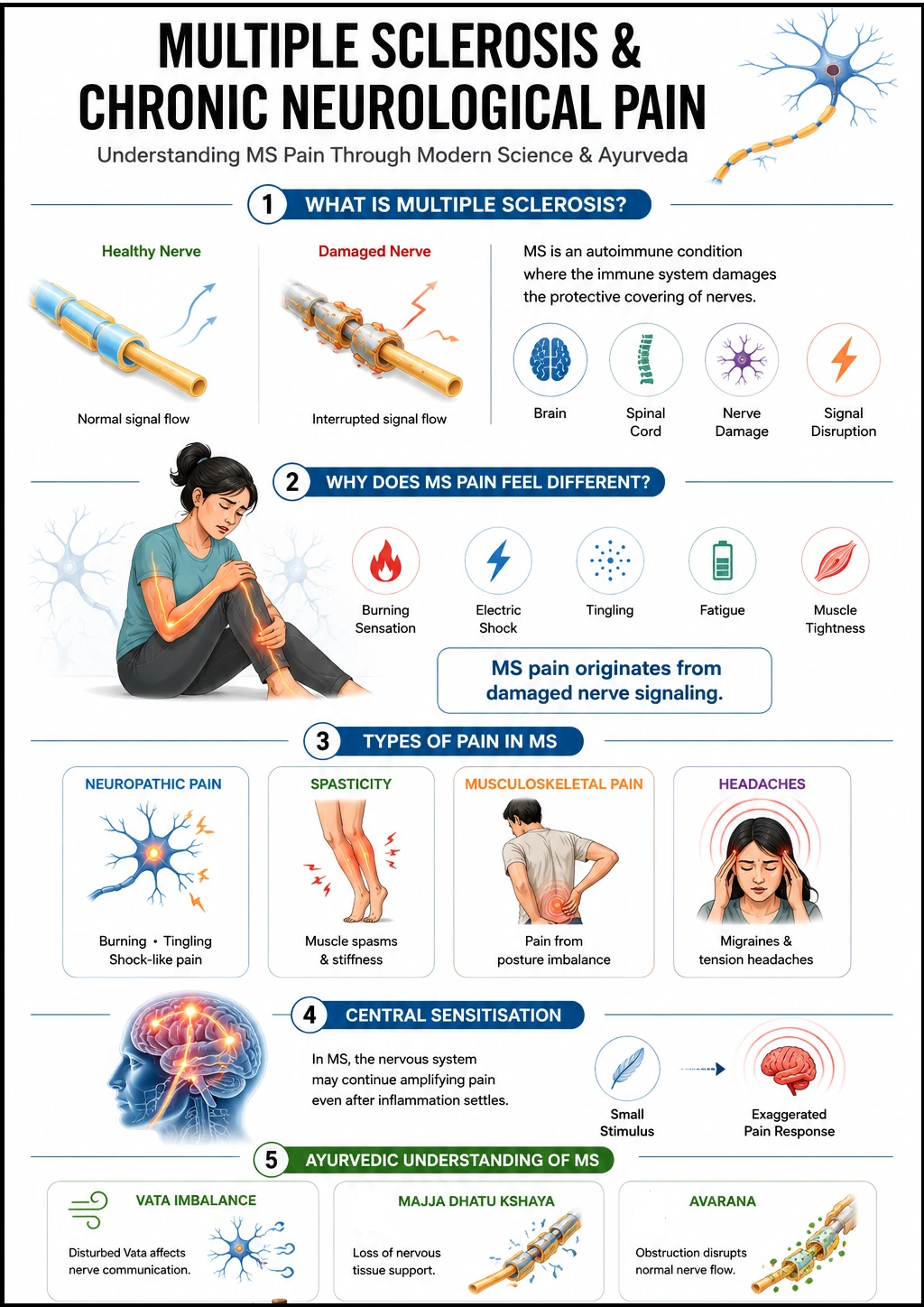
In MS, the immune system attacks the myelin sheath, which is the protective covering around nerve fibres in the brain and spinal cord. When this insulation is damaged, nerve signals do not travel smoothly. Communication between the brain and the body becomes disrupted, leading to numbness, tingling, weakness, stiffness and pain.
Pain in MS is often not a single symptom. It may appear as burning sensations, stabbing discomfort, electric shock-like pain, tight muscles, or deep aching. In many patients, this pain continues even when the disease appears stable. That is why MS neuropathic pain can be especially frustrating. It is not simply “muscle pain”; it is pain arising from the nervous system itself.

Different forms of pain in MS
MS pain can show up in several ways.
Neuropathic pain is one of the most common and distressing forms. Patients often describe it as pins and needles, burning, shooting pain, or a shock-like sensation. An example of this is Lhermitte’s sign, where a forward bend of the neck causes an electrical sensation along the spine.
The other one is spasticity, where muscles become stiff and difficult to move due to their inability to relax. It interferes with movement including walking and sleep.
Other common problems include musculoskeletal pain. Due to the compensation for weakness and imbalance in the body, there is development of pain along the back, hips, knees and shoulders.
There are many cases of headaches and migraines among individuals with MS, mostly caused by factors such as stress, lack of sleep and tiredness.
Why MS pain is different
Ayurvedic understanding of MS
Ayurveda does not label MS in the same way modern medicine does, but it understands the condition through patterns of Vata disturbance, tissue depletion, and obstruction.
Vata governs movement, nerve communication, coordination, and sensory function. An excess of Vata dosha makes the body dry, unstable, weak and vulnerable to unpredictable symptoms. This condition corresponds to the weakness, stiffness, tremors, and erratic nerve impulses seen in MS.
It is necessary to consider another Ayurveda concept, which is Majja Dhatu. ‘Majja Dhatu’ means ‘nervous and marrow tissues’. The MS pathology can be described from this perspective in terms of Majja Dhatu Kshaya – the deterioration of the protective qualities of the nervous tissues.
A similar concept is that of Avarana, when normal functioning is inhibited by such obstacles as Ama and other doshas. This idea explains the unexpected exacerbations and neurological problems seen in MS.
Thus, using this approach, Ayurvedic treatment for MS implies pacification of Vata, nourishing of nervous tissues, toxin elimination, and tissue regeneration.
The Ayurveda goal: not just symptom control, but better living
MS is a chronic condition, and patients often come to Ayurveda with a very practical question: “Can this treatment help me live better?”
The answer is yes — when treatment is individualised and realistic. The purpose of MS chronic pain AyurVeda treatment is not to promise a cure but to improve quality of life by reducing discomfort, improving sleep, supporting mobility, and strengthening the body over time.
The core goals are to:
- reduce pain and stiffness,
- improve nerve nourishment,
- support digestion and elimination,
- calm inflammation,
- reduce fatigue,
- and restore confidence in daily functioning.
Panchakarma in MS care
Panchakarma plays an important role in neurological rehabilitation.
Among the most valued therapies is Basti for multiple sclerosis. In Ayurveda, Basti is one of the most important treatments for Vata disorders. It is believed to deeply nourish and balance the nervous system while helping the body eliminate waste. In clinical practice, patients often report better bowel function, reduced stiffness, improved sleep, and a greater sense of lightness after appropriately planned Basti therapy.
Another useful therapy is Abhyanga, or oil massage. The use of warm oils, mixed with medication, helps relieve dryness, loosen stiff muscles, and promote circulation. Ksheerabala for MS is particularly useful due to its properties to nourish the nerves, relieve spasms, and pacify Vata. Most patients find this technique beneficial in reducing tightness and heaviness.
Shirodhara could also prove beneficial if any anxiety, lack of sleep, or overstimulation of mind exists. The steady flow of warm oil over the forehead can have a deeply calming effect on the nervous system.
Nasya, the administration of medicated oil through the nose, is another classical therapy used to support the head and upper nervous system.
Herbs that may support recovery
Several Ayurveda herbs are commonly used in neurological care.
Ashwagandha is known as a ‘Rasayana’ herb and is often used for strength, resilience, sleep support, and to combat fatigue.
Brahmi is traditionally used for memory, concentration, and mental clarity.
Bala is used to support strength and reduce weakness.
Guduchi is valued for its immunomodulatory and anti-inflammatory properties.
These medicines should always be used under proper supervision, especially in chronic disease, because the treatment plan must be customised to the individual’s condition, digestion, medication history, and overall strength.
Yoga and movement with awareness
Exercise is important in MS, but it must be adapted to the patient’s capacity. Many people are afraid to move because they feel weak or unsteady, but gentle movement can actually reduce stiffness and improve confidence.
Chair yoga, supported stretching, breathing practices, and slow mobility work can be very helpful. The aim is not to push the body, but to maintain flexibility, circulation, and balance without strain. Yoga also supports emotional steadiness, which matters greatly in chronic illness.
Fatigue: the symptom that people often underestimate
Fatigue is one of the most disabling symptoms in MS. For some patients, it is more difficult than pain. It can be physical, mental, and emotional all at once.
Ayurveda addresses fatigue by strengthening Agni, improving sleep quality, nourishing the tissues, and balancing Vata. Warm, easily digestible food, routines, adequate rest, and restorative therapies all play a role.
Supportive care for multiple sclerosis with Ayurvedic treatment often includes Rasayana support, Basti for multiple sclerosis, and carefully chosen herbs to rebuild strength over time.
Conclusion
References
- Umesh C. Ayurvedic Management Of Multiple Sclerosis: A Case Report. Int J Sci Res. 2018;7(9).
- Prakash G, Pandey A, Tiwari M. Developing an evidence based algorithm for pain management in Multiple Sclerosis using Panchakarma therapy. Int J Med Public Health. 2025;15(3):197-205.
- Farinotti M, Vacchi L, Simi S, et al. Dietary interventions for multiple sclerosis (Review). Cochrane Database Syst Rev. 2012;(12):CD004192.
- Deshpande S, Padavi D. Effect of Panchakarma Chikitsa in the Management of Multiple Sclerosis: A Case Report. Eur J Pharm Med Res. 2024;11(3):368-371.
- Majdinasab N, Siahpush A, Mousavinejad SK, et al. Effect of Boswellia serrata on cognitive impairment in multiple sclerosis patients. J Herbal Med. 2016;6(3):119-127.