Going through cancer treatment changes everyday life in ways that are hard to fully prepare for. One of the most difficult parts for many patients is not just the treatment itself, but the feeling that the body is no longer as strong as it used to be.
Even simple things like meeting people, eating regular meals, or stepping outside can start to feel different when immunity drops during chemotherapy. There is often worry in the background: “Why am I getting tired so easily?” “Is my body able to protect itself right now?” This phase is medically expected, but emotionally, it still feels heavy.
In Apollo AyurVAID’s Integrative Cancer Care (ICC), this principle is followed alongside oncology treatment. Ayurveda support is planned in coordination with chemotherapy, focusing on tolerance, recovery, and day-to-day stability rather than aggressive intervention.
Why Chemotherapy Destroys Immunity — Neutropenia Explained
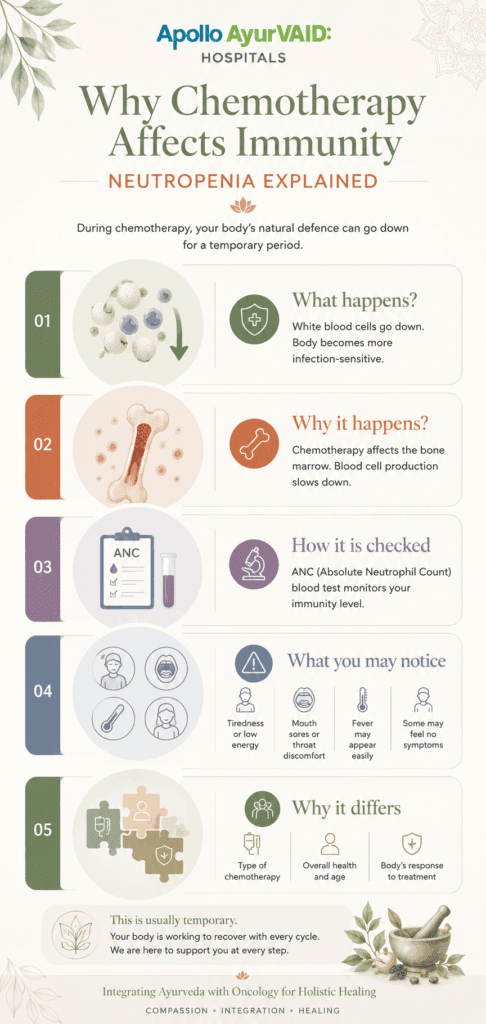
Neutropenia means the body has fewer white blood cells than normal. These are the cells that quietly protect against infections every day, so when they drop, the body doesn’t respond as strongly to small exposures that it would usually handle without notice. During chemotherapy, this occurs because the treatment affects rapidly dividing cells. The bone marrow, which produces blood cells, is also temporarily affected during this process. So for a few days or weeks in a cycle, the body slows down production of white blood cells. Doctors track this through routine blood tests, especially the ANC (Absolute Neutrophil Count). It helps them understand how low the count has fallen and when it starts recovering again.
Some people don’t notice anything at all during this phase. Others may just feel more drained than usual, or develop issues like mouth sores, mild throat discomfort, or fever that appears more easily than before. Not everyone responds in the same way. It depends on the type of chemotherapy, overall health, age, and how the body is handling treatment at that point.
Because of this variation, doctors often adjust the plan — sometimes a cycle is delayed by a few days, or the dose is modified, or extra support is added so the body gets enough time to recover before the next round.
In Ayurveda, this is understood as a temporary disturbance in Rasa Dhatu and Rakta Dhatu, the tissues responsible for nourishment and blood formation. When treatment affects these, the body’s ability to maintain normal defence levels is reduced for some time.

Ayurveda for Immunity in Cancer Care
When Ayurveda speaks about immunity, it is not only referring to white blood cells or lab reports. It looks at overall vitality, how digestion, energy, sleep, and tissue strength come together. During cancer treatment, all of these areas can feel disturbed at once. Appetite may reduce. Energy may feel unpredictable. Even sleep may not feel as refreshing as before.
In this context, cancer immunity Ayurveda becomes a way of understanding how to support the body gently, without overwhelming it. The focus is on restoring balance in a way that feels tolerable during ongoing treatment.
There is also an emotional layer here that patients often do not express out loud: the feeling of not recognising one’s own body for a while. Ayurveda tries to meet that experience with steadiness rather than intensity.
Safe Immunomodulation During Cancer Treatment
During cancer treatment, the word “immunity” can sometimes create confusion. It sounds like something that should always be increased. But in this phase, the body does not always need stimulation—it needs stability. This is where Ayurvedic immunomodulation cancer approaches become important.
In this context, Apollo AyurVAID’s Integrative Cancer Care (ICC) follows a non-conflicting, comprehensive approach where Ayurveda support is planned alongside oncology treatment.The focus is on maintaining stability during chemotherapy cycles and ensuring that supportive care does not interfere with medical management.
Some interventions try to push the immune system harder. Ayurveda takes a slower approach here. It focuses on helping the immune system respond appropriately, without overreacting or becoming exhausted. For someone asking how to boost immunity during cancer treatment, the real answer is often gentler than expected. It is less about increasing strength quickly and more about preventing further depletion while supporting gradual recovery.
Why Not All Herbal Immune Boosters Are Safe During Cancer Treatment
It is very natural to assume that herbal products are always safe because they are “natural.” But during chemotherapy, the body processes everything differently. Some herbs can change how medications are metabolised. Others may increase liver workload or affect blood clotting. A few may even overstimulate immune activity when the body is already under stress.
That is why conversations around safe herbs during chemotherapy for immunity boosting are not just technical—they are protective.
Patients are often given many suggestions from different sources, friends, or online advice. But during this stage, simplicity and clarity are far more valuable than variety. Even in Ayurveda, not everything is used during active chemotherapy. The selection becomes very careful and personalised.
Ayurveda Herbs for Cancer Immune Support
In integrative care, certain Ayurveda herbs are used in a supportive way alongside oncology treatment. The intention is not to interfere, but to help the body cope better with stress and recovery demands.
Guduchi / Tinospora
Guduchi is often considered one of the most important Rasayana herbs in this context. It is used in situations where the body feels depleted, especially during ongoing medical treatments. Research and clinical use in integrative oncology suggest it may support immune balance and help maintain stability in blood parameters. This is why guduchi for cancer immunity and tinospora for cancer immunity support are frequently discussed in protocols.
For many patients, its role is less about “feeling stronger immediately” and more about helping the body stay steady through treatment cycles.
Amalaki
Amalaki is a gentle, nourishing fruit known for its cooling and restorative nature. During chemotherapy, when fatigue and dryness of the body are common, Amalaki is often used for its soothing and antioxidant support. It does not push the system—it supports it quietly. In discussions around Amalaki for cancer immunity, it is often included for maintaining baseline strength and reducing internal stress on tissues.
Shatavari
Like other supportive measures, it is recommended to use any herbal supplement only under strict professional supervision during chemotherapy, depending on the patient’s condition and ongoing treatment protocols.
Herbs to AVOID During Active Chemotherapy
During chemotherapy, more is not always better. Some herbal combinations may interfere with drug pathways or add unnecessary load on the body. Unsupervised “immune boosters,” detox kits, or multi-herb powders can sometimes create more confusion than benefit.
This is especially important when thinking about chemo-immunity Ayurvedic herbs, safe, because safety depends not only on the herb itself but also on timing, dose, and individual condition. A careful, minimal approach is often more appropriate than combining multiple strong interventions at once.
Diet to support immunity
During periods of low immunity in cancer treatment, food becomes closely tied to how the body manages energy from one day to the next. Appetite can change without warning, and digestion may not feel as steady as before. Because of this, eating patterns often need to stay flexible rather than fixed.
In practical terms, food that is freshly prepared and warm is often easier to handle during this phase. It feels lighter on digestion and is usually better accepted when fatigue is present. In contrast, cold or heavy meals can sometimes feel more difficult when the body is already tired from treatment cycles.
Meal size also matters. Many patients naturally shift toward smaller, more frequent meals because larger portions can feel overwhelming when strength is low. This often happens without planning; the body begins to indicate what it can manage.
Practical Infection Prevention During Low-Immunity Phase
When immunity is low, daily life naturally becomes more careful. This can feel a bit restrictive at times, especially when life already feels different during treatment. Still, it’s usually a temporary phase meant to protect the body while it is more vulnerable.
Simple habits end up mattering more than anything complicated — things like washing hands properly, being a little more careful with food, and quietly avoiding situations where infections are more likely to spread. Even small precautions like choosing quieter spaces or wearing a mask in crowded areas can help reduce risk.
There is also emotional stress in this phase that is often overlooked. Many patients feel they have to “be extra careful” all the time, and that alone can feel tiring.
Support during this phase is as much about reducing anxiety as it is about preventing infection.
Final Thoughts
The body continues working in the background even when it feels tired or slow. Chemotherapy may reduce immunity for a time, but recovery is something the body keeps trying to return to. Ayurveda, when used carefully alongside oncology care, focuses on supporting that return gently—through nourishment, stability, and gradual rebuilding. For many patients, that quiet support can make the treatment journey feel a little more manageable day by day.
References