Introduction
Every week at Apollo AyurVAID, we meet professionals who are deeply diligent, responsible, and high-achieving, yet they arrive feeling completely overwhelmed, restless, or unable to sleep. They often feel that their exhaustion is a personal failing, but in Ayurveda, we view stress as a vital signal from the mind-body asking for attention.
In today’s hyper-connected corporate world, this signal is being ignored until it manifests as workplace burnout, a state of systemic depletion that is no longer just a personal wellness issue but a measurable business crisis.
When our teams reach this point, the cost is evident in HR data, with rising attrition and chronic absenteeism. Burnout isn’t just about being “tired”; it erodes professional efficacy and mental distance from purpose. For an organisation to succeed, we must move beyond temporary fixes. Integrating a structured employee wellness program, Ayurveda is a financially and operationally responsible strategy to restore the human capital that drives your business forward.

The Real Cost of Burnout — What HR Data Shows
Burnout doesn’t just affect individuals – it affects entire organisations.
Human Resource data across industries consistently shows that employees experiencing chronic stress become less productive, make more errors, struggle with decision-making and disengage from their work.
Its effects are evident in the following ways:
- Absence caused by stress-induced diseases
- Presenteeism, where employees are present but exhausted
- Lack of innovation and creativity
- Bad collaboration among team members
- Attrition and recruitment expenses
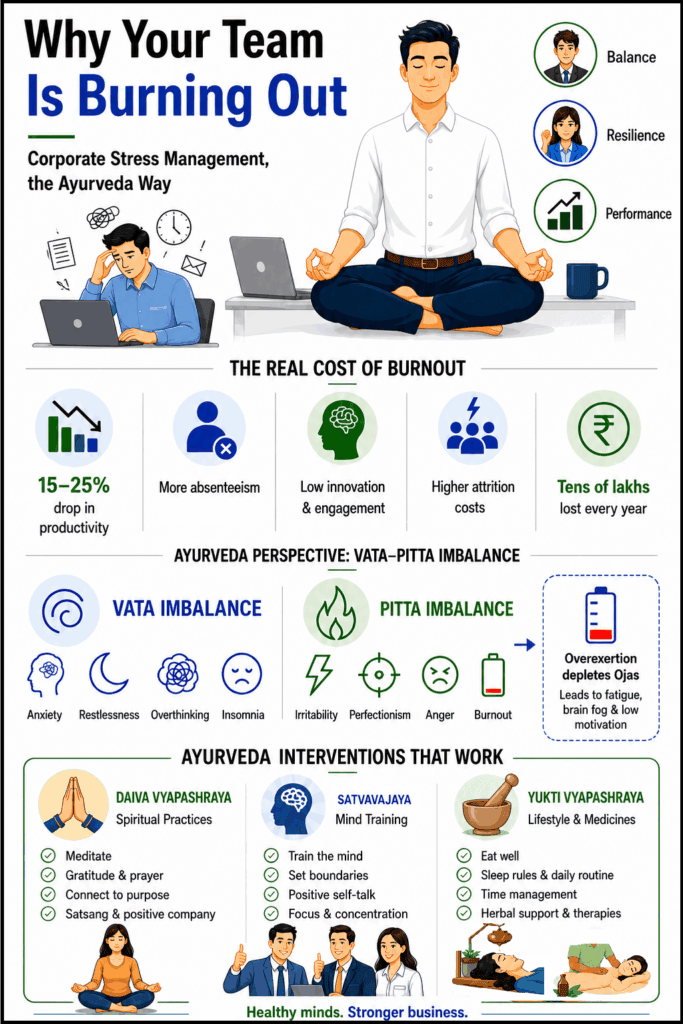
It has been estimated that productivity levels could fall by about 15–25% for employees experiencing burnout. For an organisation with around 100 employees, the financial impact of lost productivity and employee turnover alone may run into tens of lakhs each year.
More importantly, burnout slowly erodes workplace culture. Teams become reactive instead of collaborative, and high-performing employees often become the first to leave.
This is why corporate stress management deserves the same strategic attention as any other business investment.
Vata-Pitta Imbalance – Workplace Stress Through an Ayurveda Perspective
Modern theories emphasise psychological pressures, but Ayurveda looks further into the matter through the three doshas of Vata, Pitta andKapha. Our perspective on workplace stress involves viewing it as a systemic imbalance, that of Vata-Pitta.
This condition is usually caused by Sahasa or overexertion, which leads to the depletion of Ojas– the body’s energy that makes us strong and resilient. When Ojas is lost, the individual loses their inner strength, leading to the brain fog and low motivation that characterise burnout.
Ayurveda Interventions That Work in a Corporate Setting
True healing begins when we move the body and mind away from “survival mode” and back toward restoration. In our Corporate stress management initiative, we focus on practical, protocol-driven interventions that reverse damage and restore balance. An employee wellness program, Ayurveda provides the tools to purge toxins and build long-term resilience.
Shirodhara as a Stress-Reset Therapy
Abhyanga and Short Format Wellness Breaks
Abhyanga (oil therapy) is necessary for relaxing the nervous system and balancing the Vata Dosha. This practice is important for enabling employees to withstand physical stress and get quality sleep.But wellness must also be practised in the workplace itself. We propose short-format breaks based on the principle of Dinacharya. These are as follows:
- Nadi Shodhana (Alternate Nostril Breathing): Just doing this for 5 minutes helps to bring stability to the nervous system.
- Periodic Movement: Standing up and moving for 1-2 hours prevents physical rigidity and improves blood flow.
- Nutrition: Not eating heavy food during working hours ensures continuous energy.
Building a Sustainable Stress Management Programme for Your Organisation
A sustainable employee wellness program, Ayurveda must be personalised, as burnout does not look the same in every individual. Our approach at Apollo AyurVAID involves a three-dimensional framework:
1. Yuktivyapashraya (Physical/Behavioural): Personalised diet plans, Dinacharya, and the use of adaptogenic herbs such as Ashwagandha to reduce cortisol levels and restore Ojas.
2. Satvavajaya (Mind Training): Coaching on boundaries, detoxification from technology, and thinking patterns to help cope with negativity.
3. Daivavyapashraya (Inner Peace): Promoting connection with nature, meditation, and gratitude for attaining peace of mind.
Through developing resilience using such time-proven methodologies, your company will be able to create a working environment that is high in performance without sacrificing health.
References