Every year, Ayurveda Day is observed across India to recognise Ayurveda and its contribution to healthcare. The day is associated with Dhanvantari, who has long been regarded in Ayurveda as a figure connected with healing and medicine. For most people, though, Ayurveda Day is not really about knowing every story or tradition associated with Dhanvantari. It is a chance to understand what Ayurveda means in healthcare today and how its approach to health can still be relevant to the way we live, prevent illness and care for ourselves.
The 2026 theme, Ayurveda for a Healthier Tomorrow, makes this particularly relevant. Observed on 23 September, Ayurveda Day provides an opportunity to look at where Ayurveda comes from, how its approach to health has evolved and what responsible practice can look like in modern healthcare.

What is Ayurveda Day?
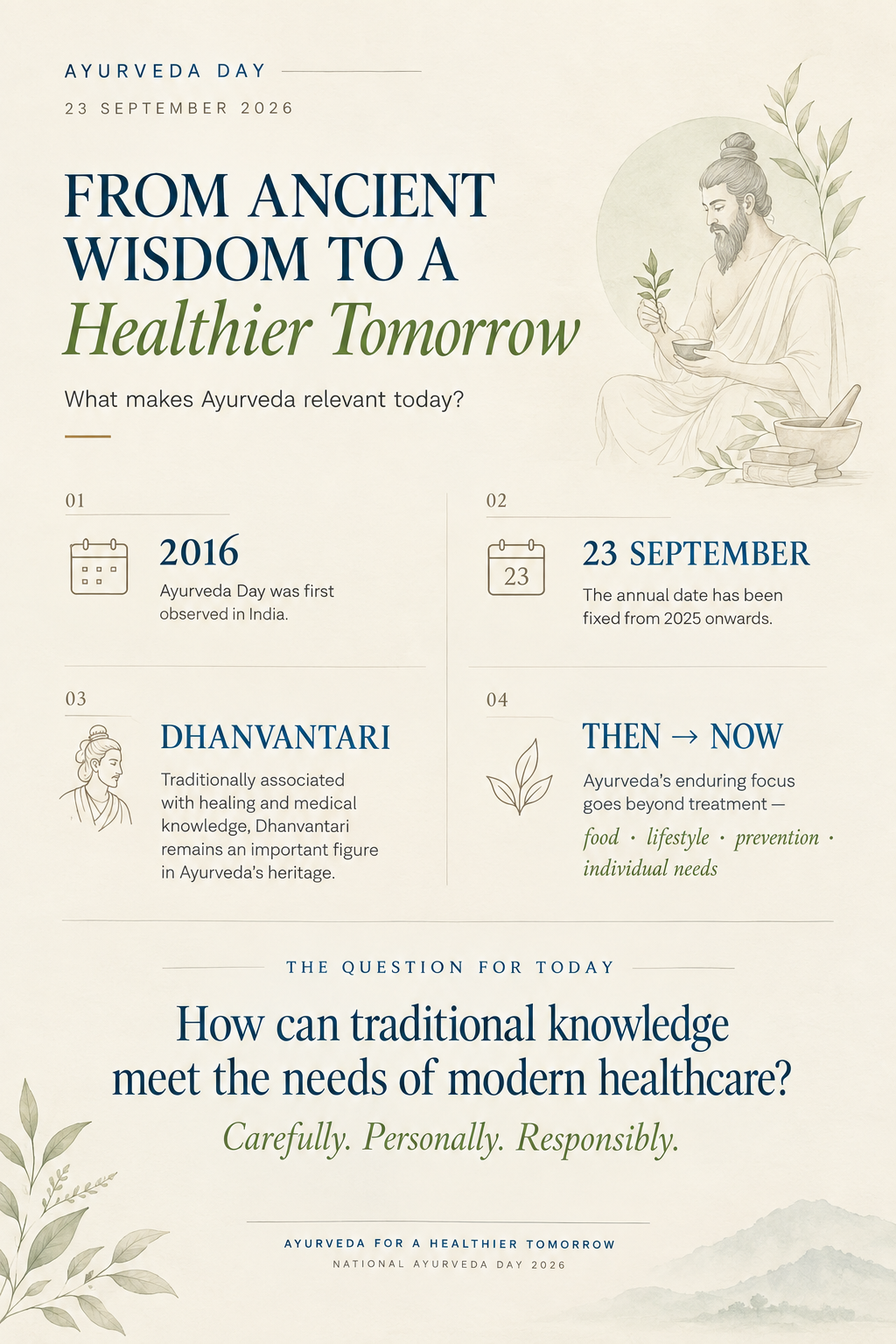
So, what is Ayurveda Day? Ayurveda Day is observed across India to bring attention to Ayurveda and its role in healthcare. It was first observed in 2016 and has traditionally been linked to Dhanvantari Jayanti. The date has since been fixed as 23 September from 2025 onwards, making Ayurveda Day easier to observe consistently across the country. For many people, the occasion may simply be associated with Ayurveda and Dhanvantari. But there is a wider story behind it. Ayurveda represents a long tradition of thinking about health through food, lifestyle, prevention, diagnosis, and treatment. That makes Ayurveda Day India 2026 more than a date on the calendar. It is also a chance to consider how this knowledge can be applied carefully and meaningfully to the health concerns people face today.
Why is Dhanvantari associated with Ayurveda?
Dhanvantari has an important place in the traditional history of Ayurveda. Different accounts describe his connection with healing and medical knowledge, and he is respected within the Ayurveda tradition as a figure associated with the practice of medicine. There are also traditional accounts linking Dhanvantari with the teaching of Ayurveda and the development of medical knowledge in ancient India. These stories form part of India’s cultural and medical history.
For a modern discussion of Ayurveda Day, however, the larger idea is more useful than the mythology itself. Dhanvantari represents the value placed on medical knowledge, healing and the responsibility that comes with caring for another person. Those principles remain relevant even as healthcare itself has changed considerably. A patient seeking care today still expects a physician to listen carefully, understand the health problem, assess the individual and make decisions responsibly. The tools may have changed, but the responsibility has not.
The significance of Dhanvantari Jayanti
The Dhanvantari Jayanti significance is often discussed in terms of tradition and cultural observance. In the context of Ayurveda Day, it can also be viewed as a reminder of the purpose behind medical knowledge. Health is not limited to treating a symptom after it appears. Food, sleep, physical activity, daily routine,stress and existing health conditions can all influence how a person feels and functions.
Ayurveda has traditionally paid attention to these aspects of everyday life. Its approach also recognises that people with the same diagnosis may not necessarily have the same health history, symptoms, routines or needs. That perspective is particularly relevant today, when healthcare is increasingly concerned with prevention, personalised care and long-term management of chronic conditions.
Ayurveda history in India: a tradition that continues to evolve
The history of Ayurveda India knows today extends across centuries of medical learning and practice. Classical Ayurveda texts discuss areas such as diagnosis, diet, lifestyle, medicines, therapeutic procedures, and disease management. Ayurveda also developed knowledge across different areas of medicine, including internal medicine, surgery, paediatrics, ophthalmology and ENT, toxicology, rejuvenation and reproductive health.
One feature that stands out through this long tradition is attention to the individual. Age, constitution, digestion, habits, environment and the nature of a health problem could influence how care was approached. This way of looking at the individual has an interesting connection with the direction healthcare is taking today.
Two people can have the same diagnosis and still have very different experiences. Their symptoms may differ. Their medication history, sleep, diet, activity levels and other health conditions may also be different. Understanding those differences can make clinical assessment more meaningful.
From Ayurveda to Precision Ayurveda
The continued relevance of Ayurveda depends not only on preserving its history but also on how it is practised. This is where a more structured approach to care becomes important.
Precision Ayurveda begins with understanding the person rather than looking at a diagnosis in isolation. A physician may consider the patient’s medical history, symptoms, diet, lifestyle, behaviour, existing health conditions and other relevant health parameters before developing a treatment approach. For example, two people living with the same chronic condition may have very different daily routines. One may struggle with poor sleep and irregular meals, while another may have a sedentary lifestyle, multiple medications or another ongoing health concern. These details matter.
A careful assessment helps the physician understand what may be contributing to the person’s health concerns and what needs attention alongside the primary condition. This is also why personalised care should not simply mean giving every patient a different set of recommendations. It requires proper assessment, a systematic clinical approach and ongoing review of how the person responds.
Patient safety has to remain central
As interest in Ayurveda grows, people now have access to more health information than ever before. Advice about diet, medicines, therapies and home remedies is readily available online. The problem is that information that appears harmless may not be suitable for everyone. This is particularly important for older adults and people managing chronic or complex health conditions. Responsible Ayurveda care therefore needs more than traditional knowledge. It needs careful clinical assessment, appropriate treatment selection, quality standards, documentation and monitoring. Patient safety should remain central throughout the process.
It is equally important to recognise when a patient may need another form of medical care or specialist attention. Good healthcare is ultimately about addressing the patient’s needs appropriately.
What does “Ayurveda for a Healthier Tomorrow” mean?
The theme ‘Ayurveda for a Healthier Tomorrow’ brings the discussion into the present. A healthier future cannot be built only through treatment after illness develops. Everyday habits also have a role in maintaining health. Ayurveda has long placed importance on daily routines and food habits. Dinacharya looks at daily routines, while Ritucharya considers changes across the seasons. Ayurveda dietary principles also take into account how much a person eats, when they eat and how well they digest food. These ideas need to be considered in the context of the individual rather than applied as fixed rules.
There is no single daily routine or diet that is appropriate for everyone. This is where individual assessment becomes important. Rather than turning traditional principles into fixed rules, they can be considered as part of a broader clinical understanding of the person.
Ayurveda’s role in modern healthcare
Healthcare today is increasingly complex. People may live with multiple chronic conditions, take several medications, require specialist care and need support with lifestyle changes at the same time. An integrative approach can help bring different areas of healthcare together when clinically appropriate.
Modern medicine has an essential role in areas such as emergency care, surgery, diagnostics, critical care and specialised treatment. Ayurveda can contribute through its focus on diet, lifestyle, individual constitution, health maintenance and certain therapeutic approaches. The important question is not which system should always take precedence. The more useful question is, what does this particular patient need, and what approach is safe and appropriate for them? A patient-first approach leaves room for different forms of healthcare to work alongside each other when there is a clear clinical rationale for doing so.
Keeping Ayurveda relevant
Respecting Ayurveda’s history does not mean treating it as something that must remain unchanged. Medical knowledge develops as clinical practice improves, evidence grows, and healthcare systems become more structured. Ayurveda also needs careful interpretation and responsible application if it is to remain meaningful for future generations. That includes maintaining the foundations of the tradition while strengthening areas such as clinical quality, documentation, research, outcome measurement and patient monitoring. For healthcare organisations, this also means having systems that support consistent standards rather than relying solely on individual expertise. This is particularly important when Ayurveda is being used for people with complex or long-standing health concerns. The value of traditional knowledge is strengthened when it is applied with clarity about what it can offer, where its limits lie and how patient outcomes are being followed.
Looking ahead to Ayurveda Day 2026
As India observes National Ayurveda Day in 2026, it is worth looking at what Ayurveda needs to offer healthcare today and in the years ahead. That means strengthening the way Ayurveda is practised, with careful clinical assessment, patient safety, consistent quality, measurable outcomes and care that is suited to the individual. It also means recognising where collaboration with other systems of medicine can help provide better care for patients.
The theme ‘Ayurveda for a Healthier Tomorrow’ points towards this larger role for Ayurveda. Its future will depend not only on preserving what has been passed down but also on how responsibly that knowledge is understood, applied,and evaluated in clinical practice. Ayurveda Day can therefore be a time to look both back and ahead, to acknowledge the knowledge that has come before us while continuing to raise the standard of care for the people who depend on it.
References