A balanced plate is usually described in terms of vegetables, protein, carbohydrates, healthy fats and portion sizes. Ayurveda looks at the same plate through a different lens. It asks another set of questions: Is this food suitable for my constitution? Is it the right food for this season? Will I be able to digest it comfortably? Does the meal provide a range of tastes, or is it dominated by one?
This is the foundation of an Ayurvedic diet plan India can actually relate to. Ayurveda does not prescribe one ideal plate for everyone. Food is considered in relation to Prakriti (individual constitution), the current state of theDoshas,Agni (digestive capacity), age, activity, season and overall health. So, an Ayurveda-balanced plate is not about eating more foods. It is about choosing the right foods, in the right combination and quantity, at the right time.

What Makes a Meal Balanced in Ayurveda?
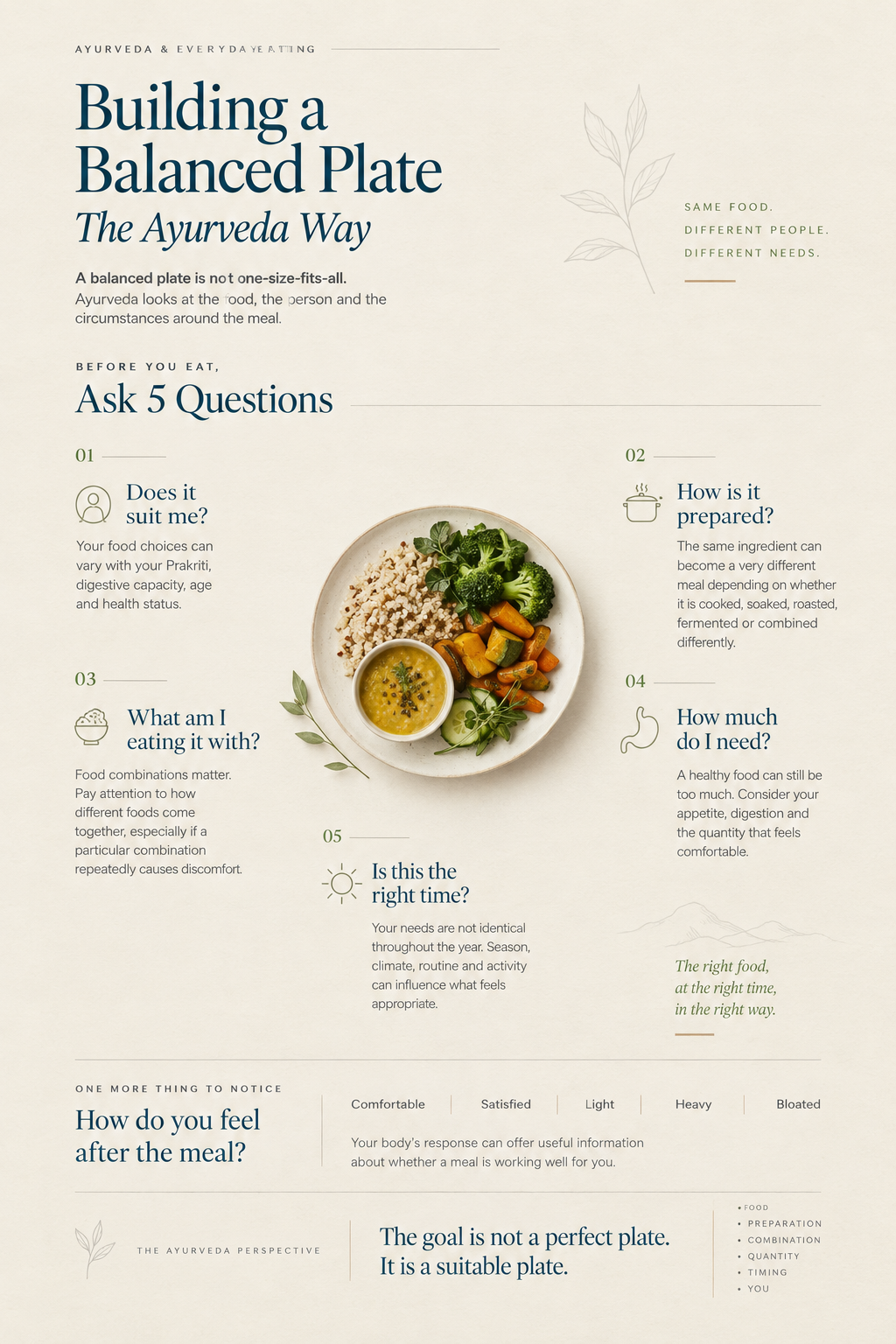
One of the classical frameworks used to understand food is Ahara Vidhi Vishesha Ayatana. It describes eight factors that influence how food should be considered:
- Prakriti – the nature or qualities of the food
- Karana – how the food is processed or prepared
- Samyoga – the combination of foods
- Rashi – the quantity consumed
- Desha – the place or environment
- Kala – time and season
- Upayoga Samstha – the manner and rules of eating
- Upayokta – the person who eats the food
These eight factors make the Ayurveda understanding of a meal considerably broader than its nutrient content. Take rice as a simple example. The rice itself is only one part of the picture. How it is prepared, what it is eaten with, how much is served and who is eating it all become relevant. This is also why an Ayurvedic diet plan cannot be reduced to one standard plate that everyone should follow.
Your Prakriti changes how you build your plate
There is no universal food list that works equally well for everyone. Your Prakriti, current Dosha state and digestive capacity all matter.
- Warm rice or wheat preparations
- Moong dal
- Well-cooked vegetables
- Soups and stews
- A moderate amount of ghee
- Naturally sweet and nourishing foods
- Limit excessive raw foods, very dry snacks, cold foods and irregular eating.
- Rice and wheat
- Moong dal
- Gourds and other mild vegetables
- Amalaki
- Fresh seasonal fruits
- Coriander, fennel and other milder spices
- Limit excessive chilli, very spicy preparations, deep-fried foods, excessive sourness, pickles and very salty foods.
- Barley and lighter grains
- Moong and other suitable pulses
- Cooked leafy vegetables
- Bitter and astringent vegetables
- Ginger, cumin and other digestive spices
- Limit frequent heavy meals, excessive sweets, oily foods, fried foods and large portions.
These are broad principles rather than fixed food lists. The same food can be prepared differently, eaten in a different quantity or chosen at a different time depending on the person and the circumstances.
The Six Tastes: More Than a Checklist
Ayurveda describes six tastes, collectively known as Shadrasa:
Madhura – sweet
Amla – sour
Lavana– salty
Katu– pungent
Tikta– bitter
Kashaya– astringent
These tastes are found naturally across different foods. Rice, wheat and many fruits bring sweetness; lemon and certain fermented foods bring sourness; salt contributes the salty taste; spices contribute pungency, while vegetables and greens provide bitter and astringent notes. The purpose is not to make every meal a mathematical exercise involving all six tastes. Rather, Shadrasa offers a way of looking at variety in the diet. A meal built around one dominant taste every day is very different from a varied diet that includes different foods, preparations and flavours over time.
Preparation Changes the Food
The way food is prepared is an important part of Ayurveda dietary thinking. This is covered by Karana, which refers to processing or transformation. Cooking, soaking, grinding, fermenting, roasting, and other methods can change the characteristics of food.
Consider a pulse. It may be soaked before cooking, cooked until soft and combined with spices, or prepared in another form altogether. These are not simply different recipes; the preparation changes how the food is presented and consumed. Ayurveda, therefore, pays attention to the method of preparation rather than treating an ingredient as though its qualities remain the same in every form. This is particularly useful when thinking about everyday meals. The question is not only “What am I eating?” but also “How has it been prepared?”
Food Combinations Matter
Another factor is Samyoga, or combination. Ayurveda describes certain combinations as Viruddha Ahara, generally understood as incompatible food combinations. The concept is broader than simply naming a few combinations that should never be eaten. It considers factors such as the properties of foods, their preparation and how they are combined.
This is one reason Ayurveda dietary advice may sometimes differ from a simple nutrient-based approach. Two foods may each be nutritious when considered separately, while their combination, quantity or preparation may not be suitable in a particular context. It is not necessary to turn this into a long list of dietary restrictions. The useful takeaway is to pay attention to the way foods are put together, particularly when a particular combination repeatedly causes discomfort.
How Much Food Is Right for You?
Is Food Always Healthy?
Ayurveda’s concept of Pathya–Apathya adds another layer to this discussion. Pathya refers to what is suitable or wholesome, while Apathya refers to what is unsuitable. The important point is that suitability is contextual. A food is not necessarily “good” for everyone, at all times, in every quantity. Its suitability can change with the person’s condition, season, place, preparation and other circumstances. This is particularly relevant today, when individual foods are often simply labelled as “healthy” or “unhealthy”. Ayurveda takes a more contextual view.
For instance, a food that is comfortable for one person may not suit another. The same person may also respond differently to the same food at different times. That does not mean there are no general dietary principles. It means those principles are applied with attention to the individual and the situation.
The Plate Changes With the Seasons
Food is also connected with Kala, which includes considerations of time and season. Ayurveda’s seasonal approach, or Ritucharya, recognises that the body and environment are not static throughout the year. Appetite, activity, digestion, temperature and routine can all change with the seasons. So, the foods and preparations that feel appropriate in summer need not be identical to those preferred in the colder months.
Seasonal eating does not have to mean following an elaborate seasonal menu. It can be as simple as noticing changes in appetite and choosing preparations that feel more appropriate to the weather and one’s routine. This is one reason an Ayurvedic diet plan may need to change over time rather than remain unchanged throughout the year.
Where Does Agni Fit In?
No discussion of food in Ayurveda is complete without Agni, or digestive fire. Agni is central to the Ayurveda understanding of digestion and metabolism. Rather than looking only at the food consumed, Ayurveda also considers how the body is handling it.
A person may notice that a meal that usually feels comfortable now leaves them feeling heavy. Someone else may experience an irregular appetite or bloating after changing their routine. These responses are relevant when considering diet. Ayurveda describes different states of Agni, including Samagni, Mandagni, Tikshnagni and Vishamagni. These terms describe different patterns of digestive function and help explain why dietary advice cannot always be separated from the individual’s current state. The aim is not to diagnose yourself from a few digestive symptoms. It is to recognise that digestion is an important part of how food is understood in Ayurveda.
Building a Balanced Plate the Ayurveda Way
The Ayurveda approach to food is not about making eating complicated. It is about looking beyond the ingredient list. Food has a nature. It can be transformed through preparation, combined with other foods, eaten in different quantities and consumed under different circumstances. The person eating it matters too.
That is the value of looking at food through Ahara Vidhi Vishesha Ayatana. It brings together factors that are often considered separately in modern discussions about nutrition: the food, the preparation, the combination, the quantity, the season, the manner of eating and the individual. A balanced plate, therefore, is not necessarily one that looks identical every day. It makes sense for the person eating it, the food being prepared, and the circumstances in which it is eaten. That is where Ayurveda brings a different perspective to the everyday question: What should I put on my plate?
References