Healthcare today is very different from the healthcare available even a few decades ago. We have sophisticated diagnostic tools, advanced medicines, better imaging and a much clearer understanding of how different systems in the body influence one another. At the same time, many of the health problems people live with today are not simple or short-lived. Diabetes, chronic pain, digestive disorders, metabolic conditions and several neurological problems often require ongoing attention to more than one aspect of health. This is where Ayurveda can have a relevant place in contemporary healthcare.
The conversation is no longer simply about choosing between Ayurveda and modern medicine. Increasingly, it is about understanding where different approaches can complement each other, while keeping appropriate diagnosis, safety and measurable outcomes at the centre of care. This is the thinking behind Ayurveda in modern healthcare integrative medicine.

Ayurveda’s place in modern healthcare: not alternative, but integrative
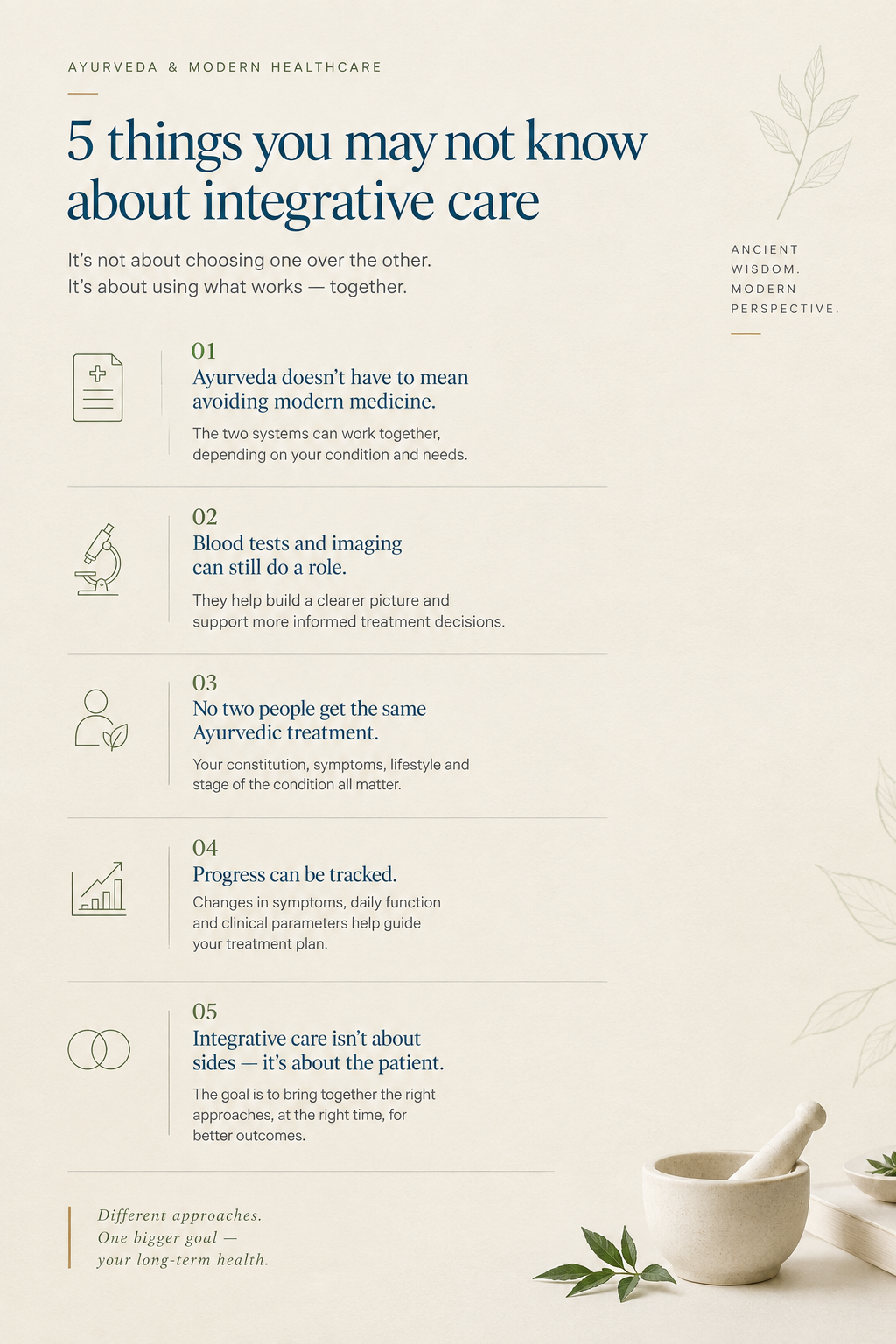
Ayurveda has its own clinical framework for understanding health and disease. An Ayurveda physician looks beyond the presenting symptom to consider factors such as the individual’s constitution, disease stage, digestion, diet, lifestyle, sleep and other factors that may influence the condition.
Modern medicine brings a different but equally important set of strengths. Laboratory investigations, imaging, functional testing and established medical interventions can help identify disease, understand its severity and monitor changes over time. These approaches do not always need to exist separately.
For a patient with a chronic condition, for instance, modern diagnostic investigations may establish what is happening physiologically, while an Ayurveda physician may use Ayurveda-based clinical assessment to understand the condition and develop an individualised management plan. That is a more useful way of looking at Ayurveda and modern medicine in India. The goal is not to replace one system with another but to use each appropriately as part of patient-centred care. At Apollo AyurVAID, this philosophy is reflected in the Precision Ayurveda approach.
Precision Ayurveda: a structured approach to individualised care
Precision Ayurveda begins with understanding the individual patient rather than treating a diagnosis in isolation. Medical history, family history, diet, lifestyle, behaviour, existing health conditions and relevant clinical parameters all contribute to the assessment. The treatment plan is then personalised according to the patient’s condition and its stage. This is important because Ayurveda is not simply a collection of therapies. Its clinical application involves assessment, diagnosis, treatment planning and continued review. An individual with diabetes, for example, may have very different contributing factors and treatment requirements from another person with the same diagnosis. A standardised prescription cannot account for those differences in the same way that an individualised clinical assessment can.
This is the foundation of integrative Ayurveda evidence-based practice: retaining the clinical principles of Ayurveda while applying them within a structured healthcare environment.
How Ayurveda complements modern diagnostics
Choosing Ayurveda does not have to mean stepping away from modern diagnostic medicine. Blood tests can help assess blood glucose, lipid levels, liver and kidney function and other important parameters. Imaging can identify structural changes. Functional assessments can provide information about movement, neurological function and physical capacity. These investigations can be particularly useful when Ayurveda is being used to manage a chronic or complex condition.
The Ayurveda physician can consider these findings alongside the patient’s history and clinical presentation. The result is a broader picture of the patient’s health rather than an assessment based only on symptoms. For someone with persistent back pain, for example, imaging may help identify structural changes, while the clinical assessment can also consider the nature of the pain, mobility, daily activity, sleep and other relevant factors. The point is not to make Ayurveda imitate modern medicine. It is to use appropriate information from both clinical perspectives to make patient care more informed.
Published research and clinical outcomes
AyurVAID’s clinical work has also been documented in published medical literature. One example is Use of Ayurveda in the Treatment of Type 2 Diabetes Mellitus, published in Global Advances in Health and Medicine in 2019, with Dr Zankhana Buch of AyurVAID Hospitals among the authors. The paper reviews the available evidence on Ayurveda in Type 2 diabetes and includes a clinical case from an AyurVAID clinic in Bengaluru. Such publications contribute to the growing body of Ayurveda clinical research in India. They also reinforce the need to document clinical outcomes carefully and continue building stronger evidence around Ayurveda approaches.
Case studies from AyurVAID: learning from clinical practice
Research is one way to understand a medical approach. Carefully documented clinical cases offer another perspective by showing how treatment is applied to an individual patient over time. AyurVAID’s case studies are based on original observations made by its Ayurveda practitioners. One such case describes a 26-year-old man who presented with elevated blood sugar, weight loss, tiredness, poor concentration and numbness and burning in his feet. His initial fasting blood sugar was 263 mg/dL and post-meal blood sugar was 370 mg/dL. Insulin had been advised before he approached AyurVAID. His management included a personalised combination of diet, lifestyle, Ayurveda medicines and cleansing therapies. The team followed his progress through laboratory investigations and clinical assessment. The case records subsequent improvement in his blood glucose parameters, weight regain, and resolution of several presenting symptoms. The case also records a gradual reduction and eventual withdrawal of oral medication, followed by continued monitoring.
Cases such as this should be understood in their proper context. It documents one patient’s clinical journey; it does not mean that every person with diabetes will have the same response or that prescribed diabetes medication should be stopped without medical supervision. What it does demonstrate is the way an individualised Ayurveda treatment plan can be developed and followed through measurable clinical outcomes.
Click here for more patient stories.
Global recognition: where does Ayurveda fit in?
The discussion around Ayurveda is also taking place within a much larger global conversation about traditional, complementary and integrative medicine. In 2025, the World Health Assembly adopted the WHO Global Traditional Medicine Strategy 2025–2034. The strategy calls for stronger evidence and research, appropriate standards for safety and quality, and the responsible integration of traditional, complementary and integrative medicine into health systems.
For Ayurveda, this direction is significant. Global recognition is not simply about giving traditional medicine a larger platform. It also brings greater attention to questions of evidence, quality, safety, research and responsible clinical practice. That is increasingly relevant to contemporary Ayurvedic practice, particularly when Ayurveda is being delivered within modern healthcare environments.
What should patients know before choosing Ayurveda?
Patients considering Ayurveda should approach it as they would any other form of medical care: with informed questions and appropriate clinical guidance.
Start by choosing a qualified Ayurveda physician who can assess your condition properly. Share your complete medical history, including existing diagnoses, medicines, investigations and previous treatments. It is also important to understand how your treatment will be monitored. Ask what outcomes will be assessed, how often you will be reviewed, and when further investigations or referral to another specialist may be needed. Most importantly, do not stop prescribed medicines on your own because you have decided to try Ayurveda. Any change to an existing treatment plan should be made with appropriate medical supervision.
A responsible Ayurveda practice should be able to explain its approach clearly, acknowledge the available evidence and limitations, and keep the patient’s safety at the centre of treatment.
Bringing Ayurveda into the healthcare conversation
References