‹

Stridor in Children: When a Noisy Breath Needs Urgent Attention

Table of Contents

A change in the way a child breathes is not always easy to interpret. One sound that deserves particular attention is a harsh, high-pitched noise coming from the throat while breathing. This is called stridor.

Stridor in children occurs when air has difficulty moving through a narrowed part of the upper airway. The narrowing may be caused by swelling, inflammation, a structural problem or something blocking the airway. Because a child’s airway is smaller than an adult’s, even a small amount of swelling can have a noticeable effect on breathing. Stridor is a symptom rather than a condition on its own. It can occur with common childhood illnesses such as croup or with conditions such as laryngomalacia in babies. If it starts suddenly after a child has choked on food or a small object, however, an airway blockage needs to be considered. The circumstances around the noisy breathing matter. When it starts, whether the child is comfortable at rest and whether there is any difficulty breathing can help determine how urgently the child needs to be assessed.

Insurance Backed

Precision Ayurveda
Medical Care

Stridor vs wheezing: what is the difference?
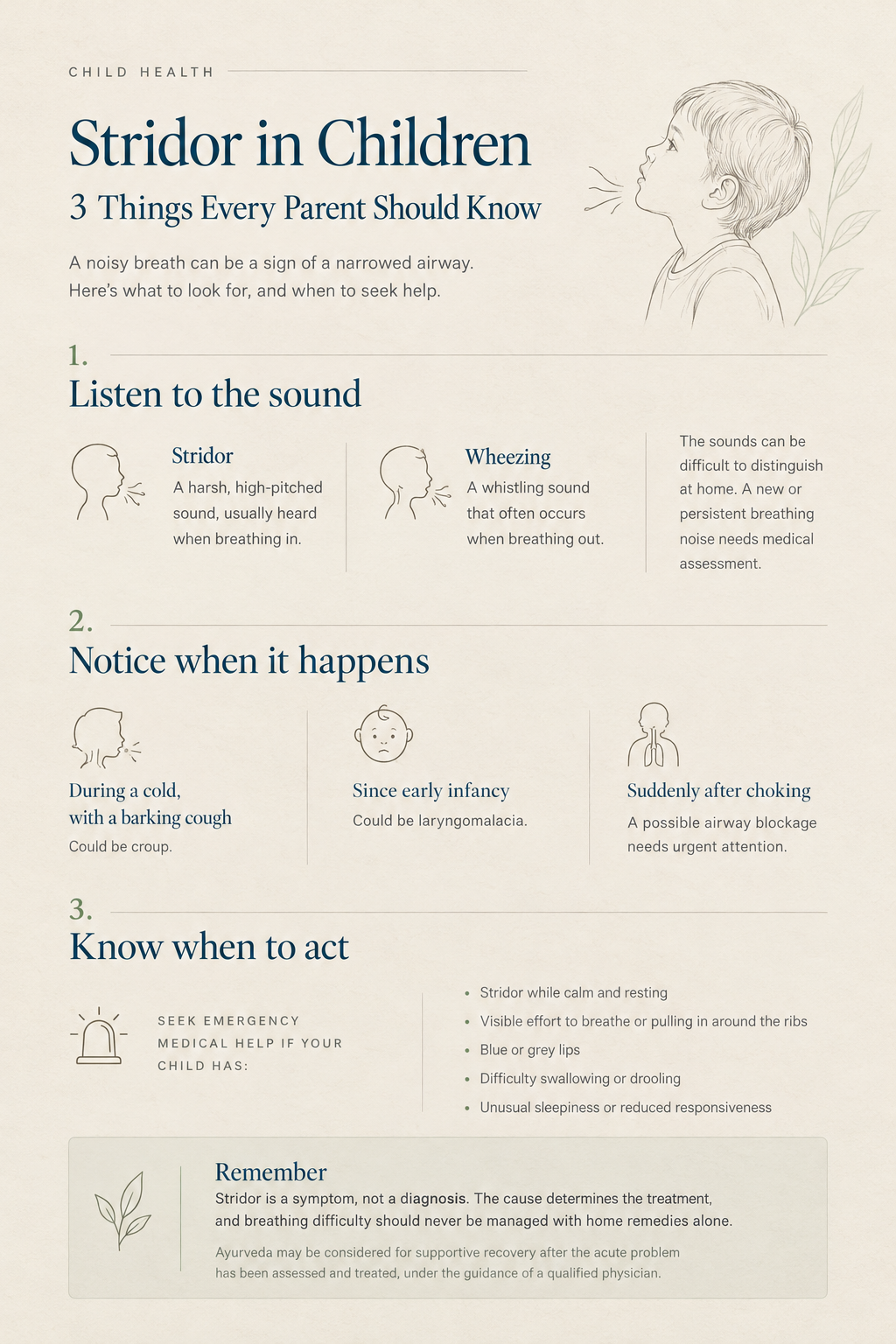
 Stridor and wheezing are both unusual breathing sounds, but they usually come from different parts of the respiratory system. Stridor is caused by narrowing or obstruction in the upper airway, such as around the throat or larynx, while wheezing generally occurs when the smaller airways inside the lungs become narrowed. The timing of the sound can also be different. Stridor is often more noticeable when a child breathes in, although it can occur during breathing out or both. Wheezing is more commonly heard during breathing out, and it tends to have a softer, musical or whistling quality.

The causes are different too. Stridor may occur with croup, laryngomalacia or an object blocking the upper airway, whereas wheezing can be associated with conditions such as asthma, viral infections or inflammation of the lower airways. For parents, the distinction is useful but not always easy to make by listening alone. If a child has a new or persistent breathing sound, particularly along with difficulty breathing, feeding problems, a change in skin colour or unusual tiredness, the child should be assessed by a healthcare professional rather than relying on the sound to determine what is wrong.

What causes stridor in children?

There are several stridor causes children may experience. Age, the way the sound began, and other symptoms can all help point towards the cause.

Croup

Croup is a common viral infection in young children. It causes swelling around the voice box and windpipe, making the upper airway narrower than usual. The usual signs are a barking cough, hoarse voice and stridor, particularly when the child breathes in. Some children may also have a fever or find it harder to breathe. Croup can range from mild symptoms to more significant narrowing of the airway. If the noisy breathing is present even when the child is calm and resting, or if the child is working hard to breathe or becoming increasingly distressed, they need prompt medical attention.

Laryngomalacia

Laryngomalacia is a common cause of noisy breathing in babies. In this condition, the tissues around the voice box are softer than usual and can partly fall inward when the baby breathes in. The sound may be present from the first few weeks of life and can become more noticeable when the baby is feeding, crying, or lying in certain positions. This is often what parents mean when searching for laryngeal stridor baby symptoms.
Many babies with laryngomalacia grow out of the problem as the tissues around the airway become firmer. However, noisy breathing should be assessed if the baby has trouble feeding, is not gaining weight properly, has pauses in breathing or seems to be working hard to breathe.

A foreign object in the airway

A stridor that starts suddenly is more concerning, particularly if it happens while a child is eating or playing with a small object. Food or another object can accidentally enter the airway instead of the food pipe. The child may suddenly cough, choke, develop noisy breathing or struggle to breathe. This situation needs prompt medical attention. Even if the child seems to settle after the initial choking episode, continued coughing, noisy breathing or other breathing changes should not be ignored because an object may still be partly blocking the airway.

Other causes

Not every episode of stridor is caused by croup or an infection. Problems involving the vocal cords, swelling from an allergic reaction or infection, an injury to the airway, or a structural problem present from birth can also narrow the airway and produce stridor. This is why the way the stridor began is useful information for a doctor. Stridor that develops during a viral illness, has been present since infancy, or appears suddenly after choking points to very different possibilities and may require different treatment.

When does stridor require emergency care?

The loudness of the sound is not the best measure of how serious the problem is. A more useful question is whether the child is able to breathe normally. Get emergency medical help if a child with stridor has:

  • difficulty breathing or visibly increased effort when breathing
  • skin pulling in around the ribs, neck or breastbone
  • blue, grey or unusually pale lips or skin
  • drooling or difficulty swallowing
  • difficulty feeding or drinking
  • unusual sleepiness, confusion or reduced responsiveness
  • rapidly worsening breathing
  • stridor that continues while the child is calm and resting
  • sudden stridor after choking or possible inhalation of an object

If the child is struggling to breathe, do not wait for the noise to settle on its own. Contact your local emergency service or take the child to an emergency department. Do not put your fingers or another object into the child’s mouth or throat to look for a possible obstruction.

How is stridor diagnosed?

A doctor will first look at how well the child is breathing. Questions about when the sound started, whether it occurs while breathing in or out, and whether there has been a recent cold, fever, cough or choking episode can be useful. The doctor will also check the child’s breathing, oxygen level and general condition. In some cases, the cause becomes clear from the symptoms and examination alone. If it is not clear, the doctor may recommend further tests, such as an X-ray or another scan, or may use a small flexible camera to look at the airway more closely. A more detailed airway assessment may be needed when the cause is unclear, or the symptoms keep returning. The aim is to identify where the airway is narrowed, understand why it has happened and determine whether immediate treatment is required.

How is stridor treated?

Treatment depends entirely on what is causing the stridor. For example, a child with croup may need treatment to reduce airway swelling. In cases where a foreign object has entered the airway, trained medical professionals must remove it. Other children may require treatment for an infection, allergic reaction, vocal cord problem or structural abnormality. When airway narrowing is severe, emergency measures may be required to maintain the airway and support breathing. There is no safe way to decide on treatment simply by listening to the noise. A child with a relatively mild condition and a child with a serious airway problem can both have noisy breathing.

Can Ayurveda support recovery after the acute phase?

Once the acute breathing problem has been assessed and treated and the child is medically stable, Ayurveda may be considered as part of supportive recovery. It is important to draw a clear line here: Ayurveda should not replace emergency medical care for active stridor, breathing difficulty, suspected foreign body aspiration or signs of airway obstruction. During recovery, a qualified Ayurveda physician may look at aspects such as appetite, digestion, sleep, energy and food habits along with the child’s overall health. Dietary and lifestyle measures can then be considered according to the child’s age, condition and stage of recovery. Medicines should also not be started simply because they are traditionally used for cough or respiratory complaints. Children require age-appropriate doses and careful consideration of their individual condition, so any Ayurveda medicine or procedure should be recommended by a qualified physician.

Helping your child recover

Once the immediate problem has been dealt with, recovery is usually a matter of following the advice given by the treating healthcare team. Adequate rest and fluids, where appropriate, can help. Keeping the child away from cigarette smoke, strong fumes and other respiratory irritants is also sensible. Pay attention if the noisy breathing returns. If your child has stridor more than once, especially without a clear infection, speak to a doctor about it. Episodes that are becoming more frequent may need a closer look. With babies and young children, keep small objects out of reach and stay nearby during meals to reduce the risk of choking. Good hand hygiene and recommended vaccinations can also help reduce the risk of some respiratory infections.

When a noisy breath should not be ignored

Difficulty breathing, difficulty swallowing or feeding, a change in skin colour, reduced alertness or rapidly worsening symptoms are reasons to seek emergency care. For less urgent but persistent or recurring noisy breathing, a medical evaluation can help determine what is happening rather than treating the symptom as an ordinary cold. Once the acute problem has been properly managed, appropriate follow-up and supportive care can help the child return to normal. Ayurveda may have a place during this recovery period when guided by a qualified physician, while urgent airway problems continue to require prompt medical care.

References

Prajakta Palande, Yogesh Surse. Conceptual study on CROUP in children w.r.t. its management in Ayurvedic and Contemporary Sciences. J Ayurveda Integr Med Sci 2023;12:95-100. external link
Celmina M, Paule S. Stridor in children. Breathe (Sheff). 2018 Sep;14(3):e111-e117. doi: 10.1183/20734735.017018. PMID: 30364492; PMCID: PMC6196318.
Supriya, N & Murthy, G & Kumar, P & S, Sanjay. (2020). Etiological evaluation of stridor in children. Indian Journal of Child Health. 7. 309-312. 10.32677/IJCH.2020.v07.i07.007.
Selvam, D. K., Vikram, V. J., Saktheeswaran, M., & M P, M. I. (2017). A study on paediatric stridor causes and management: case series. International Journal of Otorhinolaryngology and Head and Neck Surgery, 3(4), 1031–1035. external link
C, Bijumon & Saji, Anjana. (2025). AYURVEDIC MANAGEMENT OF ACUTE LARYNGITIS: A CASE REPORT. International Ayurvedic Medical Journal. 13. 2683-2687. 10.46607/iamj3213092025.

FAQ

Can stridor in children go away on its own?
It can, depending on the cause, and some mild cases may resolve as the underlying problem improves. However, don't ignore new or persistent stridor, especially if the child has difficulty breathing.
Why does my child’s stridor become louder when they cry?
Crying can make the sound more noticeable because the child is moving air more forcefully through an already narrowed upper airway. If the stridor is also present when your child is calm, they should be assessed by a doctor.
Can stridor occur without a cough or fever?
Yes, stridor does not always occur with an infection and may be linked to conditions such as laryngomalacia, an airway abnormality or a foreign object. The absence of fever or cough does not by itself tell you whether the stridor is serious.
Should I be concerned if my baby has noisy breathing during feeding?
Noisy breathing during feeding can occur with conditions such as laryngomalacia, but it should be discussed with a doctor if it is persistent. Difficulty feeding, poor weight gain, pauses in breathing, or increased effort to breathe all need prompt medical attention.
Can Ayurveda be used when a child has stridor?
Ayurveda may have a role in supporting recovery after the acute breathing problem has been assessed and treated. It should not be used instead of urgent medical care for active stridor, breathing difficulty or suspected airway obstruction.
Homepage B RCB

Please fill out the form below to Request a call back

Patient details

Table of Contents
Latest Post
Blog Images part 2 (1)
Beyond the Diagnosis: How Ayurveda Views Emotional Distress — and Why Seeking Help Matters
Blog Images part 2
10 Ayurvedic Home Remedies for Cough and Cold This Winter
Blog Images part 2 (5)
10 Ayurveda Home Remedies for Fatty Liver
AyurVAID Shop
Book a consultation now

Consult our Ayurvedic doctor with 20+ Years of experience &
Insurance Approved Treatment

Homepage B RCB

Please fill out the form below to Request a call back

Patient details

Popular Searches: DiseasesTreatmentsDoctorsHospitalsWhole person careRefer a patientInsurance

Follow Apollo AyurVAID hospitals