- AyurVAID Pharmacy
Have you ever felt unusually drained, not just tired in the ordinary sense, but as though your body itself has less reserve to give? A little less strength in the muscles, a little less brightness in the eyes, a little less steadiness in the bones, a little less vitality overall? Ayurveda describes this state with remarkable depth through the concept of Dhatu Kshaya.
In simple terms, Dhatu Kshaya means depletion of the body’s tissues. It is regarded as a deterioration of the foundation which underpins optimal health, vitality, resilience and immunity. The strength of the building does not come from a single wall or pillar but from each support structure. When such structures become weak, they compromise the building’s overall stability. Ayurveda offers knowledge through the Sapta Dhatus, the seven fundamental tissues that nourish the body.
“Dharanat dhatavaha” – Dhatus refer to the fundamental tissues that nourish and support the body’s physical structure. The body is built upon seven layers of tissue, each one serving a distinct purpose and nourishing the next in sequence.
The first is Rasa (Plasma), the liquid that distributes nutrition to the body. It can be compared to the sap of a tree that distributes the nutrients to each leaf.
Secondly, we have Rakta (Blood), the tissue that provides us with colour, energy and vitality.
Thirdly, we have Mamsa, the muscle tissue. It is what allows us to move, hold posture and carry out daily activities.
Medas follows, representing adipose tissue and lubrication. It protects the body and helps in the proper functioning of joints and adds softness and stability.
Asthi is the bone tissue that gives the rigid structure. They are the pillars of the body providing shape and form.
Majja includes the tissues of marrow and the nervous system. It fills the gaps between the bones and helps in coordination and communication.
Finally, Shukra represents the reproductive tissue, the most refined essence of bodily nourishment. It is closely associated with vitality, fertility and radiance.
These tissues are not isolated. They are part of a continuous flow. When one is disturbed, the next is often affected too. This is why Ayurveda treats tissue depletion as a systemic issue.
The word Kshaya means decrease, loss or depletion. So, Dhatu Kshaya refers to a condition in which one or more tissues lose quality, quantity, or strength.
This does not happen overnight. It usually develops slowly, often silently. A person may first notice reduced energy, then weakness, then poor recovery, then dryness, and finally a sense of “not feeling well in their own body”. Ayurveda sees these changes as signs that the body’s inner reserves are being consumed faster than they are being rebuilt.
In a healthy state, digestion, metabolism and tissue nourishment work together like a well-organised supply chain. Food is digested properly, nutrients are transformed effectively, channels remain open, and tissues are nourished in order. But when that process is disturbed, the whole system begins to suffer.

The most common underlying factor is a problem with Agni, the digestive and metabolic fire of the body. Ayurveda gives Agni a central role because it determines how well food is transformed into nourishment.
When Agni is balanced, food is digested properly and becomes usable tissue. But when it is weak, irregular, or impaired, the nourishment is incomplete. Instead of producing healthy Dhatus, digestion produces Ama—the sticky, toxic, undigested residue that obstructs the body’s channels.
This is an important point: sometimes a person eats enough, even eats well, but still feels depleted. In Ayurveda, this can happen because the problem is not just intake. The problem is transformation.
Think of a kitchen with a weak flame. You may have the best ingredients, but if the fire is too low, the meal will not cook properly. Ayurveda looks at tissue depletion in the same way. The ingredients may be present, but the metabolic fire is not strong enough to convert them into strength.
Dietary Causes
Very little food, poor-quality food, prolonged fasting, or a diet that is too dry, bitter, or astringent can all weaken the tissues. Such habits increase Vata, which gradually dries and thins the body.
Lifestyle Causes
Over-exertion, lack of sleep, excessive sexual activity and suppression of natural urges all disturb the body’s balance. Over time, these habits reduce strength and accelerate tissue depletion.
Psychological and Biological Causes
Continuous worry, grief, fear, and anger can steadily drain the body’s vitality. Ageing naturally increases Vata and contributes to the gradual thinning of the tissues. Certain chronic diseases such as diabetes, infections, and damage to vital points could cause Dhatu Kshaya.
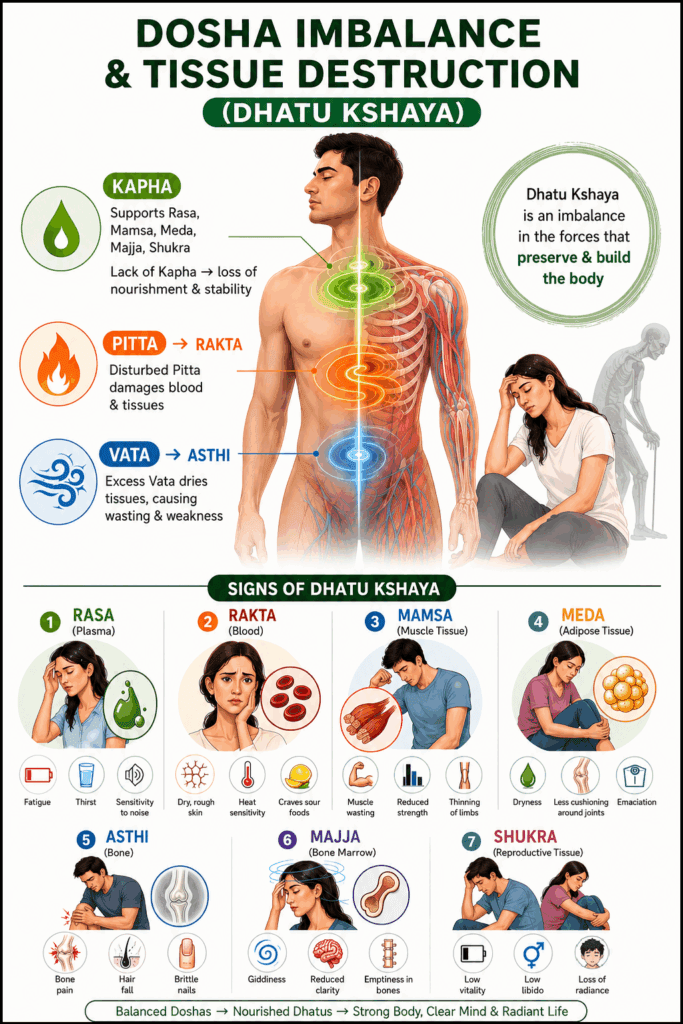
There is a strong connection between the Doshas and the Dhatus. This connection has been explained as Ashraya-Ashrayi Bhava, which means “residence and abode”. The Doshas reside in the Dhatus, and when they are disturbed, they affect the tissues they live in.
Among the three Doshas, the relationship of Vata and Asthi is especially important. Vata has drying, light, mobile and rough qualities. When Vata becomes excessive, it tends to dry out the tissues, leading to wasting, weakness and degeneration.
This is one reason tissue depletion is often seen more clearly with ageing. As we age, Vata naturally increases. If not balanced, it can accelerate dryness, frailty and loss of tissue integrity.
Pitta is more closely connected with Rakta Dhatu, so when Pitta is disturbed, blood-related depletion or heat-related tissue damage occurs.
Kapha supports the more nourishing and structural tissues such as Rasa, Mamsa, Meda, Majja and Shukra. When Kapha is insufficient or disturbed, these tissues may lose compactness, lubrication, and stability.
So, Dhatu Kshaya is not only a matter of “loss”. It is also a matter of imbalance in the forces that preserve and build.
The symptoms of Dhatu Kshaya vary depending on which tissue is affected. Ayurveda pays close attention to these signs because they help identify the pattern of depletion.
When Rasa Dhatu is depleted, a person may feel constantly tired, low in energy, dry, thirsty, or overly sensitive to noise and exertion. There may be a sense that even small tasks feel exhausting.
When Rakta Dhatu is affected, the skin may become dull, rough, dry, or cracked. The body may appear less vibrant, and you may feel more sensitive to heat or crave sour and cooling foods.
When Mamsa Dhatu is weak, muscle wasting, reduced physical strength and visible thinning of the limbs may occur. The body may lose its firmness and feel less supported.
When Meda Dhatu is depleted, there may be emaciation, a loss of cushioning around the joints, dryness and a sense of reduced lubrication in the body.
When Asthi Dhatu is involved, bone pain, brittle nails, hair fall, joint looseness and weakness in the skeletal framework may appear.
When Majja Dhatu becomes depleted, you may notice symptoms such as giddiness, emptiness in the bones, reduced clarity, or a sense of internal hollowness.
And when Shukra Dhatu is affected, you may notice reduced vitality, low reproductive strength, reduced libido and a general decline in radiance and stamina.
These are not just isolated symptoms. They often reflect a deeper pattern of depletion in the entire bodily system.
While Ayurveda uses its own language and framework, many of the clinical patterns of Dhatu Kshaya resemble modern conditions such as dehydration, malnutrition, anaemia, sarcopenia, osteoporosis, wasting disorders and some forms of neuropathy or chronic weakness.
This does not mean the two systems are identical. But it does show that Ayurveda had already observed, in a sophisticated way, the same broad picture of tissue loss, decline in structural integrity, and failure of nourishment.
In chronic diseases such as diabetes, for example, there may be a progressive weakening of the body, with loss of weight, strength, and vitality. Ayurveda recognises this pattern as a kind of tissue depletion, where the body’s nourishment is unable to remain stable.
One of the most important insights in Ayurveda is that Dhatu Kshaya and Vata aggravation often feed into each other.
As tissues become depleted, the body becomes lighter, drier and more unstable. This in turn increases Vata. And when Vata increases, it further dries and weakens the tissues. So, the condition becomes self-perpetuating.
This phenomenon is why Dhatu Kshaya should not be viewed casually. It is not merely a sign of ageing or fatigue. If ignored, it can create a cycle of progressive weakness.
Ayurveda does not approach depletion by simply adding more nourishment in a random way. It first asks, ‘Can the body actually receive and use that nourishment?’
That is why treatment usually begins with restoring Agni and clearing obstruction.
Deepana and Pachana: Rekindling the Fire
The first step is often to improve digestion and metabolism. This means strengthening Agni and reducing Ama. Warming, digestive and channel-clearing measures may be used so the body can begin processing food properly again.
Without this step, simply “feeding” the body may not help. In fact, if digestion is weak, simply feeding the body may worsen heaviness or obstruction.
Shodhana: Purification of the Body
If there is excessive buildup of Ama or any other type of imbalance, then procedures like Panchakarma for cleansing of the body may be prescribed based on the bodily strength of the patient. These cleanse out the toxins and ensure free flow of nutrients in the body through the channels. These are medical cleansing procedures conducted only under suitable circumstances.
Rasayana: Rebuilding and Rejuvenation
Once the body is ready, Rasayana therapy helps restore and strengthen the tissues. Rasayana means rejuvenation, but in Ayurveda, this process is not merely about looking younger. It is about improving nourishment, immunity, resilience and cellular quality.
Herbs, foods and other nourishing formulations are traditionally used to support specific tissues and improve vitality. The idea is not to give a quick stimulant. The idea is to rebuild from within.
One of the most compassionate truths in Ayurveda is that deep depletion cannot be reversed overnight. Tissue rebuilding is gradual. Just as weakness develops slowly, strength also returns gradually.
This requires effective digestion, adequate rest, proper food, appropriate medication or herbal support and a lifestyle that does not keep draining the body.
Sleep, routine, emotional stability and mental quiet are not luxuries in this process. They are part of treatment. A person with Dhatu Kshaya needs not only nutrition but also restoration.
As we work hard to improve our services, your feedback is important to us. Please take a moment to help us serve you better.
Subscribe to our hospital newsletter for the latest health tips, updates on services, patient stories, and community events. Sign up today and stay informed!

Report Problem
Popular Searches: DiseasesTreatmentsDoctorsHospitalsWhole person careRefer a patientInsurance

