A traditional Sadya (meaning ‘feast’ in Malayalam) has its own way of being eaten. The small portions arranged across the banana leaf are not simply a colourful display of Kerala’s festive cooking. The meal has a natural rhythm, moving through different tastes, textures and courses rather than being eaten all at once.
There is a practical reason to pay attention to this way of eating. Ayurveda has always looked at food beyond individual ingredients. Agni, or digestive capacity, Shadrasa, the six tastes, the quantity and combination of foods, meal timing and the state of the mind while eating are all part of its understanding of digestion.
The Sadya brings many of these ideas together naturally. You experience variety without necessarily needing large portions, stronger flavours can be enjoyed in smaller quantities, and the meal has a clear progression from one course to the next. Just as importantly, there is time to eat with other people.
That last part matters too. A Sadya is a community meal. The conversations, familiar rituals, sharing and unhurried pace can change the way we experience food. Perhaps that is the real digestive wisdom hidden in an Onasadya: not just what is served, but how it is served, eaten and enjoyed.

First, look at the leaf
Before the rice arrives, the banana leaf is already a map of flavours. Depending on the household, region and occasion, there may be banana, banana chips, sharkara varatti, pickle, inji puli, thoran, avial, olan, erissery, pachadi, kichadi and other preparations. The exact list varies between households.
Each dish has a different character. Avial brings vegetables, coconut and seasoning; thoran is drier; olan is mild; erissery combines vegetables, pulses and coconut. Pachadi, kichadi, inji puli and pickle add their own sour, sweet, salty and spicy notes.
The sequence is part of the meal
Once rice is served in the centre of the leaf, the meal takes on a rhythm. Rather than mixing every curry at the beginning, rice is generally paired with different preparations as the meal progresses. Parippu with ghee and rice is commonly followed by sambar. Rasam comes later, and curd or buttermilk may form part of the final rice course, depending on the household and tradition. Families have their own customs, but the important point is the movement from one taste and texture to another.
Parippu and ghee give the rice a soft, comforting beginning. Sambar brings a fuller, spiced flavour. Rasam is thinner, lighter and more peppery. The later curd or buttermilk course changes the experience again. Then comes the sweet course.
You are not simply eating more; you are moving through the meal. Ayurveda similarly considers appetite, quantity, preparation, combinations and digestive capacity.
Shadrasa on one banana leaf
One of the strongest links between a Sadya and Ayurveda is Shadrasa, the six tastes: sweet, sour, salty, bitter, pungent and astringent. A Sadya brings these tastes together through its different preparations, although not every taste is present in the same intensity.
Sweetness is more noticeable in rice, mildly sweet vegetables and payasam. Sour and salty flavours come from dishes such as inji puli, pachadi, kichadi and pickle, while ginger, pepper and chilli contribute pungency. Bitter and astringent notes are subtler and depend on the vegetables, greens and pulses used in the meal.
Ayurveda considers these tastes in relation to the individual, season and digestive state. The point is not to make sure every meal contains exactly six tastes, but to understand the role that taste, quantity and balance play in the way food is experienced and digested.
The dishes are interconnected
A Sadya makes more sense when the dishes are seen as parts of one meal rather than separate recipes. Rice becomes the base for different curry combinations. A strong pickle is not eaten like thoran; inji puli is taken sparingly, and mild olan contrasts with sharper preparations. Sambar and rasam each change the character of the rice.
This interconnectedness has an interesting parallel with Ayurveda, where food is considered in relation to its qualities, preparation, quantity and combinations rather than only its individual ingredients. That does not mean every Sadya combination was designed as an Ayurveda formula. The connection is more practical: the meal has evolved around contrast, variety and combinations that work together.
Where Agni comes in
Ayurveda’s concept of Agni, broadly referring to digestive capacity, becomes particularly relevant when the meal is this elaborate. Appetite and the ability to handle a large meal can vary with sleep, activity, stress, season and health. Two people can therefore eat the same Sadya and feel very different afterwards.
One may feel satisfied and comfortable. Another may feel heavy halfway through the meal.
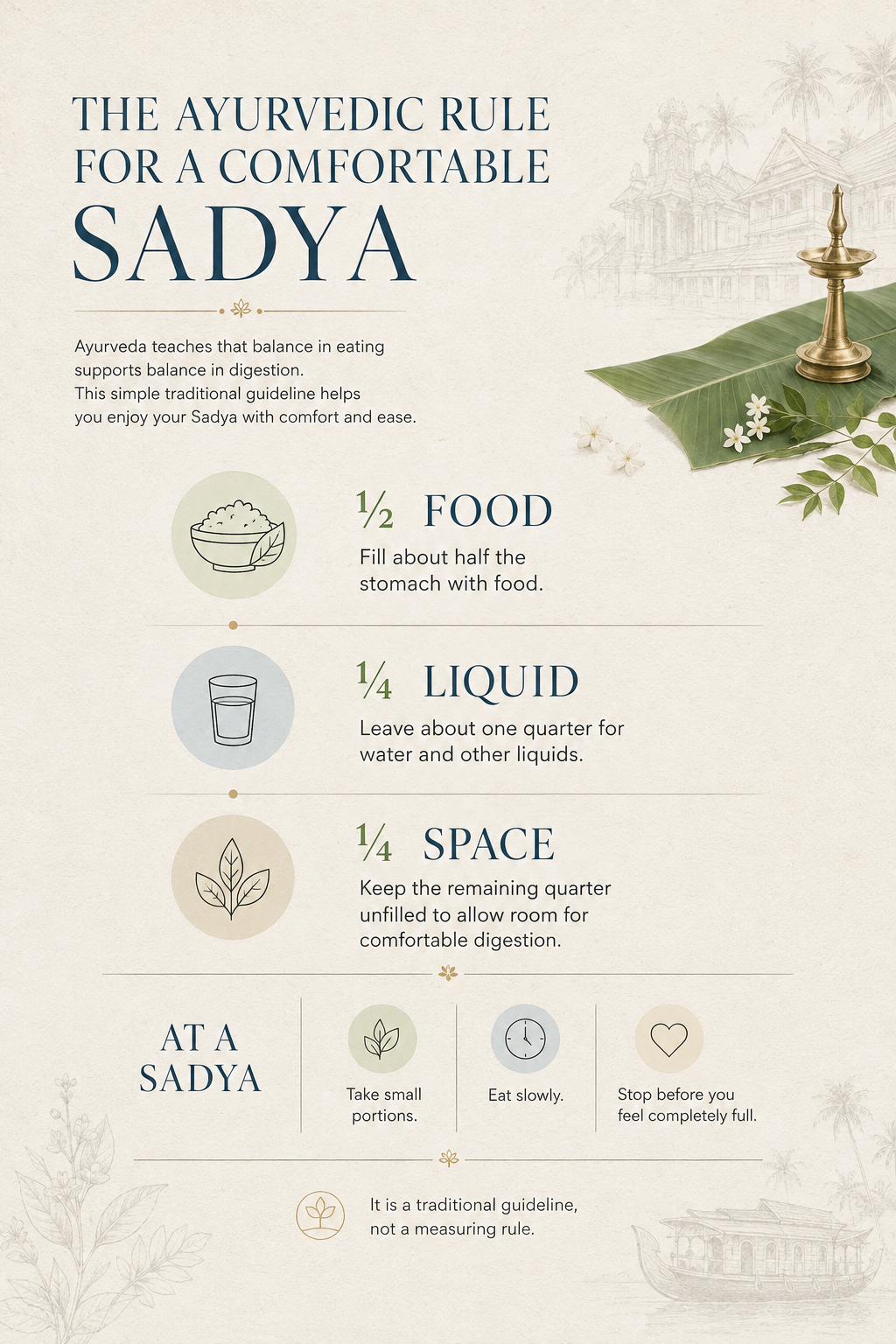
This is why the number of dishes should not determine the amount you eat. There may be fifteen or twenty preparations on the leaf, but you do not need a full serving of each. Take a little. Taste it. Go back for more if you are genuinely hungry. The leaf offers variety; your appetite decides the quantity.
How to enjoy a Sadya without overeating
Sadya makes overeating very easy. The rice is served generously. Someone offers another curry. You notice your favourite dish and take some more. Then payasam arrives when you are already comfortably full.
A few simple habits help.
- Start with a moderate portion of rice. You can always take more later.
- Take smaller portions of the accompaniments. This lets you taste more dishes without becoming full too early.
- Do not mix everything at once. Eating different curries with rice lets you notice their individual flavours and slows the meal naturally.
- Pause before accepting seconds. A polite offer does not have to become another helping. Ask yourself whether you are actually hungry.
- Go back selectively. If you want more, choose the dishes you genuinely enjoyed instead of taking another serving of everything.
- Enjoy the payasam. Ada pradhaman, parippu payasam, or pal payasam is part of the celebration. There is no need to make festive sweets forbidden, but there is also no need to eat beyond comfort.
If you are still full later, do not force yourself to eat a heavy dinner simply because it is your usual mealtime. Let appetite guide the next meal.
A Sadya feeds the mind too
The most important part of an Onasadya may not be on the leaf at all. It is the people around it. A Sadya is traditionally a community meal. Families and friends sit together. Food is served around the banana leaf. People talk and laugh while they eat. Someone insists that you take more avial. Someone else asks if you have tried the payasam. The meal becomes part of the celebration.
The social setting can change how we eat. A meal eaten alone at a desk is different from one eaten slowly with family. When distracted or stressed, we may eat quickly and barely register the food. This is one way to understand mindful eating through the Sadya. It does not require silence or a meditation app. It can simply mean seeing the food, tasting it, eating slowly enough to notice fullness and enjoying the people around you.
Food eaten during Onam also carries memories of family, hospitality and togetherness. A community meal can make eating feel less like a task and more like an experience.
Is a Sadya sattvic?
The word ‘sattvic’ is associated with clarity, balance and harmony in Ayurveda and yogic traditions. Some Sadya preparations may fit aspects of this description.
But calling the entire Sadya ‘sattvic’ would be too simplistic. This is festive food, with pickles, spicy preparations, chips and payasam. A more useful question is whether the food and quantity suit the person eating it.
The wisdom that stays after the feast
The post-Sadya feeling is familiar. A little extra rice, another spoonful of avial and a second taste of payasam can make dinner seem very far away. There is no need for guilt.
One festive meal does not undo a balanced eating pattern. If you are still full, let your appetite guide the next meal.
Notice how you felt. Were you comfortably satisfied or excessively heavy? Did you eat because you were hungry or because food kept being offered? Did slowing down help you to recognise fullness? These observations are more useful than labelling foods as good or bad.
The real Onasadya Ayurveda digestive wisdom is not hidden in one magical ingredient. It is in the way the meal comes together: Shadrasa, the progression of rice and curries, portion awareness, sensory experience and the company around the banana leaf.
A Sadya reminds us that digestion is not only about what we eat. How we eat matters too. Take a little. Taste it properly. Do not rush. Notice when you have had enough. And whenever possible, sit down and share the meal with people you love. Sometimes, the most practical digestive wisdom has been sitting on a banana leaf all along.
References