Most people don’t come looking for Ksheerabala. They come because something in the body has stopped feeling reliable. A knee that no longer bends as easily. A back that feels stiff every morning. A hand that tingles, or a leg that feels weaker than it should. In the beginning, these are small things. You adjust, ignore, and carry on. But over time, the pattern changes. The stiffness stays longer. The body takes more time to recover. Some days, there is pain and fatigue without a clear reason. When this kind of pattern sets in, the issue is usually not just local. It is not just the joint or the muscle. There is often a deeper involvement of the tissues and the nervous system. This is where Ksheerabala Thailam is used, not as a quick pain reliever but when the body needs steady support to regain strength and stability. This becomes especially relevant in chronic neurodegenerative conditions and integrative care pathways, where people explore multiple sclerosis Ayurvedic treatment, post-stroke rehabilitation, and neurological pain management Ayurveda approaches, where improvement is sustainable.
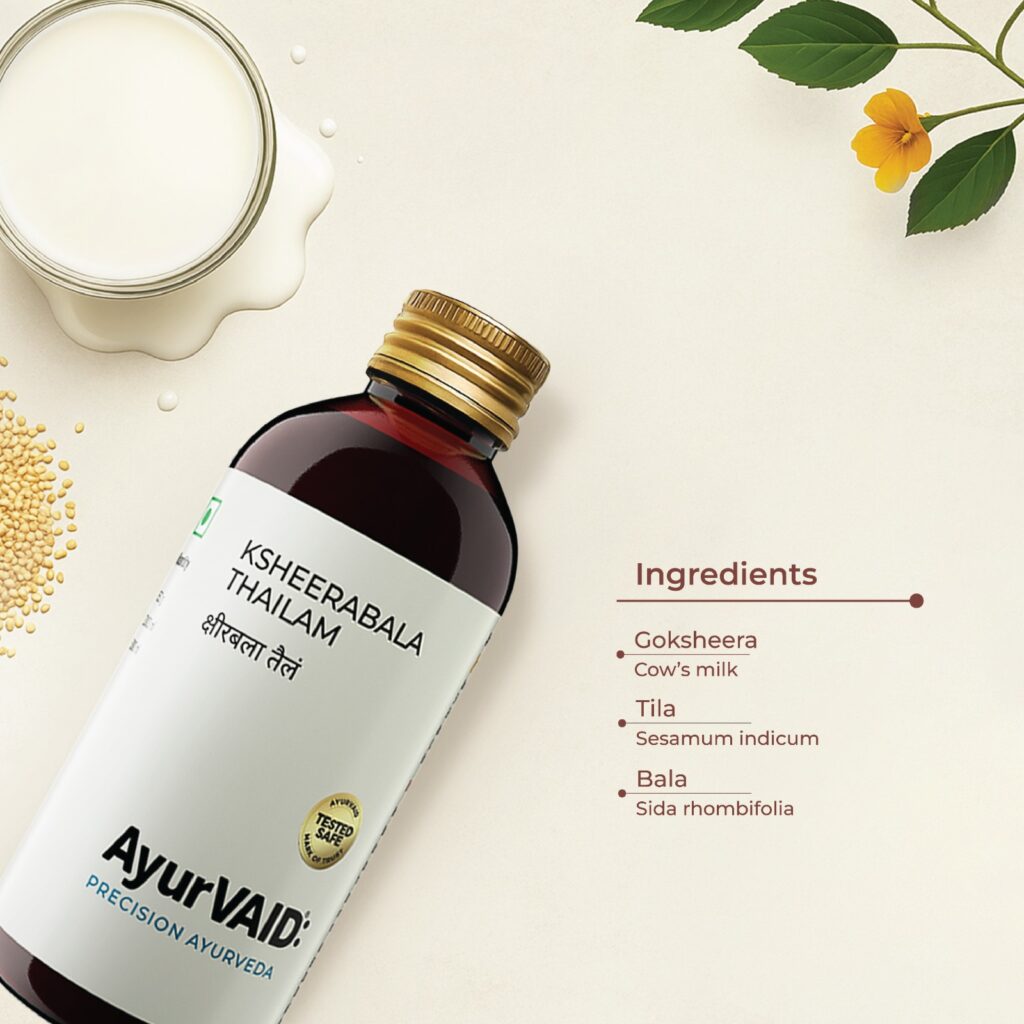
What is Ksheerabala Thailam? The Classical Formulation Explained
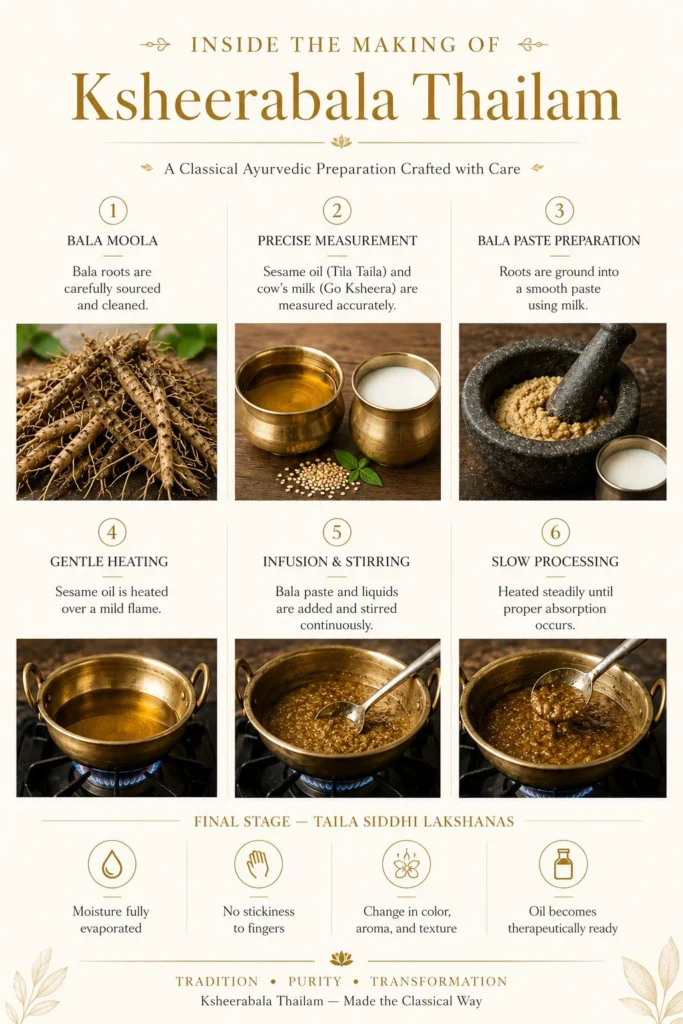
Ksheerabala Thailam is traditionally prepared using the classical Sneha Paka Vidhi. Bala moola (roots of Sida cordifolia) are first collected and carefully weighed. The required quantity of sesame oil (Tila taila) and cow’s milk (Go-ksheera) is also measured accurately. The Bala moola is then ground and made into a smooth paste by pounding it with milk. In the next step, sesame oil is taken in a vessel and heated over a mild flame. The prepared Bala paste, along with the liquid media, is then added to the oil. The mixture is continuously stirred to ensure even processing and to prevent the paste from sticking to the vessel.
The heating is continued in a controlled manner until the liquid components gradually evaporate and the preparation reaches the desired stage, identified as ‘taila siddhi lakshanas’, when the moisture has reduced, the bubbling settles, and the paste no longer sticks to the fingers. The smell, colour, and texture also change slightly. These are practical indicators used in classical preparation to ensure the formulation has reached the right stage. This step matters because, at this point, the oil is no longer just a base. It has taken in the properties of Bala and milk in a form that the body can absorb and use effectively. This is what is used as Ksheerabala Thailam in its classical form, typically for external use, such as application or massage. It is used in therapies to address stiffness, joint discomfort, and neuromuscular fatigue. It works well when the imbalance is more functional or surface-level.
Ksheerabala 101 is where the same process does not stop once. The entire cycle is repeated again and again. Each time, fresh Bala, fresh milk, and fresh decoction are added, and the oil is processed again. With every cycle, the formulation becomes denser. The concentration of active components increases. The behaviour of the oil itself begins to change. Over time, the texture becomes thicker. The colour turns lighter and more opaque. The feel shifts closer to something between oil and ghee. This happens because the milk component keeps getting integrated deeper into the base. From a clinical perspective, this repeated processing does two important things. It reduces the quantity needed for effect and improves how the body absorbs and responds to it. This is why Ksheerabala 101 is often chosen when the condition is deeper, more chronic, or involves the nervous system in more advanced conditions, including MS neuropathic pain, spasticity, and more established neuromuscular weakness. In multiple sclerosis pain management, this distinction matters. A stronger preparation is not always the right starting point. The choice depends on the stage of the condition and the person’s overall strength.
Why Ksheerabala: The Role of Milk, Bala and Sesame Oil
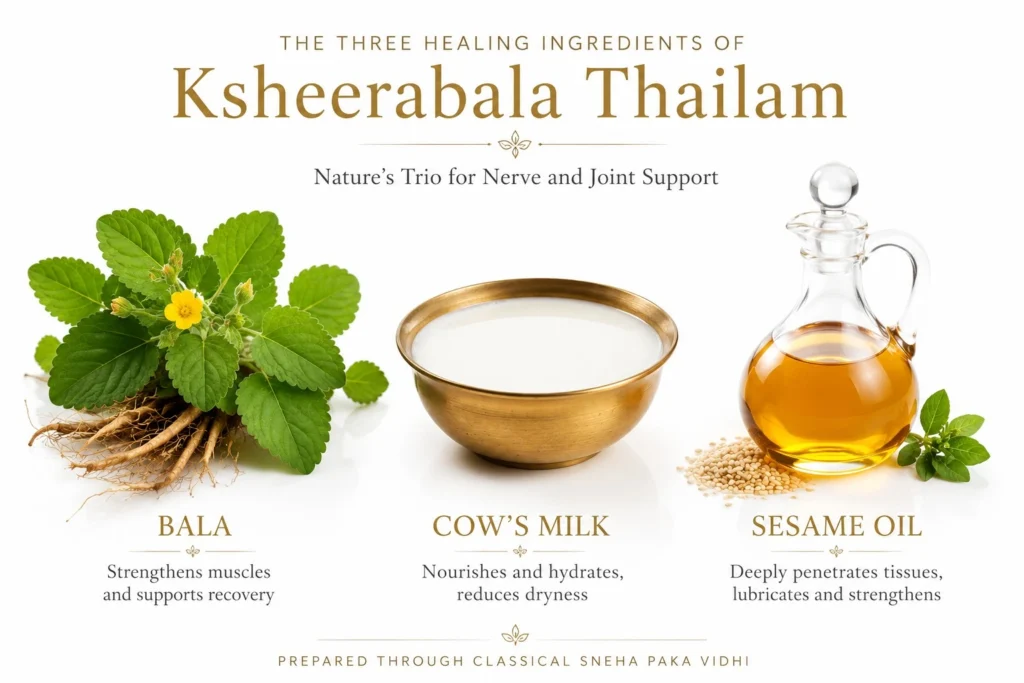
The strength of Ksheerabala lies in how simple ingredients are combined. Bala supports neuromuscular strength and helps in recovery where weakness is present. Milk nourishes and reduces internal dryness, which is often the root cause of these conditions. Sesame oil carries these effects deeper into the tissues and restores lubrication. Together, they address both dryness and depletion. This becomes particularly relevant in conditions described as MS in Ayurveda, where there is instability along with gradual ‘Dhatukshaya’, or tissue loss.

How Ksheerabala Works: A Majja Dhatu Perspective
In Ayurveda, the nervous system is understood through Majja Dhatu. When this system is affected, symptoms go beyond pain. There may be fatigue, reduced coordination, nerve sensitivity, and a gradual loss of strength. Ksheerabala works by addressing dryness and depletion at this level. It helps restore lubrication in tissues that have become dry and supports nourishment where there is a gradual loss. Over time, this helps improve stability in movement and reduces the sense of fragility in the body. This is why it is often used in structured care approaches, such as multiple sclerosis Kerala Ayurveda-based therapies, where the focus is on steady functional improvement.
Conditions Ksheerabala Treats Best
Ksheerabala is mainly used when a Vata imbalance is showing up as weakness in the tissues. In joint pain and arthritis, it is often helpful in long-standing cases where stiffness is more noticeable than swelling. In nerve-related problems like neuropathy, it can ease symptoms such as tingling, numbness, and pain that spreads along the nerves, including in some chronic conditions like MS. In paralysis and post-stroke recovery, it supports neuromuscular rehabilitation as part of a larger plan. It is used as supportive care in multiple sclerosis Ayurvedic treatment, particularly for fatigue and functional stability. It is also used in Parkinsonian stiffness. Chronic back pain can involve nerve issues, such as sciatica, and may also lead to muscle fatigue when recovery is incomplete.
How to Use Ksheerabala Thailam Externally
How to Use Ksheerabala 101 Internally
Internal use of Ksheerabala 101 is not routine and should not be self-started. It is given in small quantities, usually along with milk, and only when digestion and overall condition allow it. In certain cases, including protocols involving MS spasticity, Ayurveda treatment and Ksheerabala for MS, internal use may be part of treatment and even as Nasya. The dosage is always decided based on individual assessment. These include chronic nerve weakness, reduced function, and spasticity. Because it is more concentrated, it is used carefully and under supervision, usually as part of a broader plan rather than alone.
A Note on Product Quality and Safety
Ksheerabala Thailam is often used for long periods. Because of this, the quality of the oil matters as much as the formulation itself. When oil is applied daily or used for months, safety cannot be assumed. It has to be ensured. Preparations that are tested for safety, with heavy metals within permissible limits and aligned with API standards, offer greater confidence for long-term use. AyurVAID Ksheerabala Thailam and AyurVAID Ksheerabala 101 follow classical preparation using Bala, milk, and sesame oil and are also part of a Tested Safe range where purity and safety are verified. This becomes particularly important in chronic conditions and in those exploring Ayurvedic treatment for MS in India, where treatment is not short-term and consistency matters.
Who Should Not Use Ksheerabala Thailam
Ksheerabala Thailam is generally well tolerated, but it is not suitable in every situation. It may not be ideal in conditions where heaviness and congestion are dominant. Internal use should be avoided if digestion is weak. In chronic neurological conditions, it is important not to self-treat and to seek proper guidance.
Final Note
Ksheerabala Thailam works best in chronic imbalances, particularly in the nerves and joints, where the body benefits from gradual, steady support. When used consistently and appropriately, it helps restore a sense of stability in movement and function. In conditions such as multiple sclerosis pain management, where improvement is gradual, this kind of steady support becomes meaningful over time.
References
- Swathy SS, Indira M. The Ayurvedic drug, Ksheerabala, ameliorates quinolinic acid-induced oxidative stress in rat brain. Int J Ayurveda Res. 2010 Jan;1(1):4-9. doi: 10.4103/0974-7788.59936. PMID: 20532090; PMCID: PMC2876928.
- Cheriyan, B. V., Ranganathan, P., S, S., KK, K., P, K., Prassana Bharathi, S., … V, J. (2025). Deciphering the Neuroprotective Role of Ksheerabala: Bridging Modern Medicine and Ayurveda Through Reverse Pharmacology. International Journal of Ayurvedic Medicine, 16(3), 625–632. https://doi.org/10.47552/ijam.v16i3.5970
- S, Huded & D., Rakshitha & Jg, Mitti. (2024). PHARMACEUTICO-ANALYTICAL STUDY OF KSHEERABALA TAILA AVARTANA 101. International Journal of Biology, Pharmacy and Allied Sciences. 13. 13. 10.31032/IJBPAS/2024/13.10.8384.
- Kumari, T.J., Pratap, G.P., Prasad, S.B. and Prasad, G.P. (2019). Development of quality standard of Ksheerabala oil: An Ayurvedic Formulation. International Journal of Pharmaceutical Quality Assurance 10(4): 567-570.
- Dr. Anupama Bhardwaj, “Therapeutic Use of Ksheerbala Tail in Manoavsad (Depression) – A Conceptual Study’’ IJMSAR – November – 2023, Vol. – 6, Issue – 6, Page No. 35-41.