Most injuries don’t arrive with drama. They slip in quietly. A small cut while cooking. A twist you barely noticed in the moment. Sometimes it’s just swelling that shows up later in the day. At first, it feels manageable. Then it lingers a little longer than expected. That’s usually when we start paying attention.
In Ayurveda, this stage matters. These are early signs of abhighata janya vikara (conditions that arise from injury or external impact), often linked to vata dosha. That is where formulations like Murivenna come in. Quietly, without fuss.
Most people know Murivenna as an oil. That’s how it has been used traditionally. Creams exist, but they are relatively recent and not as widely available. They simply make the application easier for those who prefer a lighter, less oily format. If you are exploring Murivenna cream uses, it helps first to understand its original formulation.
What is Murivenna? Origins and Traditional Use
Murivenna is a classical taila kalpana (medicated oil preparation). It is made using taila paka vidhi (a method where herbal paste and liquid extracts are slowly processed with oil to extract their active properties).
The name is simple. ‘Muriv’ means ‘wound’. ‘Enna’ means ‘oil’. Murivenna is not described in the main Ayurveda samhitas (foundational classical texts). It is understood to originate from Agastyamarma Shastra (a Siddha text on vital points and injury care) and later became widely used in Kerala practices. Traditionally, it has been used in Shalya Tantra (the branch dealing with injury care), especially in conditions like:
- Vrana (wounds)
- Shopha (swelling)
- Asthi bhagna (fractures)
- Sandhi chyuti (joint dislocation)
It is applied through methods like Abhyanga (application of oil), Pichu (keeping soaked material over the area), and Bandhana (medicated dressing). In the end, Murivenna cream uses come down to something simple. Early care. The kind you don’t overthink, but don’t ignore either.
Murivenna Oil vs Ointment vs Cream - Which Format Should You Use
The original form of Murivenna is an oil. It works well, especially when you want deeper snehana (oleation). But oils are not always practical. Murivenna cream came in as a simpler option. The oil spreads easily. It works well for larger areas but can feel heavy. The cream is lighter. You apply it and forget about it. No stickiness. The ointment stays longer on the skin. Slightly thicker, more focused and easy to carry around.
So when comparing Murivenna ointment uses, the difference is mostly in how you prefer to use it. That said, the experience can vary slightly depending on how much of the classical formulation is retained in the base. Some creams today are made with a higher proportion of Murivenna taila, which can influence how effectively they absorb and act.

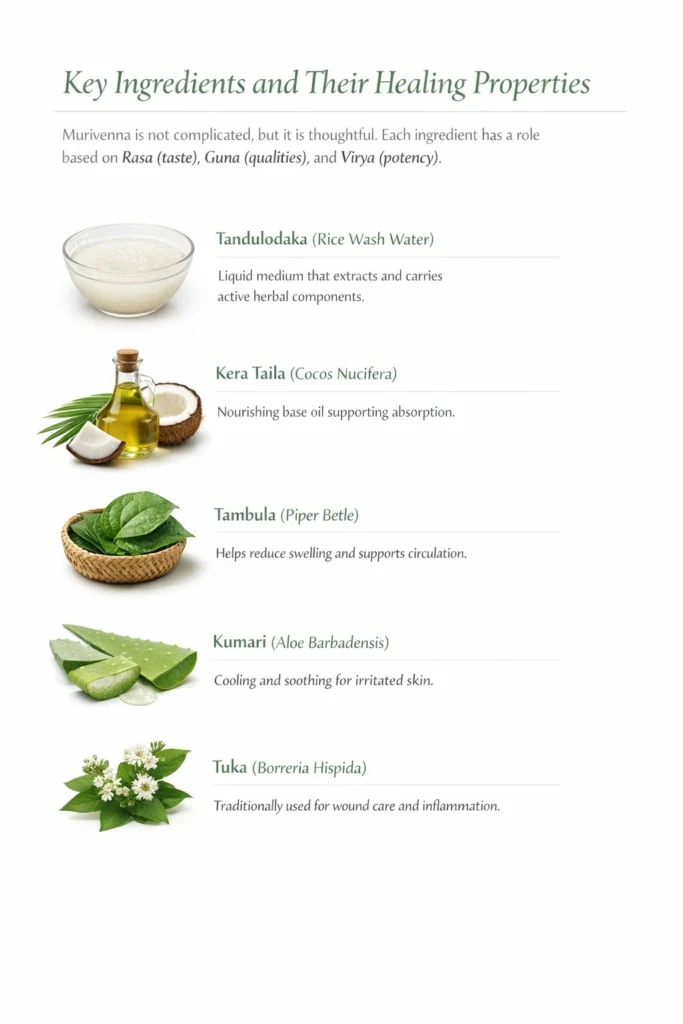
Key Ingredients and Their Healing Properties
Murivenna is not complicated, but it is thoughtful. Each ingredient has a role based on Rasa (taste), Guna (qualities), and Virya (potency).
- Tandulodaka (rice wash water)
Acts as a dravya (liquid medium), helping extract and carry the active components of the herbs.
- Kera taila (Cocos nucifera)
Serves as the sneha dravya (base oil), supporting absorption and nourishing the affected area.
- Tambula (Piper betle)
Known for helping reduce shopha (swelling) and supporting local circulation.
- Kumari (Aloe barbadensis)
Cooling due to sheeta virya (cold potency). Helps soothe irritated or damaged skin.
- Tuka (Borreria hispida)
Traditionally used in external applications for wound care and inflammatory conditions.
Together, they work on tridosha, with more focus on calming vata, which is often the reason behind pain. That’s where most murivenna benefits come from.
Benefits of Murivenna Cream
Murivenna cream is usually used early. Before things settle in.
Murivenna cream for wounds
One of the most common murivenna benefits is vrana ropana (supporting wound healing).
Fractures and sprains
Used as an Ayurvedic cream for fractures, it supports asthi dhatu poshana (nourishment of bone tissue).
Murivenna for joint pain and Stiffness
Murivenna helps manage aggravated vata, thus reducing the daily aches
First-degree burns and minor injuries
Its cooling nature helps calm the skin. Under a doctor’s guidance, it can even be used to aid in the quick healing of anal fissures.
Murivenna Taila: Traditional Uses of the Original Oil
Before creams and ointments became common, Murivenna was used in its original oil form. The focus was simple. Apply it early, support the body, and let healing take its course without overdoing it.
In traditional practice, Murivenna Taila was used across different types of injuries and external conditions:
• Cuts and wounds (vrana)
It was used to support natural healing and keep the area calm without excessive dryness.
• Swelling (shopha)
Applied to help reduce visible swelling and ease local discomfort.
• Sprains and minor trauma
It is used in early stages to manage pain and support movement.
• Fractures and joint injuries
It is often applied as part of external care to support tissue recovery alongside other treatments.
The method of application was just as important as the oil itself:
• Abhyanga (gentle application)
Lightly applied without pressure, especially in sensitive areas.
• Pichu (soaked dressing)
Cotton soaked in oil placed over the affected area for steady contact.
• Bandhana (medicated dressing)
It is used when the area needs to be covered and protected.
What stands out is how quietly it was used. No rush, no complexity. Most of what we now call Murivenna cream uses come from these same traditional practices. The format may feel modern, but the approach has always been simple. Early care that supports healing without getting in the way.
Murivenna for Skin Conditions
Murivenna is not only used for injuries. In many cases, it is also applied when the skin feels irritated, sensitive, or slightly damaged. The approach stays the same. Keep it simple, support the skin, and avoid anything too harsh.
In traditional use, it is applied in a few common skin-related situations:
• Minor burns and heat-related irritation
Its cooling nature helps calm the skin and reduce the feeling of heat.
• Rashes and redness
Used to soothe irritated areas and bring down visible inflammation.
• Dry or cracked skin
It helps reduce roughness by providing gentle nourishment without clogging.
• Small cuts, abrasions, and insect bites
Supports early healing and keeps the area comfortable.
The way it is applied depends on how sensitive the skin feels:
• Direct application
A small amount applied gently over the affected area.
• Light layering
It is used without rubbing when the skin is already irritated or tender.
• Repeated use
Applied two to three times a day for consistent support.
What makes it useful here is its mildness. It doesn’t try to act fast or aggressively. Most Murivenna cream uses for skin conditions come down to this kind of steady, low-interference care that allows the skin to recover on its own terms.
How to Apply Murivenna Cream
If you’re wondering how to use murivenna, don’t overthink it. Clean the area first. Then apply a small amount.
- For muscle or joint discomfort
Apply and gently massage. A light rubbing helps - For wounds
Apply softly. Let it sit. No rubbing needed - Repeat
Two to three times a day works for most cases
A product like AyurVAID Murivenna Cream fits easily here. It absorbs quickly and doesn’t interrupt your day.
Apollo AyurVAID Murivenna Cream
For those who prefer a ready-to-use format, Apollo AyurVAID Murivenna Cream offers a more convenient way to use this formulation without moving too far from its original base.
It is developed using Murivenna, with about 30% medicinal content, which helps retain the character of the classical preparation while still being easy to apply as a cream.
- Supports care for cuts, wounds, and minor burns
- Helps manage swelling and discomfort in sprains
- Useful in day-to-day joint and muscle pain
- Absorbs quickly without leaving a heavy or greasy layer
The formulation is also part of India’s First & Only TESTED SAFE Ayurveda range (within limits for heavy metals and microbial loads) and does not contain added artificial colours, which makes it suitable for regular external use. For many, it becomes less about choosing between oil and cream and more about finding something they will actually use consistently.
Murivenna Cream for Sports Injuries – Athlete's Guide
- Helps bring down visible swelling, especially in the first few hours
- Helps reduce movement-related discomfort
- Supports the body’s natural recovery without creating heaviness on the skin
Murivenna Cream for Arthritis and Joint Pain
Long-term joint discomfort is often associated with vata vyadhi (conditions arising from vata imbalance), where dryness, stiffness, and restricted movement are commonly seen. Murivenna Cream is used here as a supportive external application.
- Helps reduce joint stiffness over time
- Supports improved mobility with regular use
- Helps ease movement-related discomfort
It is typically used as part of a consistent routine rather than for immediate relief. With regular application, the overall murivenna benefits become more noticeable in day-to-day movement.
Side Effects and Precautions
Murivenna is generally safe for external use.
- Murivenna side effects are uncommon
- Mild irritation can happen in sensitive skin
- A patch test is always a good idea
Avoid using it on deep or infected wounds without proper advice. And yes, prakriti (individual body type) can influence how your skin responds.
Murivenna vs Other Ayurveda Pain Creams
Murivenna-based formulations are often used a little differently from most commercially available pain relief creams. While many creams focus on quick, surface-level relief, Murivenna has traditionally been used in injury care, especially where there is shopha (swelling) and vrana (wounds). The approach is less about instant masking and more about supporting recovery over time.
The difference within Murivenna creams usually lies in their formulation. Some are lighter, with smaller amounts of the original taila (medicated oil), while a few retain a higher proportion. For instance, formulations like Apollo AyurVAID Murivenna Cream are made with a higher percentage of medicinal content, staying closer to the classical base. It’s a small detail on paper, but it can influence how the product feels and performs with regular use.
Final Thoughts
References