Not all abdominal pain is the same. Some people describe it as bloating, twisting, pressure, or a vague discomfort that comes and goes. But for others, it is far more serious — pain that wakes them at night, drives them to the bathroom repeatedly, and causes bleeding, weakness, and fear of eating. That is the reality of inflammatory bowel disease, or IBD.
On World IBD Day (19 May), it is important to remember that IBD is not “just abdominal pain” or something that can be ignored. It is a chronic inflammatory condition that can deeply affect the gut, the body, and a person’s quality of life. Understanding the IBD vs IBS pain difference is the first step toward getting the right help.
Why IBD pain feels so different
People often confuse IBD with IBS because both can cause abdominal discomfort and altered bowel habits. But the two conditions are very different.
IBS is a functional disorder. Although there are no apparent problems with the functioning of the digestive system as seen in the examination results, it cannot perform well due to changes in the level of gut sensitivity, gut motility problems, and an imbalanced communication between the gut and brain caused by stress.
Abdominal pain IBD is severe, deep, and tiring. It is not simply a reaction to food or stress. It often reflects actual injury (structural) in the intestinal lining. The pain may be accompanied by urgency, loose stools, blood in the stool, weight loss, fatigue, and a reduced appetite. For many patients, it affects sleep, work, travel, and emotional wellbeing.

Crohn’s disease vs ulcerative colitis
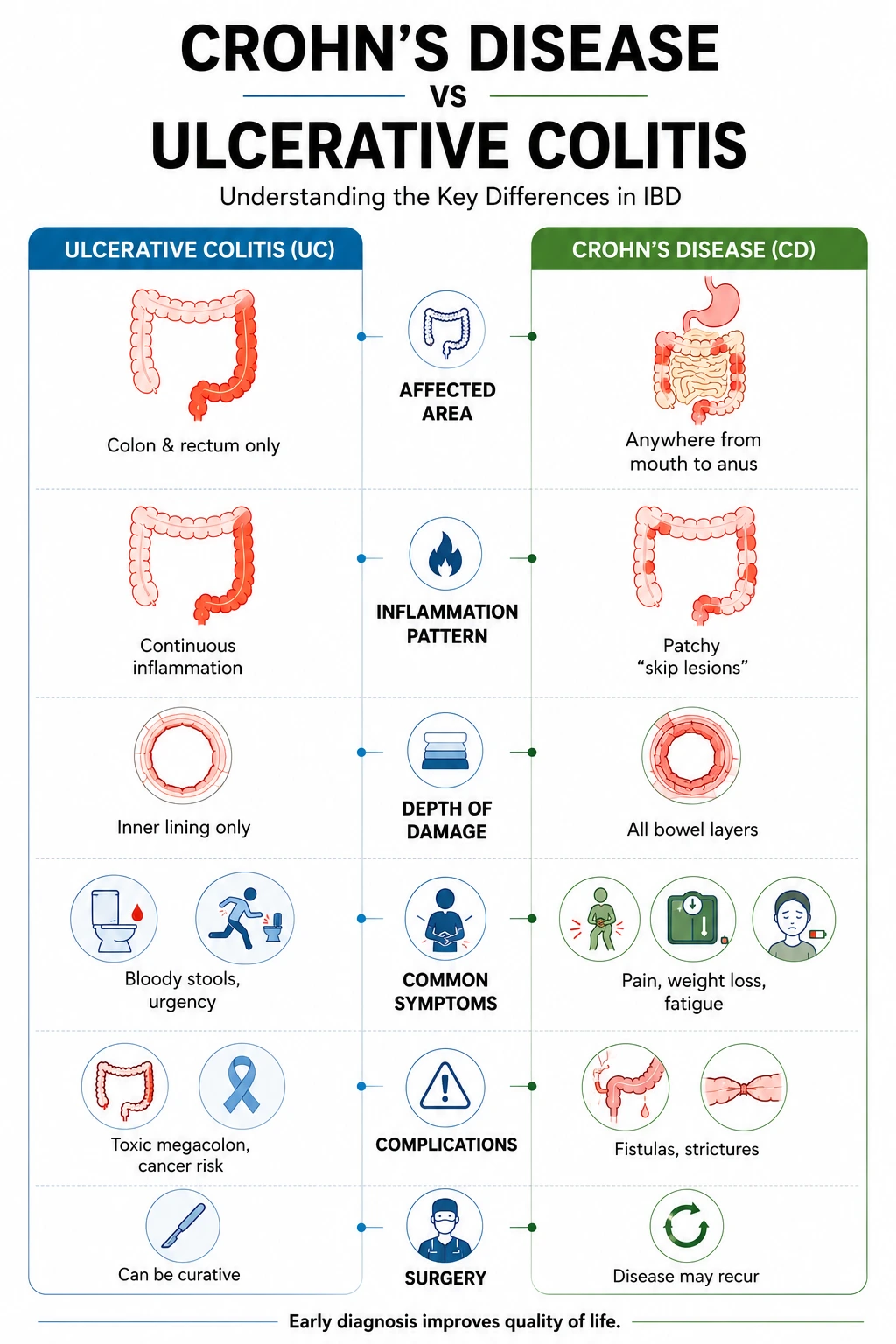
When we speak about Crohn’s vs Ulcerative Colitis, we are speaking about two different patterns of inflammation within IBD.
Crohn’s disease can affect any part of the digestive tract, from the mouth to the anus. The inflammation may appear in patches, leaving healthy tissue in between. It can penetrate deep into the mucosa of the intestine, hence the possibility for problems like strictures, abscesses, and fistulas to arise. It can cause acute pain that is crampy and located anywhere within the abdominal cavity.
However, Ulcerative colitis is limited to the large bowel. Inflammation occurs continuously starting from the rectum. The inflammation is continuous and usually starts from the rectum. This often leads to cramping, urgency, rectal bleeding, and tenesmus — that painful feeling that the bowel has not fully emptied.
For patients and families, this distinction matters because the treatment approach, symptom pattern, and long-term monitoring can differ significantly.
The stages of ulcerative colitis
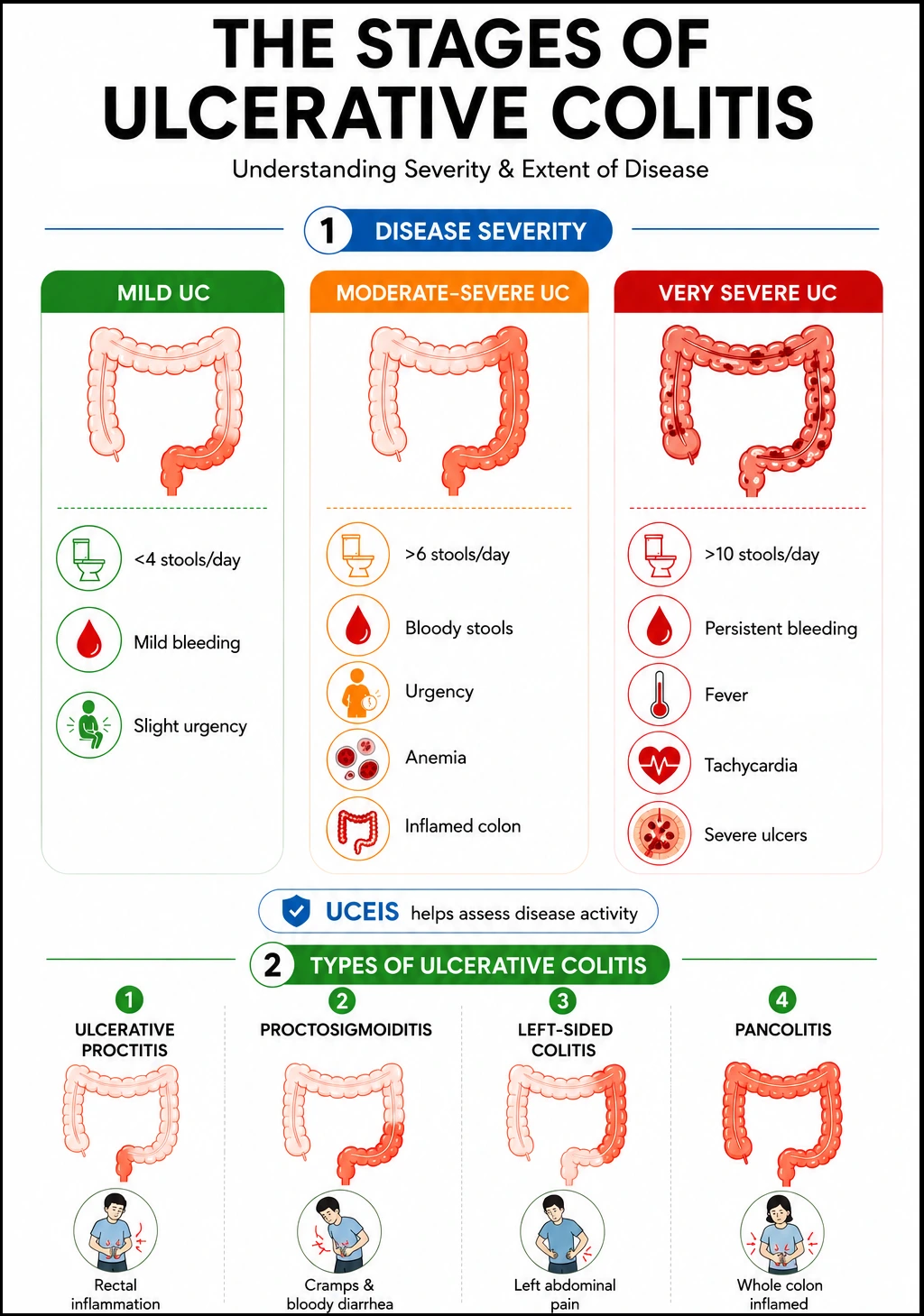
Many people ask about the stages of ulcerative colitis, and it helps to think of them in terms of how much of the colon is involved.
In the management of ulcerative colitis, doctors commonly use the Ulcerative Colitis Endoscopic Index of Severity (UCEIS) to assess disease activity.
Mild UC
- Less than four stools per day
- Stools with traces of blood
- Slight urgency
Moderate to Severe UC
- More than six stools per day
- Blood in most stools
- Urgency
- Anaemia and an inflamed colon
Very Severe UC
- More than ten stools per day
- Persistent bleeding and urgency
- Fever, anaemia, tachycardia
- Severe ulcers in the colon
It can also be classified into 4 types as follows:
- Ulcerative Proctitis: Inflammation is confined to the rectum; pain is often localised with rectal urgency.
- Proctosigmoiditis: The rectum and sigmoid colon are affected causing more cramping and bloody diarrhoea.
- Left-sided Colitis: The inflammation involves the splenic flexure; the pain is more generalised on the left side of the abdomen.
- Pancolitis: The whole colon is inflamed causing severe abdominal pain, which IBD patients find debilitating and often need intensive care.
These levels are more than mere classifications. They indicate the level of inflammation involved, helping with patient care and recovery.
IBD is not just a Gut Disease
Many patients are not refusing surgery out of fear alone. They are looking for a more conservative path that gives their body a chance to respond before a major intervention. That is where pain management without surgery becomes especially valuable.
Ayurveda is selected by patients who seek treatment that is root cause oriented. These patients might have been taking medication, getting rest, or having physiotherapy treatments, yet they are restricted because of pain. For such individuals, non surgical pain treatment can offer a structured next step rather than a desperate last resort.
This is also why people increasingly seek an Ayurveda alternative to surgery for chronic musculoskeletal issues. The aim is not to promise miracles. The aim is to preserve function, reduce pain, support tissue health, and help the patient make a better-informed decision. In some cases, patients gain enough improvement toavoid surgery with Ayurveda entirely. In others, they become stronger, more mobile, and better prepared should surgery ever become necessary later.
Understanding of IBD in Ayurveda
In order to get a deeper understanding of how Ayurveda approaches inflammatory diseases of the colon and small intestine, one can consider some conditions such as Raktatisara, Pakvashayagata Vata, and Pittaja Grahani.
In Raktatisara, there is an indication of bleeding and ulcerative damage.
Pakvashayagata Vata shows signs of dryness, abdominal pains, cramps, and impaired motility of the intestine.
Inflammation, diarrhoea, burning sensation, and disturbed digestion are the characteristics of Pittaja Grahani.
This condition is where Ayurvedic treatment for inflammatory bowel disease becomes highly individualised. The aim is not only to control symptoms but also to support intestinal healing, reduce inflammation, and restore digestive strength.
A gentle approach to healing
In Crohn’s disease, the focus is often on soothing irritation, supporting the gut lining, and rebuilding strength without aggravating the system further. Treatment may include anti-inflammatory herbs, digestion-supporting formulations, and therapies chosen according to the patient’s condition, strength, and stage of disease.
For ulcerative colitis pain management, the goals are similar, but the strategy may differ depending on the extent of colonic involvement, bleeding, urgency, and tissue sensitivity. The intention is to calm Pitta, support healing, and protect the bowel from repeated injury.
In many cases, Basti is an important therapy in classical Ayurveda, especially when the colon is involved. Some patients may also benefit from mucosal-supportive and restorative approaches such as Picha Basti under careful medical supervision.
IBD diet
While diet does not cause IBD, it can play a key role in how IBD affects someone’s life. Diet is critical for people with IBD. An Indian diet for Crohn’s Disease or Ulcerative colitisneeds to be mild, warm, and easily digested.
During flares, simple foods work best. Thin rice gruel, soft khichdi made with mung dal, warm water, and lightly spiced buttermilk may be better tolerated in some patients. Pomegranate, when suitable, is traditionally valued for its soothing properties.
Between flares, one can gradually reintroduce soft-cooked vegetables such as bottle gourd, pumpkin, and other easy-to-digest foods. Small amounts of ghee may be helpful for some patients, depending on digestion and tolerance.
At the same time, it is important to avoid foods that may worsen irritation — raw salads during active flares, deep-fried foods, excessive chilli, processed snacks, and anything that repeatedly triggers symptoms. The best diet is not rigid. It is responsive.
Stress and the gut
The connection between stress and IBD is very real. The gut and brain are constantly speaking to each other. It is known that the emotional state may complicate the condition, affect digestion and cause pain.
That is why treatment cannot be confined solely to medications. Yoga, breathing exercises, relaxation, and other supportive measures are likely to have an effect. In Ayurveda, pacifying Vata is a key aspect of treating this disease. Practices such as Takradhara, gentle pranayama, and stress regulation can complement medical care and help patients feel more stable.
A calm mind does not cure IBD by itself, but it creates a better environment for healing.
The way forward
Living with IBD is not easy. It is physically and emotionally exhausting. However, with proper diagnosis and treatment, along with the proper supportive measures, a number of patients have found substantial relief from their conditions. Learn about the IBD vs IBS pain difference and get treated promptly, regardless of whether it is colitis or Crohn’s disease you are dealing with.
With an integrated approach incorporating the knowledge of modern diagnosis and ancient Ayurveda, the road to recovery will be smooth. It becomes a path toward strength, stability, and confidence again.
References
- Dwivedi S, Kumar A, Prasad JS, Mishra S. An etiopathological study of Grahani Roga in relation to Manasik Bhavas: a literary review. World J Pharm Med Res. 2025 May 8;11(6):48-50.
- Jat R, Gavali P, Sharma R, Gavali K, Ahlawat M, Mansukhbhai SA, et al. Ayurvedic intervention in IBS: a clinical trial on a herbal formulation’s effectiveness. Int J Drug Deliv Technol. 2026;16(25s):328-35.
- Maurya AK, Singh AP, Goel N. Conceptual study of Grahani Roga w.s.r. to Irritable Bowel Syndrome: an Ayurvedic perspective. Int J AYUSH. 2026 May;15(5):33-44.
- Subraya MT. Management of inflammatory bowel disease with Ayurveda: a case report. J Indian Sys Medicine. 2023 Jul 11;11:131-9.
- Verma S, Sawarkar P, Sawarkar G, Parwe S. Effective management of irritable bowel disease (Grahani) through Ayurveda: a case report. J Clin Diagn Res. 2024 Sep 1;19(3):JD08–JD10.