Many men have a habit of brushing off pain. Ask how they feel when their back hurts, their knee acts up, or their shoulder has bothered them for weeks, and the answer is often the same: “It’s nothing.” In many cases, they aren’t trying to hide their discomfort. They genuinely believe it isn’t important enough to talk about. Work has to be done.
Responsibilities don’t stop. Life keeps moving. So the pain gets pushed aside. Over time, however, that approach can come at a cost.
A minor ache becomes a daily irritation. An old sports injury never quite settles down. A recurring joint problem starts affecting sleep. What began as an occasional inconvenience gradually becomes part of everyday life. That is one reason conversations about Men’s health week and pain awareness are important.Pain isn’t always loud. Sometimes, it changes how a person lives long before it sends them to a clinic. Across professions, age groups, and lifestyles, the most common male pain conditions India sees today often begin with symptoms that are dismissed or ignored.
Looking Beyond the Symptom
One of the reasons people explore pain in men Ayurveda approaches is that it asks questions that go beyond the painful area itself. A practitioner may want to know: How well are you sleeping? How physically active are you? Has your routine changed recently? What does a typical day look like? How are stress levels?
At first, these questions may seem unrelated. After all, what does sleep have to do with back pain, or stress with an old sports injury? In reality, pain is often shaped by a combination of factors that extend beyond the painful area itself. Anyone who has noticed an old injury acting up during a stressful week or felt more aches and stiffness after a few nights of poor sleep has probably seen this connection for themselves. This is also why the same advice does not always work for everyone. Two people may have similar symptoms but arrive there through very different circumstances.
At Apollo AyurVAID, this understanding shapes how we approach pain management. Rather than assuming every patient with the same diagnosis needs the same solution, Precision Ayurveda focuses on understanding the individual first. Clinical assessment, evidence based Ayurveda care, and an integrative view of health help build a clearer picture of what may be contributing to the problem.

A Quick but Important Disclaimer
Before discussing specific conditions, it is worth clarifying something. Ayurveda does not offer universal solutions. The herbs, therapies, and concepts mentioned in this blog are discussed for educational purposes. They are not blanket recommendations and should not replace professional medical advice. Decisions about treatment should always be made with qualified healthcare professionals. With that in mind, let’s look at five pain conditions that commonly affect men.
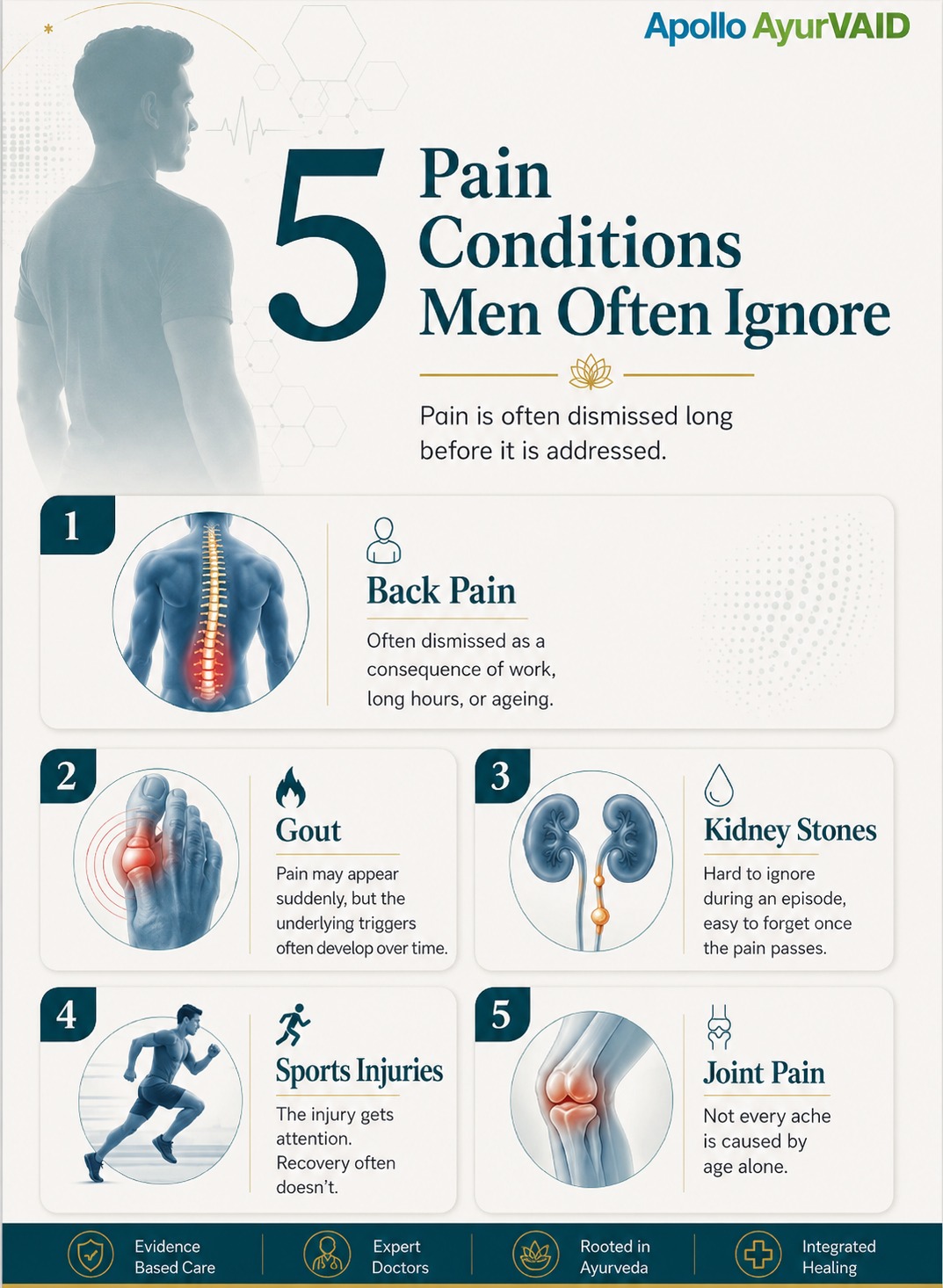
Back Pain: The Problem Many Men Learn to Live With
Talk to enough men over the age of thirty and back pain almost always enters the conversation. Not because everyone has a serious spinal condition. More often, it is because modern life places unusual demands on the body. Some people sit for ten hours a day. Others spend years lifting, carrying, bending, and working in physically demanding jobs. Many fall somewhere in between. This explains why interest in back pain men Ayurvedic treatment continues to grow.For men in physically demanding occupations, conversations about physical labour and back pain have become increasingly common. What is interesting is how often men adjust their lives around back pain without noticing. They stop lifting certain things. They avoid particular movements. They become careful in ways they never used to be.
From an Ayurveda perspective, understanding chronic discomfort may involve looking at movement patterns, recovery, sleep quality, work demands, and overall health rather than focusing exclusively on the painful area. What happens next often depends on the individual. For one person, the conversation may revolve around reducing physical strain. For another, it may focus on recovery, posture, daily habits, dosha imbalance or factors that are preventing the body from healing effectively.
Gout: When Pain Shows Up Unannounced
Some health conditions arrive gradually. Gout often does not. Many people describe a sudden episode of severe joint pain that seems to appear out of nowhere. Yet the underlying changes may have been developing quietly for years.
For many people, the immediate concern is getting through a painful flare-up. Once that settles, attention often shifts to a different question: why did it happen in the first place? That is where a broader assessment can become valuable. Understanding recurring triggers, lifestyle patterns, and long-term health factors may provide important clues that help guide future decisions.
This broader perspective is one reason many people explore gout pain men Ayurveda management when looking beyond short-term symptom relief.
Kidney Stones: Pain That Is Hard to Ignore
Unlike some conditions that quietly become part of daily life, kidney stones tend to demand attention. People who have experienced them rarely forget the moment symptoms began. The pain can be intense and disruptive.
Once the immediate episode has passed, many people are left with practical questions. Could it happen again? Are there dietary factors involved? Is there anything that can be done to reduce the risk of recurrence? For many individuals, the painful episode is only part of the story. Long-term prevention, hydration habits, and factors that may contribute to recurrence often become equally important parts of the conversation.
Sports Injuries: The Recovery Nobody Likes
Joint Pain and Ageing: Not Always the Same Thing
One of the most common assumptions in men’s health is that joint pain automatically comes with age. Reality is usually more complicated. Previous injuries matter. Activity levels matter. Body weight matters. Lifestyle habits matter.
Many men do not seek help because they assume discomfort is simply something they must accept. Yet maintaining mobility has a huge impact on independence, confidence, and quality of life. For many men, the real goal is not simply reducing discomfort. It is being able to move with confidence, stay active, continue working, travel comfortably, and participate in the activities that matter to them.
Testosterone and Pain: An Emerging Area of Interest
Researchers continue to explore the relationship between testosterone and pain. Pain is rarely explained by a single factor, and hormones are only one part of a much larger picture. However, hormonal health may influence muscle strength, recovery, energy levels, and overall wellbeing. The relationship is complex, and ongoing research continues to improve our understanding of how hormones may affect the way pain is experienced.
The Conversation Men Need to Have
Pain does not always need an emergency to be taken seriously. Sometimes it deserves attention simply because it has become part of everyday life. A back that hurts every morning. A knee that no longer feels reliable. A shoulder that has not moved comfortably in months. These things matter.
The message behind Men’s Health Week pain awareness is not that every ache is dangerous. It is that persistent discomfort should not automatically be accepted as normal. Whether someone explores conventional care, integrative medicine, Ayurveda, or a combination of approaches, the most important step is often the first one: paying attention. Because living with pain may be common. That does not mean it has to be ignored.
References