Janu Basti — Complete Guide to Ayurveda’s Most Effective Knee Pain Treatment

Table of Contents
Knee pain doesn’t usually announce itself loudly. It slips in quietly. One day, it’s a slight tightness when you stand up; another day, it’s that familiar discomfort on the stairs. Soon, you’re taking painkillers, changing how you sit, walk, and move. That’s when many people start looking for something more lasting. Not just something to dull the pain, but something that actually helps the joint feel better. If you’ve been hearing about Janu basti treatment or wondering whether Janu Basti for knee pain is worth trying, this is where Ayurveda offers a different way of looking at things.

What is Janu Basti? The Ayurveda Knee Therapy Explained
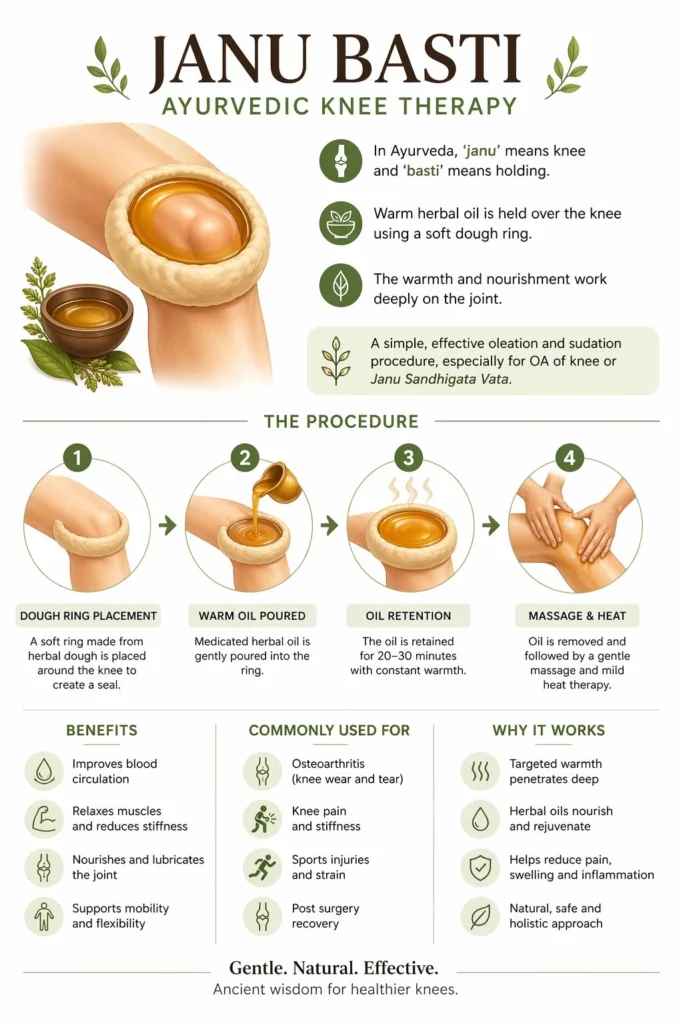
At first glance, Janu Basti treatment looks almost too simple to be effective. In Ayurveda, ‘janu’ means ‘knee’, and ‘basti’ means ‘holding’. So the therapy is really about holding warmth and nourishing herbal oil over the knee joint long enough for the body to respond. A soft ring made from black gram dough is placed around the knee. Warm herbal oil is poured into it and allowed to stay there for a while. That’s the entire setup.
But when you actually go through it, it doesn’t feel basic. It feels intentional. The warmth stays exactly where it’s needed, slowly working into the joint. People often call it ‘Ayurvedic oil pool knee therapy’. It’s a pretty accurate way to describe the experience. This approach is a simple, effective, and commonly used oleation and sudation procedure, especially for OA of knee or Janu Sandhigata Vata.

How Janu Basti Works — Mechanism and Science

The reason the Janu Basti benefits feel noticeable isn’t because of one single effect. It’s because a few things start happening together. From an Ayurveda point of view, knee joint problems are often linked to Vata dosha. When Vata goes out of balance, the joint tends to feel dry, rough, and less stable. Warm oil does the opposite. It adds softness and lubrication. This method is called snehana, and it’s one of the simplest ways Ayurveda manages joint discomfort. If you look at it more practically, the warmth itself makes a difference.

  • Circulation improves in the area
  • Tight muscles begin to relax without effort
  • The joint feels less stiff and more supported
  • Movement becomes easier over time

Another thing that stands out from clinical observations is how this therapy gradually reduces swelling, tenderness, and that heavy feeling in the knee. People also tend to notice better flexibility after a few sessions. That’s why knee basti, Ayurveda, is often suggested when the goal is not just relief but gradual improvement.

Insurance Backed

Precision Ayurveda
Medical Care

Rheumatoid Arthritis Foods to Avoid (Inflammatory Triggers)

To stop the cycle of inflammation, certain “trigger” foods must be strictly removed from your daily life. These rheumatoid arthritis foods to avoid are known as ‘Apathya’ because they are heavy, cold, and promote the formation of Ama.

  • Black Gram (Urad Dal): Extremely heavy to digest and can increase uric acid levels.
  • Dairy Products: Milk, cheese, and paneer are heavy and often provoke gut inflammation.
  • Sweets and Jaggery: High-glycemic foods increase inflammatory cytokines. (Note: While jaggery is sometimes used in specific medicinal preparations, refined sugar and excessive jaggery in the general diet are discouraged).
  • Newly Harvested Rice: Is considered heavy and Kapha-aggravating compared to old, stored rice.
  • Nightshades: Tomatoes, potatoes, eggplants, and bell peppers contain solanine, which can exacerbate pain in sensitive individuals.
  • Contaminated or Cold Water: These dampen the digestive fire and increase stiffness.

What Conditions Janu Basti Treats

One of the reasons janu basti for knee pain is so widely used is because it adapts to different kinds of knee issues.

It’s not just for one diagnosis. It’s more about how the knee feels.

  • In osteoarthritis, where the joint feels worn out and stiff, it helps bring back some ease in movement
  • In rheumatoid arthritis, it provides comfort when used along with internal treatment
  • After sports strain or overuse, it helps calm the area and reduce that lingering soreness
  • Post-surgery, it can make the joint feel less tight and more mobile
  • Even in cases where pain is present without a clear reason, people often find relief

Most people who look into knee panchakarma treatment or search for janu basti near me are usually dealing with one of these situations.

The Janu Basti Procedure — Step by Step

The janu basti procedure is one of those treatments where nothing feels rushed. You lie down comfortably. The therapist places a black gram-dough ring around your knee, shaping it carefully so it holds everything in place. Then warm oil is poured in. At first, it’s just warmth. Then slowly, the knee begins to relax.

  • The heat spreads gently across the joint
  • Stiffness starts easing on its own
  • The area feels lighter, almost as if pressure is lifting

The oil is kept warm and stays there for about 30 minutes. Once it’s done, the oil is removed, followed by a light massage. Sometimes mild heat is applied afterwards. There’s no sudden change. Just a steady shift in how the knee feels.

While janu basti treatment is gentle and external, the body is still undergoing a therapeutic process. A few simple precautions can make a noticeable difference in how well the therapy works. Right after the session, the knee area remains warm and slightly sensitive. It’s best to avoid exposure to cold air or direct wind, as this can counteract the effect of the treatment.

During the course of therapy, slowing down a bit helps the body respond better. This approach means:

  • Giving your knee enough rest instead of overusing it
  • Avoiding long walks, frequent stair climbing, or lifting heavy weights
  • Cutting down on excessive physical strain or even mental stress

Late nights and irregular routines can also interfere with recovery. Ayurveda places a lot of importance on maintaining a steady daily rhythm, so getting adequate sleep and avoiding staying up too late is recommended. Even small habits like suppressing natural urges or overexerting yourself can aggravate Vata, which is exactly what the treatment is trying to balance. In simple terms, the idea is to support the therapy by not overloading the body while it’s trying to heal.

Diet & Lifestyle Recommendations

What you eat during janu basti for knee pain plays a bigger role than most people expect. Ayurveda focuses on keeping digestion light and stable, especially when managing joint conditions like Janu Sandhigata Vata.

Warm, freshly prepared, and easy-to-digest meals are ideal during this period. Foods that are nourishing without being heavy tend to work best.

A typical supportive diet includes:

  • lightly cooked green vegetables
  • green gram (moong dal), which is easy on digestion
  • simple porridges and warm soups
  • boiled or lightly steamed sprouts
  • soaked dry fruits, especially overnight-soaked almonds
  • fenugreek, which is traditionally used for joint health
  • seasonal fruits

Even daily habits like drinking lukewarm water or using warm water for bathing help maintain internal balance and support circulation. On the other hand, certain foods can slow down recovery or increase stiffness. It’s best to limit:

  • heavy and difficult-to-digest items like black gram and beans
  • vegetables that tend to cause bloating, such as cauliflower or peas
  • excess potatoes or refined grains
  • very cold, sour, oily, or overly spicy foods

The goal isn’t a strict restriction, but making choices that keep the body light, warm, and well-supported during the treatment.

Medicated Oils Used: Ksheerabala, Dhanwantaram, Mahanarayana

In the Janu Basti treatment, the oil is where most of the healing comes from. Different oils are used depending on what the knee needs at that moment.

Based on what has been observed in practice, the choice of oil makes a real difference. Some oils are more nourishing, some work better for stiffness, and others help calm irritation in the joint. When the oil matches the condition, the results tend to feel more noticeable.

How Many Sessions Are Required

There isn’t a fixed number that works for everyone. For mild discomfort, even a few sessions can bring some relief. For long-standing issues, a longer course is usually recommended.

  • Around a week for early-stage discomfort
  • Up to two weeks for more persistent pain,
  • Repeated sessions in some cases for maintenance

Most people don’t notice a dramatic change overnight. Instead, the improvement builds slowly.

Janu Basti vs Kati Basti — Key Differences

These two are often confused because they look almost identical. The difference is simply where they are applied. The Janu basti treatment focuses on the knee joint. It’s meant for knee-related discomfort and movement issues. Kati Basti is done on the lower back and is used for back pain. Same technique, different area. If your concern is the knee, then janu basti for knee pain is the relevant one.

Janu Basti vs Kati Basti

Aspect

Janu Basti

Kati Basti

Area Treated

Knee joint

Lower back (lumbar region)

Meaning

Janu = knee

Kati = lower back

Main Use

Knee pain, stiffness, osteoarthritis

Lower back pain, sciatica, slip disc

Conditions Addressed

Janu Sandhigata Vata (knee OA)

Kati Graha, Gridhrasi (sciatica)

Procedure

Dough ring and oil placed around the knee

Dough ring and oil  placed on lower back

Goal

Improve knee mobility and reduce pain

Relieve back stiffness and nerve compression

Before and After — What to Expect: A Real Patient Journey

Before starting, most people describe a similar pattern. The knee feels stiff after sitting. There’s a slight hesitation before putting weight on it. Stairs feel like an effort. After a few sessions of Ayurvedic knee treatment Panchakarma, things begin to change, but not all at once.

  • The stiffness starts to ease
  • Movements feel smoother
  • The constant awareness of discomfort reduces

By the end of the course, many people feel more comfortable moving around. Not completely pain-free, but definitely more at ease than before.

Janu Basti Cost in India

The cost of janu basti treatment can vary depending on where you take it and how long your programme is planned for. Since Ayurveda is often personalised, the exact approach may differ from person to person. At centres like AyurVAID, the focus is not just on the therapy itself but also on the overall care plan surrounding it. If you’re considering starting, it’s best to reach out to your nearest AyurVAID hospital to get the most up-to-date pricing and guidance.

Final Thoughts

What stands out about janu basti treatment is how quietly it works. There’s no dramatic intervention. No force. Just consistent warmth, the right oil, and time. If knee pain has been holding you back, exploring knee basti Ayurveda might be a step worth taking. For many people, it doesn’t just reduce discomfort; it changes how the knee feels in everyday life.

References

Ramteke MG, Umretia B. An efficacy of different Taila used in Janubasti in the management of Janusandhigata Vata – A Systemic Review. J Ayu Int Med Sci. 2024;9(11):163-175. Available from: external link
Prasanth, Rajashekar, Raiby. Clinical Study to Evaluate the Efficacy of Janu Basti and Janu Pichu in Janu Sandhigata Vata. AAMJ. 2015;1(2):74-77.
A Comparative Clinical Evaluation of Janu Basti with and Without Upnaha in Janu Sandhigata Vata (Osteoarthritis of Knee). Int J Ayu Pharm Res [Internet]. 2024 Sep. 15 [cited 2026 Apr. 20];12(8):25-33. Available from: external link
Singh S, Rajoria K, Kumar A. A comparative clinical study of Janu Basti (medicated oil retention over knee) and Matra Basti (medicated oil enema) with Sahachara Taila along with Adityapaka Guggulu on osteoarthritis of knee joint. Ayu (An International Quarterly Journal of Research in Ayurveda). Available from: external link
Sabharwal Y, D R, Parappagoudra M, Gayakwad A, Dash GK. A comparative clinical study on Matra Basti with Kshirabala Taila and Ketakadya Taila in Janu Sandhigata Vata. International Journal of Ayurvedic Medicine. 2024;14(4):982–987. Available from: external link

FAQ

What is Janu Basti, and how does it relieve knee pain?
Janu Basti is a localised Panchakarma therapy where warm medicated oil is retained over the knee joint inside a dam made of black gram dough. The sustained heat and oil penetration lubricate the joint, reduce inflammation, nourish cartilage, and pacify Vata Dosha—the primary cause of knee pain and degeneration in Ayurveda.
What conditions does Janu Basti treat?
Janu Basti is effective for osteoarthritis, rheumatoid arthritis, post-surgical knee rehabilitation, sports injuries, ligament damage, cartilage degeneration and chronic knee stiffness. It is particularly effective for Grade 1–3 osteoarthritis, where patients are typically advised to undergo knee replacement surgery.
How many Janu Basti sessions are needed for knee pain relief?
A standard course is 7–14 sessions (daily or alternate days). For mild osteoarthritis, 7 sessions may provide significant relief. For moderate to severe knee degeneration, 14–21 sessions are recommended, typically repeated twice yearly.
Which medicated oil is used in Janu Basti?
The oil is selected based on the patient's dosha and condition. Ksheerabala Tailam is used for Vata-dominant knee pain. Dhanwantaram Tailam for degenerative conditions. Mahanarayana Tailam for inflammatory arthritis. The treating physician selects the appropriate oil after detailed assessment.
Is Janu Basti safe for elderly patients with severe osteoarthritis?
Yes—Janu Basti is gentle, non-invasive, and specifically suitable for elderly patients. It has no systemic side effects. At AyurVAID, patients in their 70s and 80s with severe OA regularly undergo Janu Basti with significant improvements in pain and mobility.
Can Janu Basti avoid the need for knee replacement surgery?
In Grades 1–3 OA, Janu Basti, combined with internal Ayurveda medications, dietary changes and weight management, has consistently helped patients avoid or significantly delay knee replacement at AyurVAID. Grade 4 (bone-on-bone) patients may not be suitable candidates — an honest assessment is done at consultation.
What is the cost of Janu Basti treatment at AyurVAID?
Treatment costs vary by location and the duration of the programme. Contact AyurVAID's nearest hospital for current pricing. A typical seven-session program includes Janu Basti therapy, physician consultations, and personalised herbal prescriptions.
Homepage B RCB

Please fill out the form below to Request a call back

Patient details

Select Preferred Center

Table of Contents
Latest Post
Blog Images part 2 - 2026-04-22T115439
Rheumatoid Arthritis (Amavata) Diet Plan — 7-Day Indian Meal Plan with Foods to Eat & Avoid
Blog Images part 2 - 2026-04-21T102913
Osteoporosis and Bone Health
Blog Images part 2 - 2026-04-20T124114
World Liver Day 2026: Ayurveda Treatment for Fatty Liver and Natural Liver Care
AyurVAID Shop
Book a consultation now

Consult our Ayurvedic doctor with 20+ Years of experience &
Insurance Approved Treatment

Homepage B RCB

Please fill out the form below to Request a call back

Patient details

Select Preferred Center

Popular Searches: DiseasesTreatmentsDoctorsHospitalsWhole person careRefer a patientInsurance

Hours of Operation:
8am – 8pm (Mon-Sat)
8am – 5pm (Sun)

Follow Apollo AyurVAID hospitals