- AyurVAID Pharmacy
In everyday cooking, ghee is loved for its taste, aroma, and nourishing qualities. In Ayurveda, ghee (known as Ghrita) is much more than a kitchen ingredient. It is one of the most valuable fats used as food and medicine, especially when made with herbs.
For many people, Ghrita is best understood as clarified butter. But in Ayurveda, it also refers to a special medicated preparation in which ghee is processed with herbs and liquid media so that it becomes a therapeutic carrier. This is why Ghrita is used in so many ways: to support digestion, calm excess heat, nourish the tissues, support the mind, and help deliver the effect of medicines deep into the body.
Ayurveda values cow’s ghee highly because of its nourishing, soothing, and balancing nature. When prepared properly, it is said to pacify Vata and Pitta, support Agni (digestive fire), and help rebuild strength when the body is depleted.
The traditional method of making medicated Ghrita is described in classical texts. It is a specialised dosage form called ‘Sneha Kalpana’.
The basic ratio used in preparation is one part herbal paste (Kalka), four parts ghee (Ghrita), and sixteen parts liquid (Drava), such as decoction, milk, or juice. These are gently cooked until the medicine is fully absorbed into the fat base.
One of the most important qualities of Ghrita is described by the principle:
संस्कारस्यानुवर्तनात्
This means that Ghrita has the unique capacity to absorb the qualities of the herbs it is cooked with, while still retaining its own beneficial nature. In simple words, ghee becomes a vehicle that can carry herbal properties in a form that the body can use well.
In Ayurveda, Ghrita is admired for being both nourishing and therapeutic. It is soft, smooth, cooling, and unctuous. These properties make it especially useful when the body feels dry, irritated, depleted, overheated, or weak.
It is also considered Medhya, meaning it supports the mind, memory, and concentration. Because of its lipid nature, Ghrita can help transport herbal constituents into deeper tissues. That is why it is used in many classical formulations for the brain, nerves, eyes, skin, and reproductive health.
On the other hand, it is more than just “fat”. It is a scientifically prepared medicine whose effectiveness depends on its correct variety, dosage, and timing.

Three distinct steps are involved in Ghrita preparation: Poorva Karma, Pradhana Karma, and Paschat Karma.
To begin with, there is murchana or purification (in specific instances), which reduces its heaviness and increases its ability to absorb medicinal properties. After that, the herb paste and solvent mediums are added. Then slowly cook under low heat until the water evaporates.
A physician or pharmacist looks for classical signs of completion. These include:
These signs help confirm that the medicine is properly prepared and ready for use.
Ayurveda describes different levels of cooking, known as Paka.
There is also Purana Ghrita, which means aged ghee. It is considered particularly valuable in certain chronic or complex conditions, especially those involving the nervous system and mind.
One of the biggest reasons Ghrita is treasured in Ayurveda is its broad therapeutic range. It supports the nervous system and mind. Being Medhya – it is used to enhance memory, concentration, and alertness. It is one of the ingredients in treatments for anxiety, lack of sleep, depression, and poor cognition.
It pacifies Vata and Pitta doshas. Being both cooling and nourishing, it is effective for dryness, restlessness, inflammation, or a burning sensation in the body. It is especially helpful in heat-related discomfort, acidity, and irritability.
It supports digestion. Many people assume that all fats are heavy and weaken digestion, but properly used Ghrita can actually support Agni. It may be used in selected cases of acid reflux, gastritis, and burning sensations, especially when the digestive system is sensitive and inflamed.
It nourishes the tissues. Ayurveda sees Ghrita as a Rasayana, meaning a rejuvenating substance. This is believed to nourishRasa Dhatu, Shukra Dhatu, and other body tissues such as Majja Dhatu and Asthi Dhatu, thereby providing strength and energy to the body. It helps to maintain skin health and wound healing. Applied externally, ghee-based preparations can soothe burns, dryness, cracks, and ulcers. Special formulations such asShata Dhauta Ghrita are often used for cooling and skin care.
It acts as a Yogavahi. This means it helps carry the herbs used in its preparation more deeply into the body, improving their therapeutic reach.
The use of Ghrita depends on the condition and the patient.
It may be taken internally in selected digestive or nourishing protocols. It may be used in Nasya to support the head, sinuses, and mind. It is also used in Tarpana for eye care and in Vasti as part of therapies for deep Vata disorders. Externally, ghee-based preparations may be applied to burns, wounds, dry skin, cracked heels, and lips.
One of the best-known skin preparations is Shata Dhauta Ghrita, which is washed many times until it becomes light, smooth, and cooling. It is generally used only externally.
Although Ghrita has many benefits, it is not suitable in every situation.
It should usually be avoided when there is Ama (a state of incomplete digestion or toxic buildup). Signs may include heaviness, poor appetite, coated tongue, or indigestion.
It is also used cautiously during fever, acute diarrhoea, vomiting, jaundice, or significant liver distress. In such cases, the digestive fire may be too weak to handle a heavy lipid preparation well.
People with diabetes, excess body weight, or digestive sluggishness should not start consuming ghee in large amounts. Even a beneficial substance can become problematic when used in the wrong dose or at the wrong time.
It is also important to remember that Shata Dhauta Ghrita is for external use only and should not be taken by mouth.
In Ayurveda, the dose of Ghrita is individualised based on strength, digestion, age, and the purpose of use. The classical therapeutic dose is 1 Pala (about 48 g or 48 ml), as mentioned in texts. Depending on the patient, the dosage may be adjusted to Uttama (48 g), Madhyama (36 g), or Heena Matra (24 g).
For daily wellness, a smaller amount, such as half to two teaspoons, is usually enough. Highly processed Ghrita, especially after Avartana, is much more potent and is used in very small doses, sometimes just 8–10 drops. In newborns, the dose may be 2–5 drops, and for Nasya, 2 drops in each nostril are commonly used.
The ideal Anupana would be lukewarm water, as it helps in digestion and assimilation. If the intention is to build body mass, promote well-being and induce sleep, warm milk is a preferred choice. The best time to consume Ghrita is early morning on an empty stomach, followed by the recommended warm Anupana.
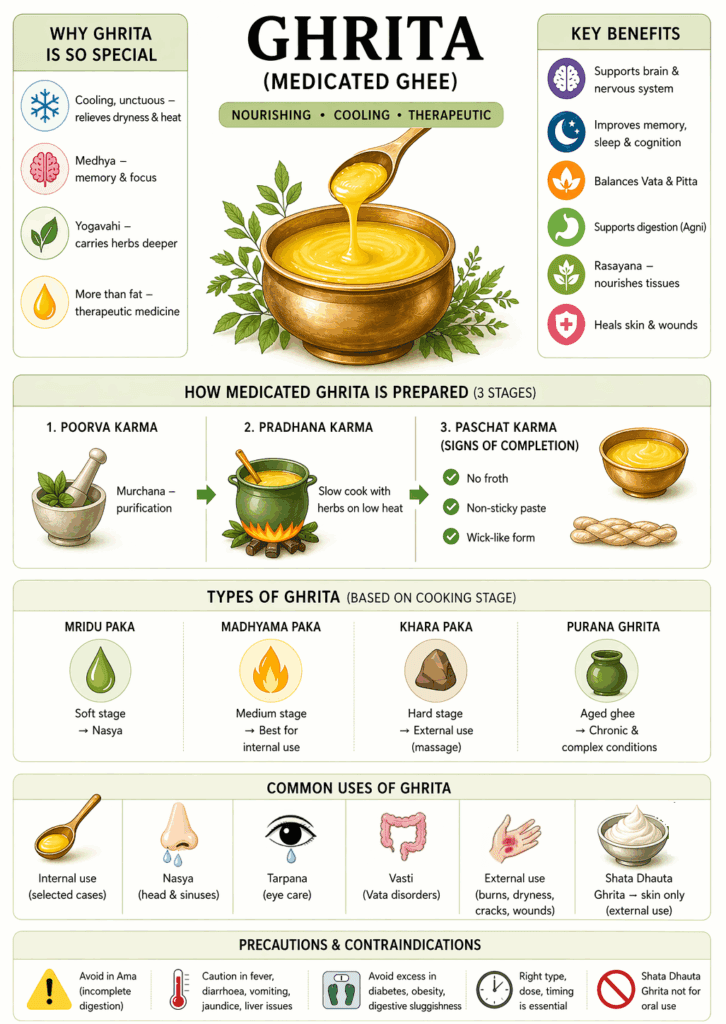
Ghrita is not suitable for everyone, and it should not be started casually without considering digestion, strength, and the present state of illness. In general, Ghrita is best avoided when there is Ama, a sign such as heaviness, poor appetite, a coated tongue, bloating, or sluggish digestion. It is also used cautiously during fever, acute loose motions, vomiting, jaundice, or significant liver-related discomfort, unless specifically advised by an Ayurveda physician.
It should have a clean aroma, smooth texture, and uniform appearance. It must not have a foul odour or be too gritty, nor should it show any signs of being spoiled. The Medicated Ghrita must always be made correctly and kept in a clean, dry, well-sealed bottle, away from heat and light. Poor storage can reduce its quality and therapeutic value.
Proper supervision is important because the dose, timing, and type of Ghrita all need to match the person and the condition.
In small, appropriate quantities, plain cow ghee may be a wholesome part of a balanced diet. It can make food more nourishing, improve taste, and support satiety. But the medicinal use of Ghrita is a different matter. When herbs are added and the preparation is cooked according to classical rules, it becomes a stronger therapeutic tool.
That is why Ayurveda treats Ghrita with such respect. It is not only fat. It is a carrier, a nourisher, a healer, and in many cases, a carefully designed medicine.
Ghrita occupies a special place in Ayurveda because it brings together nourishment and medicine in one form. It comforts the body, supports the mind, helps herbs work more effectively, and can be used both internally and externally in appropriate settings.
For the right person, at the right time, and in the right form, Ghrita can be deeply supportive. However, like all potent remedies, thoughtful use and proper supervision yield the best results.
In Ayurveda, wisdom is not just in the ingredient itself. Its preparation, administration, and compatibility with the recipient are all important. That is what makes Ghrita truly special.
As we work hard to improve our services, your feedback is important to us. Please take a moment to help us serve you better.
Subscribe to our hospital newsletter for the latest health tips, updates on services, patient stories, and community events. Sign up today and stay informed!

Report Problem
Popular Searches: DiseasesTreatmentsDoctorsHospitalsWhole person careRefer a patientInsurance

