Most people don’t walk in saying they have osteoporosis. They come with a backache that has lingered for months. Or a sudden fracture after what seemed like a harmless fall. Sometimes it’s just a sense that the body isn’t as strong as it used to be. Osteoporosis doesn’t announce itself early. It builds quietly. By the time it shows up on a scan, the process has usually been there for years.
Clinically, it is defined as a reduction in bone mineral density to 2.5 standard deviations below that of a healthy young adult. This is what appears as a T score of minus 2.5 or lower on a DEXA scan. But in practice, what matters more is understanding the underlying pattern.
Primary osteoporosis develops without a clear underlying disease. This includes postmenopausal bone loss, where hormonal shifts speed up the process, and age-related changes where bones slowly lose strength over time. Occasionally, even younger individuals present with low bone density without a clear cause.
Secondary osteoporosis is different. Here, something else is driving the loss. Long-standing deficiencies, thyroid imbalance, chronic illness, or certain medications.
In India, the concern is how early all these issues are beginning. It’s not unusual to see reduced bone density in the forties. Less sunlight, long indoor hours, changing diets, and very little weight-bearing activity all add up over time. Which is why waiting for a fracture is often too late.
Asthi Kshaya — Ayurveda's Understanding of Bone Loss
In Ayurveda, Osteoporosis is not looked at as just a calcium problem.
It is understood as Asthi Kshaya (depletion of bone tissue) and Asthi Saushirya (increased porosity of bones). The skeletal structure becomes lighter, more fragile, and less able to withstand stress. At its centre is Vata dosha. When Vata goes out of balance, it tends to dry out and weaken tissues. When this imbalance settles in the bone, it is referred to as ‘Asthigata Vata’ (Vata affecting bone tissue).
There is also a deeper connection. Asthi Dhatu (bone tissue) depends on proper nourishment from earlier stages of tissue formation, including Majja Dhatu (marrow). If that chain is disturbed, the effect shows up here.
Digestion quietly sits at the root of all this. If Agni (digestive and metabolic capacity) is not functioning well, even a nutritious diet may not translate into strong bones. So the approach shifts. Instead of only adding nutrients, the focus is on restoring balance and improving how the body uses what it receives.
Risk Factors in India: Vitamin D Deficiency, Diet, Menopause
Bone loss is rarely due to one single reason. It builds slowly, through a mix of small imbalances.
Vitamin D deficiency is one of the most common findings today. Even in places with plenty of sunlight, actual exposure is limited. Without Vitamin D, calcium absorption drops. That eventually manifests as weaker bones.
Diet has changed, too. Many traditional foods that support bone health have quietly disappeared from everyday meals.
Menopause is another turning point. The hormonal shift accelerates bone loss, sometimes quite rapidly.
Ayurveda looks at the issue more broadly.
- Aharaja or dietary causes, such as irregular meals or low nourishment
- Viharaja or lifestyle causes, like long sitting hours, poor sleep, or overexertion
- Manasika or emotional factors, including stress and mental strain
- Abhighataja or repeated physical stress or past injuries
- Other factors like improper Panchakarma practices, excessive Langhana (lightening) therapies, chronic illness, ageing, living in dry climates, weak metabolic states, and inconsistent treatment approaches
All of this affects Asthivaha Srotas (channels responsible for bone nourishment). When these channels are disturbed, the supply to the bones becomes inconsistent. Over time, depletion follows.
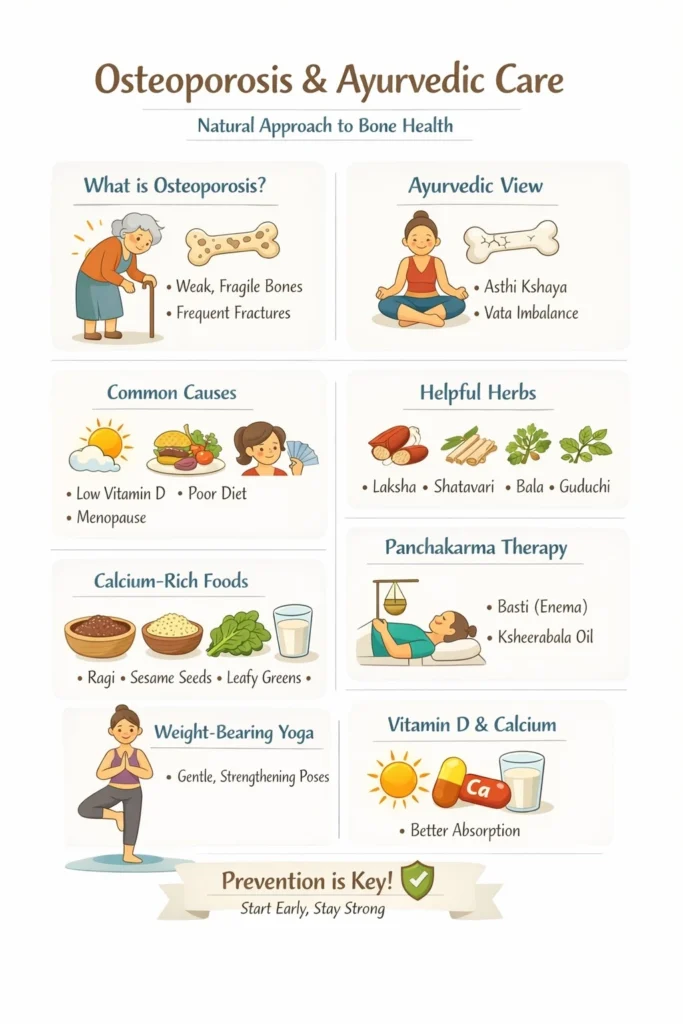

Ayurveda Medicines for Bone Density
There is often a search for a single herb or supplement that can “fix” bone density.
It doesn’t quite work that way. Ayurveda uses certain herbs that support bone health, but always in context.
- Laksha (a natural resin) has been traditionally used in bone healing and strengthening.
- Shatavari (Asparagus racemosus) supports nourishment and hormonal balance, especially in women.
- Bala (Sida cordifolia) helps build strength in tissues.
- Guduchi (Tinospora cordifolia) supports metabolism and recovery.
These are part of classical care, but they are not meant for self-prescription. The same herb can behave differently depending on digestion, constitution, and stage of the condition. That is why these should not be taken over the counter without guidance.
Calcium-Rich Foods for Indian Patients
Food is where most people expect quick answers. More calcium, milk, and supplements. But bone health doesn’t depend only on what is eaten. It depends on what is absorbed.
In Ayurveda, nourishment of Asthi Dhatu (bone tissue) happens only when digestion is steady, and tissues are well supported. So the focus is not just on adding foods but on choosing the right kind in the right way. Some foods are naturally supportive for bone strength when taken regularly and in a form that is easy to digest. Warm, soft, nourishing meals work better than dry or raw foods.
- Godhuma (wheat) in the form of soft chapatis or porridge
- Masha or Mudga (black gram or green gram), especially as well-cooked dal or kichadi
- Raktashali or Shashtika Shali (red rice or traditional rice), cooked soft
- Draksha (grapes), preferably stewed or taken in small quantities
- Badara (ber or dry jujube), depending on digestion
- Amra (ripe mango), ideally not raw, but in cooked or softened form
Milk also plays a role, but only when it suits the individual.
- Gau Dugdha or Aja Dugdha (cow or goat milk), taken warm, often with a small amount of ghee
- Ghrita (ghee), in small quantities, helps improve digestion and adds unctuousness
Certain vegetables quietly support bone health as well.
- Shigru (moringa), especially as soups or added to dal
Even something as simple as hydration matters.
- Ushna Jala (warm water), sipped throughout the day, supports digestion and tissue nourishment
At the same time, some foods and habits can worsen the condition.
- Yava (barley)
- Chanaka (black chana), especially in dry or hard forms
- Excess honey
- Dry or preserved meats
- Cold or iced drinks, which weaken digestion
- Excess alcohol
Excess intake of pungent, bitter, or astringent food can increase dryness in the body, which is not ideal when bones already need nourishment. And then there are daily habits people rarely think about. Suppressing natural urges. Irregular meals. Eating in a hurry. These small patterns, over time, affect digestion. And when digestion is affected, bone nourishment quietly suffers.
Medicines & Panchakarma for Osteoporosis
When bone depletion progresses, deeper intervention is needed.
Vasti (medicated enema therapy) is central to managing Vata. Since Vata is closely linked to degeneration, regulating it helps slow down the process.
Milk-based preparations such as Ksheerabala 101are used to nourish and support weakened tissues.
At Apollo AyurVAID, this procedure is not done in a routine, one-size-fits-all manner.
There is an attempt to understand the person first. Bone density reports are looked at, but so are digestion, sleep, strength, and overall resilience. This is where our evidence-based approach stands apart. It combines classical Ayurveda understanding with individualised care and clinical assessment.
Treatment is structured but not rigid.
- Shamana Chikitsa (palliative care) helps manage pain and stiffness
- Shodhana Chikitsa (cleansing therapies), such as Vasti, address the underlying imbalance
- Rasayana Chikitsa (rejuvenation) supports nourishment of Asthi Dhatu (bone tissue)
- Ahara Vihara (diet and lifestyle) is tailored to the individual
There is also attention to early signs. Subtle changes in nails, hair, posture, or strength are not ignored, even when scans are not yet alarming. Over time, patients often report something simple but meaningful. Pain reduces. Movement feels easier. There is less reliance on painkillers. Strength returns gradually.
Weight-Bearing Yoga for Bone Strength
Movement helps, but only when it is appropriate. Gentle weight-bearing practices are usually recommended.
- Tadasana (Mountain Pose) for posture
- Vrikshasana (Tree Pose) for balance
- Virabhadrasana (Warrior Pose) for lower body strength
- Bhujangasana (Cobra Pose) for spinal support
Nothing aggressive. Nothing that strains the bones. Consistency matters more than intensity here.
Vitamin D, Calcium and Ayurveda — The Synergy
Calcium and Vitamin D are essential for maintaining strong bones, healthy muscles, and overall structural stability in the body. That does not change. What Ayurveda adds is a deeper focus on how the body digests, absorbs, and utilises these nutrients rather than only increasing their intake. It looks at factors like digestion, metabolism, and tissue nourishment, which are considered central to long-term health.
Weak digestion can reduce the body’s ability to properly absorb calcium and Vitamin D, even if intake is adequate. So the Ayurveda approach includes improving digestive strength and supporting better tissue-level assimilation.
Apollo AyurVAID takes an integrated approach to this issue. Nutritional correction is combined with Ayurveda therapies designed to enhance digestion, circulation, and tissue nourishment. This may include personalised diet guidance, herbal support, and therapies that improve metabolism. The idea is simple but important: it’s not just what is given to the body but how well it can process, absorb, and use it over time.
Prevention vs Treatment — Starting Early Matters
Osteoporosis is easier to slow down than to reverse. That is why timing matters. Early signs are often mild. Easy to ignore. A bit of back discomfort. Reduced strength. Occasional fatigue.
But these are often the first signals of Asthi Dhatu Kshaya (bone tissue depletion). When addressed early, the course can change. When ignored, it shows up later as fractures, loss of height, or persistent pain. The encouraging part is the outcome. With the right approach, the body does respond. Slowly, but steadily. Bone health may not improve overnight. But it can improve. And that makes all the difference.
References