Introduction
A painful knee can change much more than the way you move. Climbing stairs, sitting down, getting up, taking a walk or even completing routine household activities can gradually become difficult when joint pain and stiffness persist.
On this World Arthritis Day 2026 (October 12), lets focus on Osteoarthritis (OA). It is one of the most prevalent joint disorders around the world. According to WHO, around 528 million people were suffering from OA in 2019. Among the joints, the knee is the most common joint affected by osteoarthritis, followed by the hip and hand. Osteoarthritis may cause pain, swelling, stiffness, and difficulty in mobility that affects an individual’s ability to move.
Here comes the importance of osteoarthritis treatment in Ayurveda. It does not focus solely on joint pain but considers the patient’s overall condition when planning treatment.
Understanding Osteoarthritis Through Ayurveda
People often search for the ‘osteoarthritis in Ayurveda name’. In Ayurveda, osteoarthritis is commonly correlated with Sandhigata Vata, also referred to as Sandhivata.
Osteoarthritis and Sandhigata Vata arise from different medical frameworks and should not be considered exact one-to-one diagnoses. However, Sandhigata Vata provides an Ayurveda understanding of degenerative joint complaints.
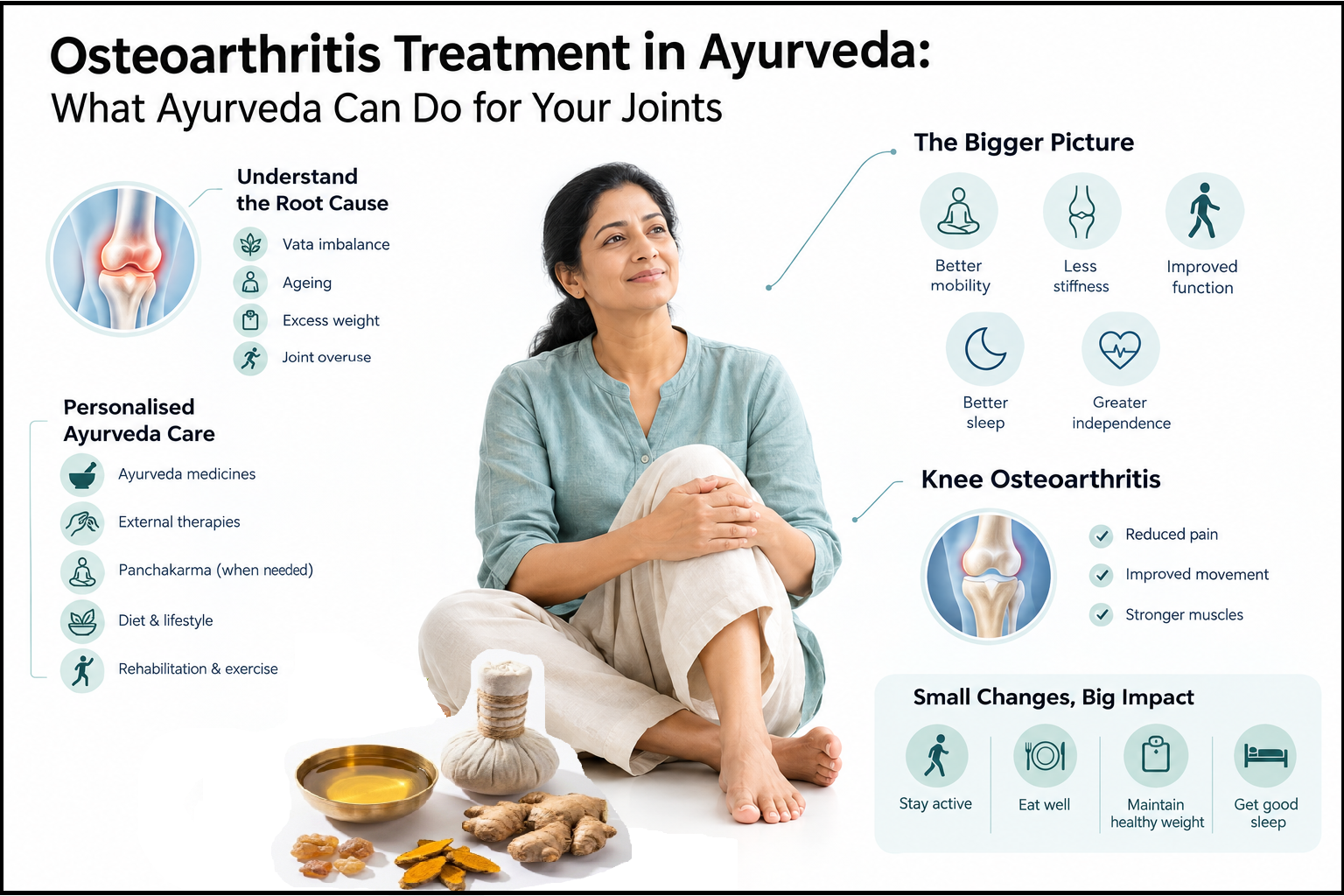
According to the AyurVAID clinical approach, factors considered during assessment may include ageing, excess weight, inappropriate diet and lifestyle, overuse of joints, disturbed sleep and other individual factors. The disease process is understood through Vata imbalance, tissue depletion and changes affecting the joint environment.
Ayurvedic Treatment for Osteoarthritis: A Personalised Approach
There is no single Ayurvedic treatment for osteoarthritis that is appropriate for every patient.
At AyurVAID, treatment begins with a whole-person clinical assessment. This includes evaluation of present and past complaints, causative factors and Ayurveda parameters such as Nidana Panchaka, Ashta Sthana Pariksha,Dasha Vidha Pariksha, andSrotas assessment. We may also consider relevant laboratory investigations and imaging when required.
The findings are brought together into a disease tree—from contributing factors and dosha imbalance to the systems involved, symptoms and progression. A personalised protocol is then designed around the individual’s needs.
Treatment includes the following:
- Ayurveda medicines: Medicines are chosen based on the patient’s presentation rather than giving the same medicine to all patients.
- External therapy: These therapies may include Abhyanga, local application, and fomentation techniques for the individual patient.
- Panchakarma: Selected therapies are done as part of a structured treatment plan. AyurVAID describes treatment in phases, beginning with management of pain and stiffness, followed by selected procedures and a longer nourishing and rehabilitation phase. Treatment duration and intensity depend on the severity of disease and the patient’s individual status.
- Diet and lifestyle: Warm, easily digestible food, appropriate activity, weight management, sleep and other lifestyle factors are prescribed.
- Functional rehabilitation: Improving muscle strength, mobility and joint function is an important component of long-term osteoarthritis care.
The focus is therefore not merely on reducing pain for a few days but also on improving movement, function and quality of life.
Ayurvedic Treatment for Osteoarthritis of Knee
The knee is the most commonly affected joint in osteoarthritis. This makes Ayurvedic treatment for osteoarthritis of knee an important area of clinical interest.
A multicentre randomised controlled trial involving 151 people with knee osteoarthritis compared a multimodal treatment approach with conventional conservative care. After 12 weeks, the Ayurveda group showed greater improvement in the WOMAC index, which assesses pain, stiffness and physical function.
The available evidence is more supportive of evaluating individualised and multimodal Ayurveda care than of promoting one medicine as a universal solution.
Can Ayurveda Cure Osteoarthritis?
This is one of the most important questions patients ask.
Osteoarthritis is a chronic condition. WHO describes it as chronic and often progressive, and current medical evidence does not support promising complete reversal of established osteoarthritis for every patient.
The goals are therefore to reduce pain and stiffness, maintain or improve mobility, support physical function, reduce disability and improve quality of life.
The stage of disease matters. A person with early or moderate osteoarthritis may have different treatment goals from someone with advanced joint degeneration. In severe disease, long-term management and appropriate orthopaedic assessment may be necessary.
Ayurveda should therefore be presented as a personalised approach to management—not as a guaranteed cure for everyone.
Is Osteoarthritis Curable in Ayurveda?
The answer depends on what is meant by “cure.”
Symptoms and functional limitations can improve with appropriate care. However, the available evidence does not support a promise that established structural damage will completely disappear.
An appropriate treatment plan should instead focus on meaningful outcomes: Are you walking better? Is stiffness reduced? Can you climb stairs more comfortably? Has your ability to perform everyday activities improved?
These functional improvements are often more than a promise of complete structural reversal.
Best Ayurvedic Medicine for Osteoarthritis
People frequently search for the best Ayurvedic medicine for osteoarthritis. However, there is no single medicine that can be considered best for every patient.
Clinical trials have evaluated different Ayurvedic formulations and whole-system approaches for osteoarthritis, but treatment selection depends on factors such as the affected joint, severity and duration of symptoms, age, strength, body weight, digestion, associated health conditions and concurrent medications.
This variability is why self-medication is not advisable. A medicine appropriate for one patient may not be appropriate for another.
Is Sandhivata Curable or Not?
Whether Sandhivata is curable or not is a common question.
Sandhivata is generally approached as a chronic degenerative joint condition. Ayurveda care aims to reduce symptoms, improve mobility and function, address contributing factors and support long-term joint health.
In advanced osteoarthritis, the focus may be on symptom control, rehabilitation and maintaining independence. Where severe pain and disability persist, appropriate orthopaedic evaluation should not be delayed.
Cinnamon for Arthritis: What Does the Evidence Say?
People also search for cinnamon for arthritis, cinnamon and arthritis as a home-remedy option.
Cinnamon may be used as a culinary spice, but the evidence is not strong enough to present it as a standalone treatment for osteoarthritis.
What Are Some Things You Can Do Each Day To Help Joint Health?
Osteoarthritis treatment should not end only with medications or therapy sessions.
Routine exercise, proper strength training, being in optimal body condition and refraining from being inactive can help maintain mobility and alleviate symptoms. The WHO highlights exercise, maintaining a healthy body weight and rehabilitation as key aspects of treating osteoarthritis.
The key is consistency. Joint care works best when treatment, movement, diet and lifestyle support one another.
Measuring Improvement, Not Just Pain
A structured treatment plan should also measure whether the patient is actually improving.
AyurVAID uses standardised outcome measures such as the WOMAC and KOOS to assess pain, stiffness and joint function, along with relevant investigations and patient-reported outcomes.
This helps shift the focus from simply asking, “Is the pain less?” to more meaningful questions:
Can you walk farther?
Can you climb stairs more easily?
Can you return to activities that you had stopped?
Has your independence improved?
These are the outcomes that matter in everyday life.
For a detailed clinical overview of arthritis Ayurvedic treatment, you can also explore our Osteoarthritis (Sandhivata) disease page.